For the first time in 30 years, I’m home for the Fourth of July — and there are no big parades or fireworks. That’s disappointing. But I remind myself that Siena’s world-famous horse race, the Palio — a tradition that goes back centuries — is also cancelled. And that is absolutely tragic.
The Palio is a very big deal in Siena. My Sienese friend Roberto describes it this way: “For the Sienese life story: You’re born…there’s the Palio…and then you die.”
The Palio di Siena takes place twice every summer — except this year — on July 2 and August 16. While Siena is quiet today, I have very fond memories of the time I watched the Palio in person when it was anything but quiet.
Even though we’re not visiting Europe right now, I believe a daily dose of travel dreaming can be good medicine. I’m about to publish a collection of my favorite stories from a lifetime of European travels. My new book is called “For the Love of Europe” — and this story is just one of its 100 travel tales.
Siena is divided into 17 neighborhoods, or contrade, of which 10 are selected by a drawing to vie for the coveted Palio banner — and all-important bragging rights. Each competing contrada’s horse is chosen randomly by lottery. The neighborhood then adopts it, showering it with love, washing and grooming it, and keeping it in a five-star stable. The contrade — each with its own parish church, fountain, and square — are staunch rivals. Each contrada is represented by a mascot (porcupine, unicorn, she-wolf, and so on) and a distinctive flag. Its colors are worn and flown all year long, but omnipresent as the race nears.
While the race itself lasts just 90 seconds, it’s preceded by days of festivities. As the big day approaches, processions break out across the city, including one in which the famed and treasured Palio banner — featuring the Virgin Mary, to whom the race is dedicated — is held high as it’s paraded to the cathedral. Locals belt out passionate good-luck choruses. With the waving flags and pounding drums, it all harkens back to medieval times, when these rituals boosted morale before battle.
The day before the race, I joined a crowd in the main square, Il Campo, to see the jockeys — mostly hired hands from out of town — get to know their horses in a practice run called the “charge of the carabinieri.” At midnight, the streets were filled with eating, drinking, singing, and camaraderie, as neighborhoods gathered to pump themselves up.
On race day, bets are placed on which contrada will win…and lose. Despite the shady behind-the-scenes dealing, the horses are taken into their contrada’s church to be blessed. “Go and return victorious,” says the priest. It’s considered a sign of luck if a horse leaves droppings in the church.
Meanwhile, Il Campo has been converted into a racetrack. Clay is brought in and packed down to create the surface while mattresses pad the walls of surrounding buildings. The most treacherous spots are the sharp corners, where many a rider has bitten the dust.
The entire city of Siena packs into Il Campo. Bleacher and balcony seats are expensive, but it’s free to join the masses in the square. The well-connected get to watch from the comfort of an apartment window. Roberto’s friend, Franco, shares his apartment overlooking the racecourse…and we enjoy the best seats in town. From this vantage point, we watch as the square fills, with pageantry unfolding, flags waving, and excitement building.
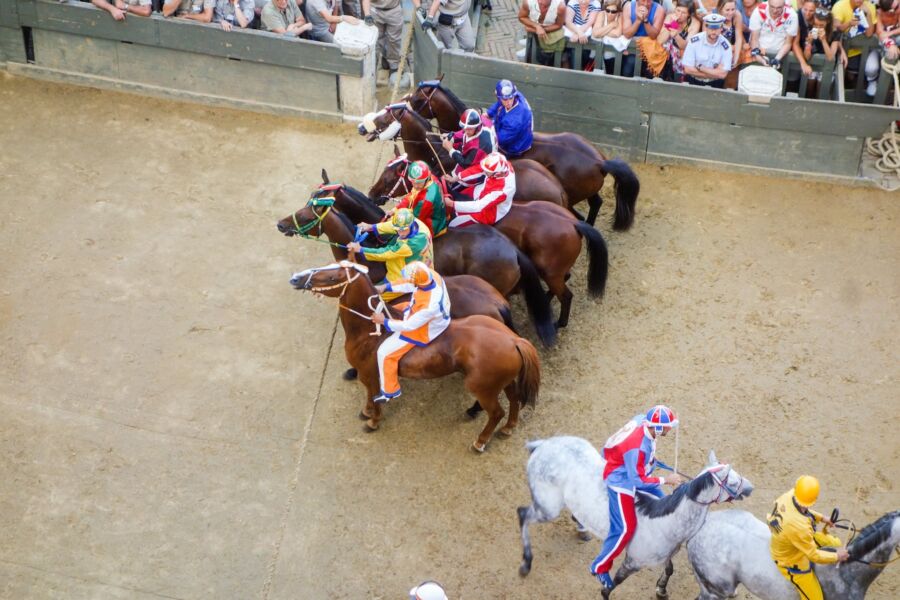
Finally, it’s time. A cart pulled by oxen carries the Palio banner into the arena. The crowd goes wild. As the starting places are announced, 10 snorting horses and their nervous riders line up to await the start. Silence takes over. And then…
They’re off! Once the rope drops, there’s one basic rule: There are no rules. The jockeys ride bareback while spectators go berserk. Life stops for these frantic three laps. Up in the apartment, Roberto and Franco hold their breath…
And then, it’s over. The winner: Lupa, the she-wolf district! We zip out into the street to join the ecstatic mobs coursing toward the cathedral. The happy “Lupa-Lupa-Lupa!” horde thunders through town, weeping with joy. At the cathedral, the crowd packs in, and the winning contrada receives the beloved banner. They are champions…until the next race.
Seeing euphoria overcome members of the winning contrada — it’s Lupa’s first win in 27 years — reminds me that it’s impossible for a tourist to really understand what this ritual race means to the people of Siena.
Carrying their coveted Palio banner high and hoisting their jockey to their shoulders, the Lupa contingent tumbles out of the cathedral and back into the streets, where the celebration continues into the wee hours — 500 years of proud tradition, still going strong.
(This story appears in my newest book, For the Love of Europe — collecting 100 of my favorite memories from a lifetime of European travel. Please support local businesses in your community by picking up a copy from your favorite bookstore on Tuesday, July 7th. Or you can pre-order For the Love of Europe online. You can also find a clip related to this story at Rick Steves Classroom Europe; just search for Palio.)