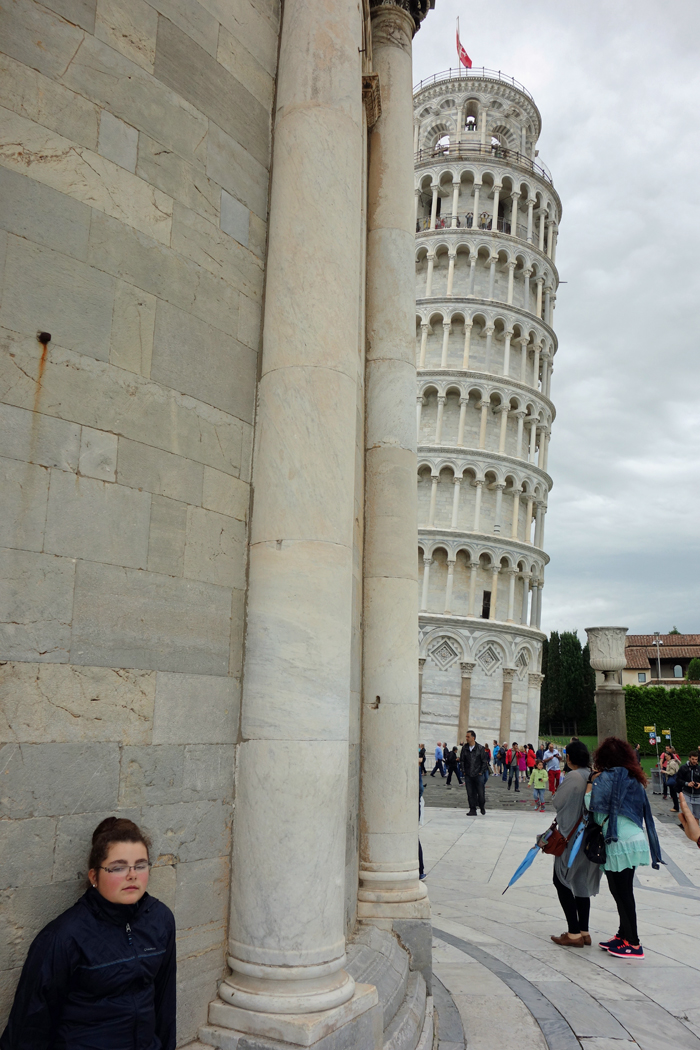
A girl hides, quietly hoping the leaning tower doesn’t find her.
(Or, perhaps I misinterpreted this scene. Can you give it a better caption?)
A girl hides, quietly hoping the leaning tower doesn’t find her.
(Or, perhaps I misinterpreted this scene. Can you give it a better caption?)
When filming our TV shows, we often note how we make things look better than they are. The truth is, there are a lot of tacky tourist traps throughout Europe. San Gimignano comes off as a pretty greedy place during the day. (But at night, they’ve made their money, and the place becomes more romantic.) Here’s a quick clip at the end of a long day of selling junk to tourists. What’s your vote for the worst tourist trap in Europe?
When it comes to hill towns in Tuscany, San Gimignano is the region’s glamour girl, getting all of the attention from passing tour buses. A quick stroll through its core, in the shadows of its 14 surviving medieval towers, is a delight.

Local guides claim that Minoru Yamasaki, the architect of New York City’s World Trade Center, was inspired by San Gimignano’s twin towers. (I have no idea if that’s true, but they sure look like they could have.) While only 14 of the town’s original 72 towers are still standing, these sisters have stood here for 700 years.

Way back in the days when Rome was falling, the people of this town were saved from barbarian ransacking by the local bishop. He eventually became a saint, and they eventually named their town after him. Today, you can see glittering frescoes of Saint Gimignano holding his town (back when it had a lot more of those towers).
High-intensity travel makes me hungry — especially in Italy. The one meal I’ve been looking forward to more than any other is a big steak dinner at Osteria dell’ Aquacheta in Montepulciano. Warning: Vegetarians may want to skip this post.
 They jam the place for four seatings (two for lunch and two for dinner) every day. It’s a long room with communal tables under a medieval barrel vault. In the back, like the engine of a steam train, a fire roars behind a huge hunk of cow lying flat as if on a gurney.
 You don’t have much of a choice here. Giulio, who reminds me of George Carlin with a cleaver, parades through the room with slabs of beef for diners to consider. It costs about €3 per hundred grams (about $3 per quarter pound) and they serve 1.6 kilos of beef for each couple (about $50 for two). You don’t say how you want it cooked. There’s a correct way: seven minutes on each side. Fifteen minutes after you say OK, it’s chow time.
 Every few seconds the happy sound of “George Carlin” slamming his cleaver through the beef rockets through the room — stoking every appetite under that old, brick-domed ceiling.
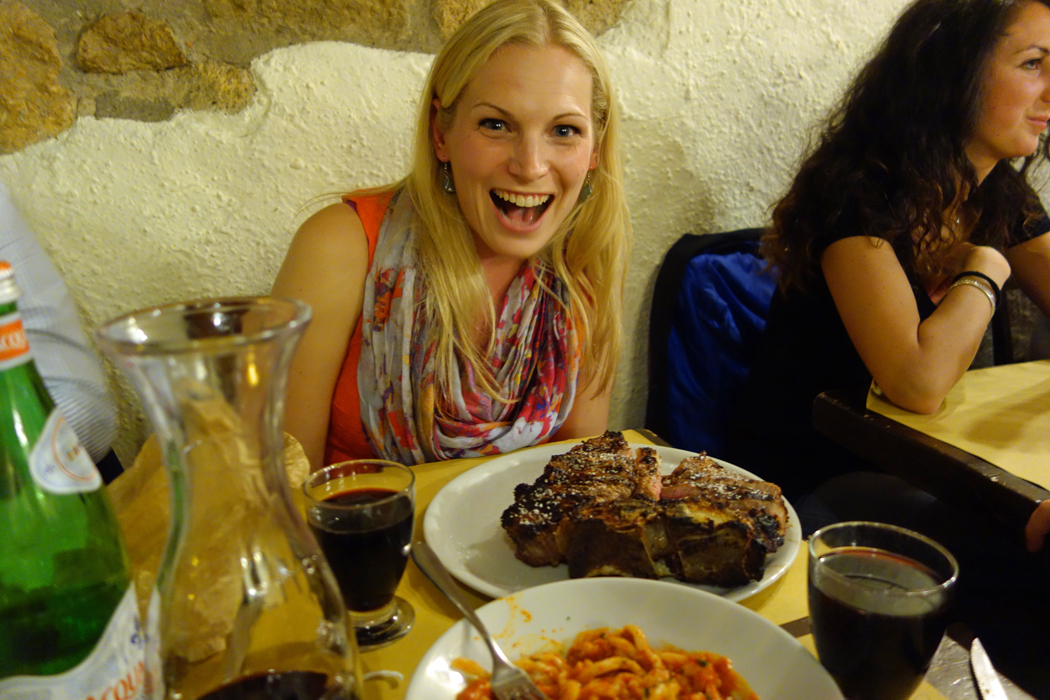 Osteria dell’ Aquacheta brings out the carnivore in all its guests.
 Vegetarians won’t enjoy this restaurant. But she sure did.
I’m 45 days into my 100-days-of-Europe blog series. I hope you’re enjoying traveling with me. I’ve picked up some new tips along the way while updating my guidebooks. Most people consider this a “dream job,” but in reality it’s a lot of hard work.

While I’m meeting up with my TV crew now and then, most of the days I’m alone and checking all the places in our guidebooks. This shot captures my view almost each evening. In this case I’ve found two wonderful new restaurants (with my scrawl on the back of their “biglietti da visita” (business cards, if I have my Italian correct). I put the restaurants in a logical order and visit when the restaurants are busy (8 p.m. to 10 p.m. or so). When all the places are crossed off my list, I get to eat.

When dining with friends, I like to eat family style, and waiters are happy to make that easy. If I’m on my own and want to double the experience without overeating, when it comes to pasta, I simply ask for a “bis” — two half-portions on a plate for the cost of one full portion. This way I get to try the wild boar sauce on the local “pici” pasta and a pasta with white truffles as well.

Risa Laib, who for nearly twenty years in my office has been a key behind-the-scenes player overseeing the growth and quality of our guidebook series, proposed producing a clever little binder so people who rip chapters out of their books (as I encourage) can have a tidy little package as they are out and about. It’s fun to see people in Europe enjoying Risa’s little innovation. Rather than toting 1,300 pages of “Rick Steves Italy,” this woman is packing light for the day with just the Siena chapter.

I find the bureaucracy and frustrations of running museums in Europe — especially Italy — fascinating. With the chaos in local and national governments, and the severe budget-cutting, things are in flux and often a mess. It seems that each year there are more notices on the window leaving the sorry soul behind the glass with less and less light…and more and more grumpy.

Researching with my local guide on the Campo (main square) in Siena, I was bumping into so many of my readers that I wasn’t getting any work done. I met some people from one of our Best of Italy tours and was so rushed that I didn’t even make time to pose for a photo. Afterwards I felt terrible. They mentioned in passing that they were on Stephanie’s tour and had free time until 2:30 p.m., when they were meeting on the far side of town at the Dominican Church. At 2:20 p.m. I told my guide we need to hoof it across town to meet the group. I know our guides are fanatically punctual — and if we’re two minutes late, we may miss them. I made it there (the local guide straggling behind me) just in time to catch Stephanie and her group. It felt great to find the people I was rude to and make sure we got that souvenir photo. They seemed like a great group and were having a beautiful trip.