Fascism Vs. Individuality: Lessons from Italy

Facism vs. Individuality: Lessons from Italy

I’m hoping to shoot a TV special about fascism in 20th-century Europe this fall. So, I spent a day in Rome with my friend and fellow tour guide, Francesca Caruso, scouting possible images that might help us tell the story.

Of course, Europe went through a difficult period between the world wars when fascist dictators came to rule Germany, Italy, Spain, and Portugal. And in Rome, plenty of Mussolini souvenirs are still standing.
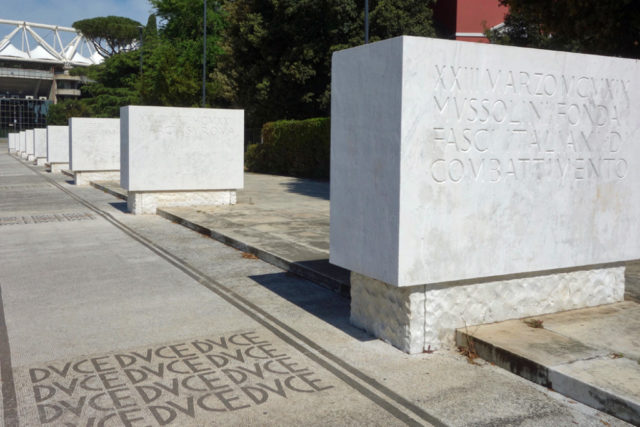
monument

Mussolini was a braggart and a publicity hound. He celebrated every new law and initiative he signed with great pride and wanted all to see. Each of these stone blocks, for example, is inscribed with an order Mussolini signed into law.
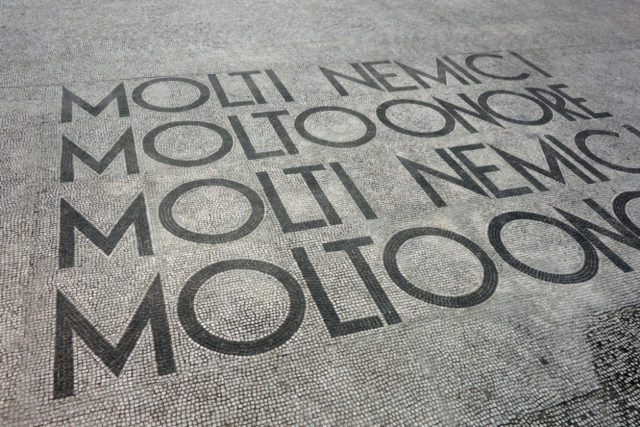
writing in cement

For some reason, fascist dictators thrive on creating enemies. Mussolini actually celebrated this notion by having this slogan set in a stone mosaic: Molti Nemici, Molto Onore (Many Enemies, Much Honor)

logo in cement

The symbol of Italian fascism was a bundle of sticks bound together along with an ax. My Italian guide made it really clear that the ax is a critical part of this symbol, as it represented harsh punishment. One stick is easy to break. But many breakable sticks bound together are unbreakable…and anyone who strays will be dealt with harshly. This symbol also adorned the back of America’s old Mercury dime.
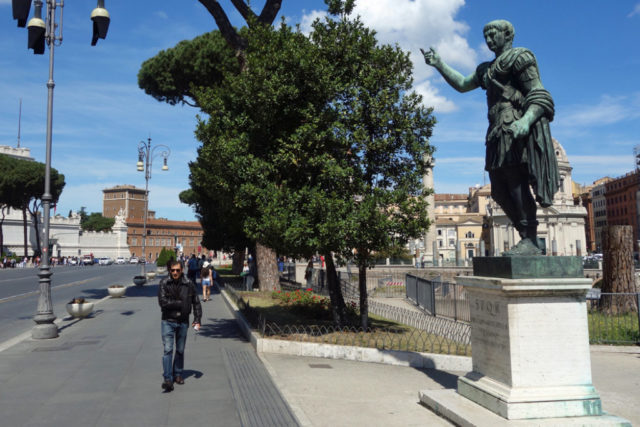
statues along boulevard

Fascist dictators find both comfort and inspiration in other autocrats who know how to wield power. In anticipation of a visit from fellow fascist tyrant Adolf Hitler, Mussolini built a grand boulevard and lined it with statues of ancient Roman emperors who ruled with appropriate gusto.
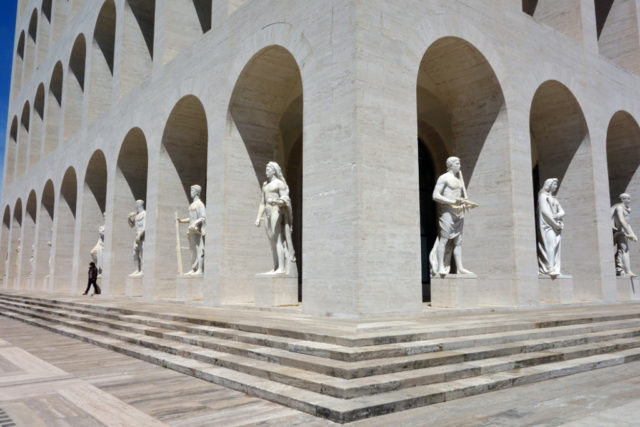
large building with statues

Mussolini’s futuristic planned city, E.U.R., was fascism in stone — stern, monolithic, no questions asked…designed to make individuals seem small…to make you cower at the force of the state.
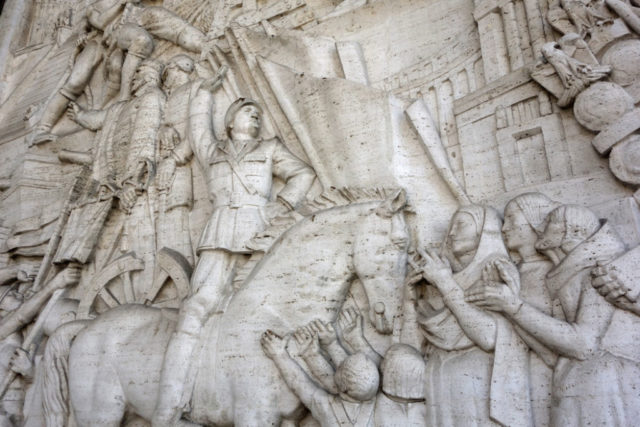
mussolini carved into facade

This is part of a relief carved in stone celebrating “Great Building of Rome” — from ancient times until the 1930s. The culmination of the story, Mussolini, is depicted being adored by his populace: workers, women, children, and soldiers.
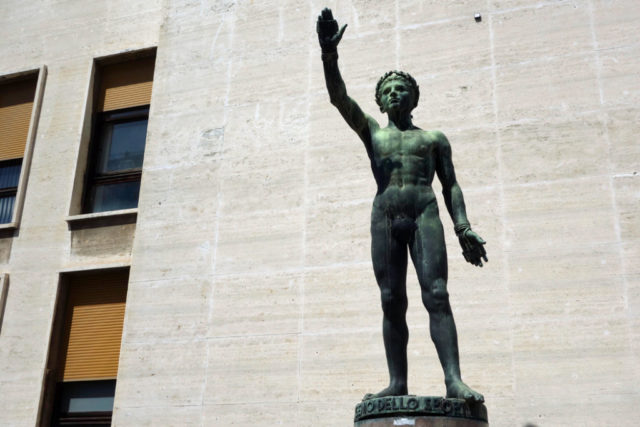
genius of sport statue

This perky bronze statue of an athletic young man was originally called “The Genius of Fascism.” After Mussolini was overthrown and Italy’s fascist nightmare ended, Romans saved the statue by putting ancient boxing gloves on him and calling him “The Genius of Sport.”

____
This is Day 32 of my “100 Days in Europe” series. As I travel with Rick Steves’ Europe Tours, research my guidebooks, and make new TV shows, I’m reporting on my experiences in Italy, Portugal, France, Ireland, England, Scotland, Germany, Switzerland, and more. Thanks for joining me here on my blog and via Facebook.
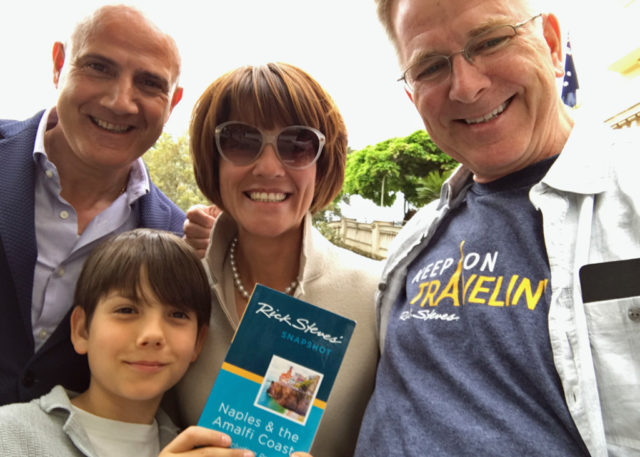
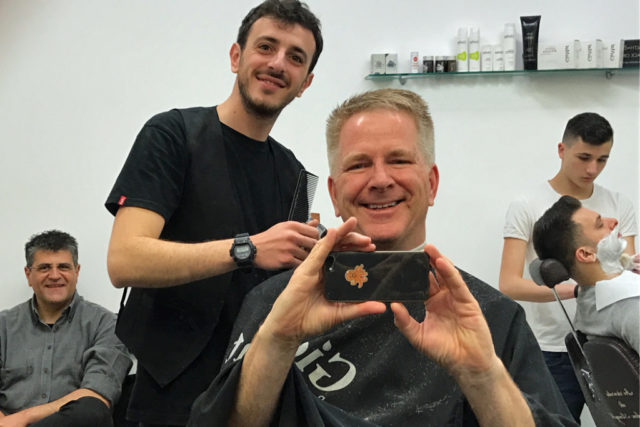
People Make the Experience

I’ve been in Europe now for a month and my most vivid memories are of the fun I’ve had with people. Simple things like getting a haircut in a foreign country, meeting the child of a guide, and going back to a restaurant again because I really like the restaurateur. These are the sparkles that keep the memories of a trip alive. (And all of these people are listed in my guidebooks.)

Rick Steves, tour guide, driver and son

In the Amalfi Coast region of Italy, I find that many couples work as driver/guide teams. Here Giovanna Donadio is my guide and her husband, Francesco del Pizzo, drives. He’s quiet and she loves to talk — a good mix. And their little boy is adorable. If someone is listed in my guidebooks (like Giovanna and Francesco), chances are I actually enjoyed their services.

Rick Steves and barber

A week before meeting my TV crew I always get a little stressed out when I need to get a haircut from someone I don’t know, in a land where I don’t speak the language. This year I had a brainstorm: I asked my favorite Amalfi Coast driver, Raffaele Monetti (you can see him looking on in this photo), to book me a time with his barber. I figured: good enough for Raffaele…good enough for me. And it was great.

Rick Steves and barbers

I dropped back into my new favorite hair salon in Sorrento, Satisfhair (run by Luca and Tony, the guys in the hats), to get the details. I added it to my book. But I’m not terribly systematic when it comes to this sort of thing. In my books, if there’s a clinic listed in a town, I likely got sick there and needed it. If there’s a masseuse listed in a town, I was likely really exhausted and in need of a good massage there (and enjoyed it). If there’s a hair salon listed…I needed a haircut (and liked the one I got).

Rick Steves and Claudio

In Rome, my personal treat is having dinner at Ristorante il Gabriello, where delightful Claudio always greets me warmly and I dine very well. He’s one of those lucky people who found his niche and really enjoys his work…and his patrons are the beneficiaries.

Francesca Caruso, Sarah Murdoch and Rick Steves

My favorite Rome guide, Francesca Caruso (on the left), spent the better part of a day with me checking sights and restaurants in Rome for the new edition of my Rome guidebook. We knew that tour guide Sarah Murdoch was treating her group to a wonderful last dinner of their trip that night — so we popped in to say hi between our many restaurant visits that evening. I love to see a group beaming at the finale of a wonderful tour. (Nice work, Sarah!)

__

This is Day 31 of my “100 Days in Europe” series. As I travel with Rick Steves’ Europe Tours, research my guidebooks, and make new TV shows, I’m reporting on my experiences in Italy, Portugal, France, Ireland, England, Scotland, Germany, Switzerland, and more. Thanks for joining me here on my blog and via Facebook.

Why Do We Travel?: Sicily Reflections

Why do we travel? It’s costly, time consuming, and — frankly — lots of work. On my recent Best of Sicily tour, the answer became happily clear as we shared 11 experience-packed days, orchestrated by a gifted guide. It was pure Sicily, and well worth whatever it took to get me there.

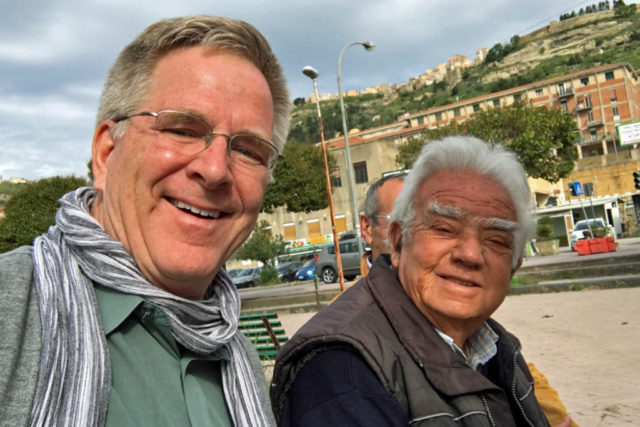
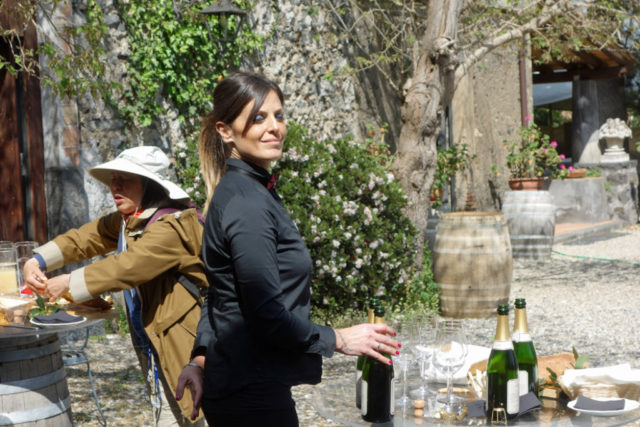
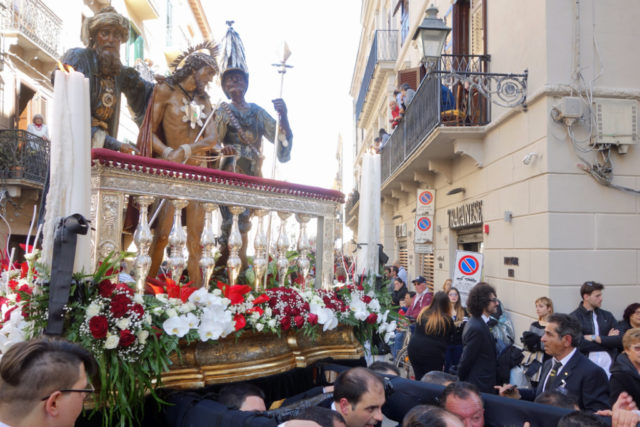
An elderly aristocrat gave me a tour of his 1935 racing car. I looked a crypt-full of monk skeletons straight in the eye sockets. After savoring cannoli where it was invented, I discovered exactly how good it can be. I learned the difference between Naples- and Sicily-style pizzas (and that I prefer Sicilian). I compared bushy eyebrows with old guys on a bench in Syracuse. I was served a glass of full-bodied red wine by a Sophia Loren–esque woman in a vineyard on the slopes of a steaming volcano. And I became part of the mesmerizing, swaying rhythm of an entire community on their Good Friday procession, by joining right in.

All these travel memories were made even better as they were shared by two dozen wonderful Rick Steves travelers. Next month, I’m doing the same thing…but on our Ireland tour! Stay tuned.

__
This is Day 30 of my “100 Days in Europe” series. As I travel with Rick Steves’ Europe Tours, research my guidebooks, and make new TV shows, I’m reporting on my experiences in Italy, Portugal, France, Ireland, England, Scotland, Germany, Switzerland, and more. Thanks for joining me here on my blog and via Facebook.

Video: Rick Steves Readers Share a Driver and Split the Bill

I love my work for many reasons. For example, this morning I woke up, looked out my window, and saw the small group of my readers that, each morning, gathers here to share the cost of a private minibus tour of the Amalfi Coast (which you’d never want to drive on your own). All over Europe, I work to help travelers economize by sharing costs. This works particularly well here in the Bay of Naples area: Every day, a local company (Mondo Guide) meets my readers for shared-cost tours of Naples, Pompeii, Capri, and the Amalfi Coast.

This is Day 29 of my “100 Days in Europe” series. As I travel with Rick Steves’ Europe Tours, research my guidebooks, and make new TV shows, I’m reporting on my experiences in Italy, Portugal, France, Ireland, England, Scotland, Germany, Switzerland, and more. Thanks for joining me here on my blog and via Facebook.
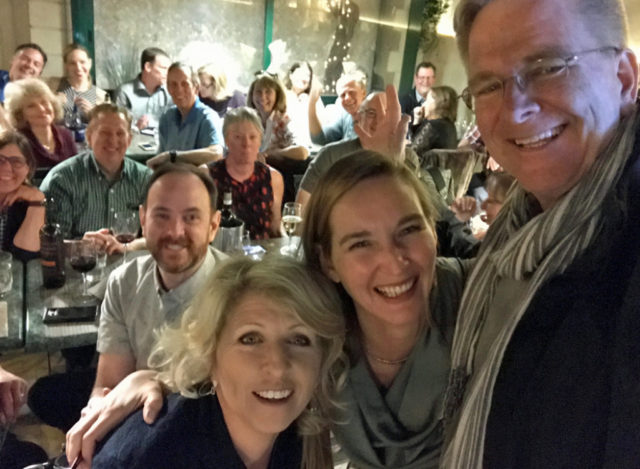
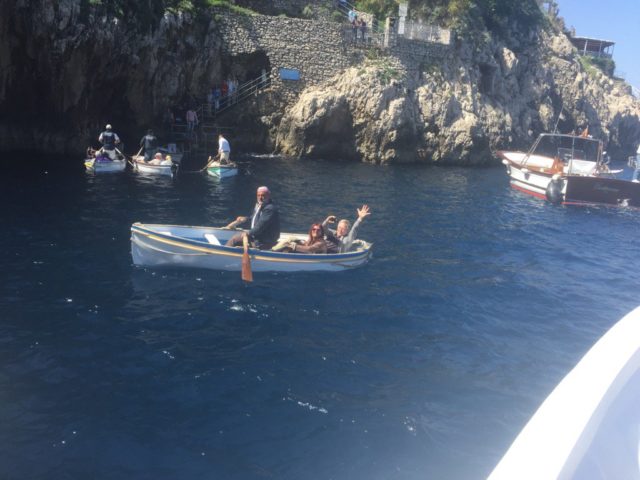
Video: Jockeying Dinghies at the Blue Grotto

rick steves at blue grotto

Thanks for the photo, Ben!

Visiting the Blue Grotto on Italy’s fabled Isle of Capri is one of those must-do experiences. Here’s a quick look at how it’s arranged. And here’s a tip: You’ll pay essentially the same (about $20) to shuttle from the big port to the grotto and back (ten minutes each way) as you’ll pay to take a scenic, narrated, one-hour ride all around the island…and the island tour stops at the Blue Grotto before completing the circle. To jump into a dinghy and pop into the grotto costs another $20. (By the way, I thought the trip around the island was as memorable and as fun as the Blue Grotto ritual.)


My Capri day was made fun and efficient with the help of local guide Anna Bilardi Leva. Thanks, Anna!

__
This is Day 28 of my “100 Days in Europe” series. As I travel with Rick Steves’ Europe Tours, research my guidebooks, and make new TV shows, I’m reporting on my experiences in Italy, Portugal, France, Ireland, England, Scotland, Germany, Switzerland, and more. Thanks for joining me here on my blog and via
Facebook.