Venice’s St. Mark’s — A Treasure Chest of Wonders

It’s clear that as we, as a society, get vaccinated, we’ll soon be free to travel again in Europe — and it’s more exciting than ever to envision the great sights and slices of culture that await. For me, one of the great joys of travel is having in-person encounters with great art and architecture — which I’ve collected in a book called Europe’s Top 100 Masterpieces. Here’s one of my favorites:   

Stand in the center of St. Mark’s Square — the center of Venice — and take in the scene: the historic buildings, the cafés with their dueling orchestras, the sheer expanse of the square, and all the people — Italians on holiday, Indians in colorful saris, and Nebraskans in shorts and baseball caps. Overseeing it all is a church that’s unlike any other in the world — the Basilica of St. Mark. 

St. Mark’s is a treasure chest of wonders acquired during Venice’s glory days. The facade shows off the cosmopolitan nature of this sea-trading city that assimilated so many different cultures. There are Roman-style arches over the doors, Greek-style columns alongside, Byzantine mosaics, French Gothic pinnacles on the roofline, and — topping the church — the onion-shaped domes of the Islamic world. The gangly structure has been compared to “a warty bug taking a meditative walk” (Mark Twain) or “a love-cluster of tiara-topped ladybugs copulating” (unknown). 

One of the facade mosaics depicts the scene when the body of St. Mark — the author of one of the four gospels in the Bible — was interred on this spot. In 1063, this church was built over Mark’s bones. As Venice expanded, the church was encrusted with precious objects — columns, statues, and mosaics — looted from their vast empire. Their prize booty was four bronze horses, placed in the center of the facade. It’s little wonder that the architectural style of St. Mark’s has been called “Early Ransack.” 

When you step inside St. Mark’s Basilica, the entire atmosphere takes on a golden glow as your eyes slowly adjust to the dark. The church is decorated, top to bottom, with radiant mosaics. It’s as intricate as it is massive. (Imagine paving a football field with contact lenses.) They tell the entire story of Christ and the saints in pictures made from thousands of tiny cubes of glass (with gold baked inside) and colored stone. The reflecting gold mosaics help light this thick-walled, small-windowed, lantern-lit church, creating a luminosity that symbolizes the divine light of heaven. 

As you explore deeper, you’ll discover the church is filled with precious and centuries-old objects: jewel-encrusted chalices, silver reliquaries, and monstrous monstrances (for displaying the Communion wafer). An urn holds the (supposed) holy DNA of St. Mark. The priceless 1,000-year-old Golden Altarpiece is a towering wall of handcrafted enamels set in a gold frame and studded with 15 hefty rubies, 300 emeralds, and 1,500 pearls. Exotic objects like these date from an era when Venice was almost as oriental as it was European. 

The church’s symbolic message culminates at the very heart of the church. There, up in the central dome, Christ reigns in the starry heavens, riding on a rainbow. This isn’t the agonized, crucified Jesus featured in most churches, but a vibrant, radiant being gazing solemnly down, raising his hand in a blessing, as the Pantocrator, or Ruler of All. His grace radiates through a ring of saints to the altar below. As the central spot in the church, the Pantocrator dome is the symbolic center of the Venetian universe itself, with Christ blessing it all. God’s in his heaven, the faithful are on earth, Venice is central, and all’s right with the world. 

Standing under the dome of St. Mark’s, it becomes clear: Among Europe’s churches, there are bigger, more historic, and even holier churches. But none are more majestic than St. Mark’s Basilica. 

The Church of David

Even though we’re not visiting Europe right now, I believe a regular dose of travel dreaming can be good medicine. I hope you’ll enjoy this travel tale from my book For the Love of Europe, a collection of 100 of my favorite stories from a lifetime of European travels.

Entering Florence’s Accademia Gallery is like entering the Church of David — a temple of humanism. At the high altar stands the perfect man, Michelangelo’s colossal statue of David. Like a Renaissance Statue of Liberty, David declares, “Yes, I can.”

This 500-year-old slingshot-toting giant-slayer is the symbol of Florence. The city’s other treasures are largely ignored by the tourist hordes that roam the streets with one statue at the top of their sightseeing list. Each morning the line forms as tourists wait patiently to enter the temple. As at any pilgrimage site, the nearby streets are lined with shops selling David knickknacks.

Inside, smartly dressed ushers collect admission tickets. Dropping mine in the basket, I turn the corner and enter a large nave. Six unfinished statues called the Prisoners — brute bodies each fighting to free themselves from their rock — line the room leading to David. His feet are at a level just above the sea of tourists’ heads. Round arches and a dome hover above him like architectural halos. People only whisper. Couples hold each other tighter in his presence, their eyes fixed on the statue.

The scene is black and white under a skylight. I don’t miss the color. I wouldn’t want color. David is beyond color, even beyond gender.

David is fundamentally human. Gathered with people from all nations, I look up to him. Tight-skirted girls who’d cause a commotion in the streets go unnoticed as macho men fold their hands. Students commune with Michelangelo on their sketchpads. Sightseers pause. Tired souls see the spirit in David’s eyes.

David is the god of human triumph. Clothed only in confidence, his toes gripping the pedestal, he seems both ready and determined to step out of the Dark Ages and into an exciting future.

When you look into the eyes of Michelangelo’s David, you’re looking into the eyes of Renaissance Man. This six-ton, 17-foot-tall symbol of divine victory over evil — completed in 1504 — represents a new century and a new outlook. It’s the age of Columbus and classicism, Galileo and Gutenberg, Luther and Leonardo — of Florence and the Renaissance.

In 1501, Michelangelo Buonarroti, a 26-year-old Florentine, was commissioned to carve a large-scale work for Florence’s cathedral. He was given a block of marble that other sculptors had rejected as too tall, shallow, and flawed to be of any value. But Michelangelo picked up his hammer and chisel, knocked a knot off what became David’s heart, and started to work.

He depicted a story from the Bible, where a brave young shepherd boy challenges a mighty giant named Goliath. David turns down the armor of the day. Instead, he throws his sling over his left shoulder, gathers five smooth stones in his powerful right hand, and steps onto the field of battle to face Goliath.

Michelangelo captures David as he’s sizing up his enemy. He stands relaxed but alert. In his left hand, he fondles the handle of the sling, ready to fling a stone at the giant. His gaze is steady…confident. Michelangelo has caught the precise moment when David realizes he can win.

David is a symbol of Renaissance optimism. He’s no brute. He’s a civilized, thinking individual who can grapple with and overcome problems. He needs no armor, only his God-given physical strength and wits. Many complained that the right hand was too big and overdeveloped. But this represents the hand of a man with the strength of God on his side. No mere boy could slay the giant. But David, powered by God, could…and did.

Renaissance Florentines identified with David. Like him, they considered themselves God-blessed underdogs fighting their city-state rivals. In a deeper sense, they were civilized Renaissance people — on the cusp of our modern age — slaying the ugly giant of medieval superstition, pessimism, and oppression.

Gathered before the high altar of David, tourists share the pews with Michelangelo’s unfinished stone Prisoners. Also known as the Slaves, they wade wearily through murky darkness, bending their heads under the hard truth of their mortality.

A passing tour guide says, “The Prisoners are struggling to come to life.” But I see them dying — giving up the struggle, wearily accepting an inevitable defeat.

Michelangelo intended to show the soul imprisoned in the body. While the Prisoners’ legs and heads disappear into the rock, their chests heave and their bellies shine. Talking through what I’m seeing, I say out loud, “Each belly is finished, as if it were Michelangelo’s focus…the portal of the soul.”

Without missing a beat, the woman next to me replies, “That’s the epigastric area. When you die, this stays warm longest. It’s where your soul exits your body.”

I welcome this opportunity to get a new perspective on Michelangelo’s work. She introduces herself as Carla and her friend as Anne-Marie. Both are nurses from Idaho. Carla turns from the Prisoners to David, raises her opera glasses, and continues, “And David’s antecubital space is perfectly correct.”

“Anti-what?” I say, surprised by this clinical approach to David.

“That’s the space inside the elbow. Look at those veins. They’re perfect. He’d be a great IV start. And the sternocleidomastoid muscle — the big one here,” she explains, running four slender fingers from her ear to the center of her Florence T-shirt, “it’s just right.”

Carla burrows back into the opera glasses for a slow head-to-toe pan and continues to narrate her discoveries. “You can still see the drill holes under his bangs. There’s a tiny chip under his eye…sharp lips…yeow.”

Her friend Anne-Marie muses, “They should make that pedestal revolve.”

Carla, still working her way down David, dreams aloud. “Yeah, pop in a euro; get 360 slow-moving degrees of David. He is anatomically correct, anatomically really correct. Not as moving as the Pièta, but really real.”

“He feels confident facing Goliath,” I say.

Anne-Marie lowers her camera and says, “Well, he’s standing there naked, so he must be pretty confident.”

Turning to Carla, she observes, “The ears are ugly. The pubic hair’s not quite right. And his right hand is huge. They always say to check out the fingers if you wonder about the other appendages. So what’s the deal?”

“The guidebook says that’s supposed to be the hand of God,” Carla explains. “You can’t measure the rest of David by ‘the hand of God.’”

Settling back into a more worshipful frame of mind, Anne-Marie ponders aloud, “The Bible says he was like 12 or 14.”

“This is no 14-year-old,” says Carla, still lost in her opera glasses.

I ask, “What’s David telling us?”

“He says God made people great,” says Anne-Marie.

I say, “No, maybe it’s David who’s made in God’s image, and David makes it clear that we — the rest of us — fall short.”

Zipping her opera glasses into her day bag, Carla looks into the eyes of David. “No,” she says. “I think we’re each great. We’re great. David’s great. God’s great. And Michelangelo’s giving us a sneak preview of heaven…”

The guards begin to usher people out. I whisper, “I like that.” Then, needing a few extra minutes to do my annual slow stroll around David, I say “ciao” and drift away from the nurses. I need more time to commune with this timeless symbol of a city that 500 years ago led Europe into a new age, a symbol that still challenges us to reach for all that we can be — to declare, “Yes, we can.”

Just a Coincidence? An Abandoned Guidebook on Venice’s Empty Streets

Have you ever experienced a coincidence…that felt like a lot more than a coincidence?

I’ve received lots of thoughtful notes from the 100 or so Rick Steves’ Europe guides who are awaiting the return of travel. This one, from one of my favorite Venice guides, fascinated me, and I thought you might also enjoy reading — and responding — to it:

Ciao Rick,

Come stai? How are you? Buon Natale e buon inizio di 2021.

This is Elena Zampiron, from Venezia. I’d love to tell you something it happened to me because it made me reflect about the time we all are experiencing.

On the 25th of December, right after Christmas lunch with my parents, I had to head out to run a virtual tour (something that helps me cope with the pandemic here in quiet and empty Venice).

I was lost in my thoughts, walking down the empty narrow streets of Venezia while locked down again: Nobody around, pouring rain, strong waves of wind, the smell of the rain mixed with the incredible silence on Christmas Day…. me thinking that I’m not designed for “virtual tours” because I miss the “touch” of real people in front of me, their visible emotions, their eyes veiled with joy and their tears of pure happiness…. and …. all of a sudden, I notice something on the pavement, far in the distance… I get closer … and closer … and here it is… “Rick Steves’ Europe, 1997.”

Open … upside down … wet … under the rain … on Christmas Day… an old, well-used, Rick Steves guidebook.

I picked it up, placed it on the window of the second-hand bookstore it belonged to, and walked on. I did my virtual tour and got back home.

But then I began thinking. I don’t believe in coincidences… at all! I believe it was a sign, not necessarily a sign to me, but sent to us all. I immediately thought of it being a metaphor for this past year. But then I had a second thought. Perhaps it is a sign from the travel spirits or whoever we believe in — a reminder that after this pandemic, we can no longer guide tours in the same ways as we have become accustomed.

I believe it is more than coincidental that in Venice I discovered a 1997 Rick Steves guidebook, abandoned… discarded, in the rain, at Christmas, in the year of the pandemic. It is a sign about how we, as guides and as travelers, will go forward. But what does it mean exactly?

I wanted to share. These are simply my thoughts, Rick. But I felt it was important to share them with you. It’s also a way to say, please be positive and don’t give up. Times can be tough, and the tourism industry can be cruel, but you are not alone. It’s tough for us guides as we have no work. But we are strong. And we guides are here to support you along the way. Together, we shall “keep on traveling,” as you like to say, after this pandemic is conquered.

Happy beginning of a brighter 2021 from Venezia and Elena!  - Elena Zampiron
___

So: What could the old guidebook, found on a rainy Christmas Day on the now-empty streets of Venice, be telling us? Please share your thoughts, so I can get back to Elena with an interpretation of an event that may not have been “just a coincidence.” Thanks!

Elena Zampiron

P.S. I hosted Elena on my radio show two Christmases ago. Take a listen to get to know her a little better — and be sure to read this interview to learn about her guiding.

Daily Dose of Europe: A Little Bone Envy

I was just 19, visiting Romania for the first time. A new friend took me inside his home, to the hearth, and introduced me to what was left of his great-grandfather. It was a skull… dry, hollow, and easy to hold in one hand. He told me it was a tradition in the mountains of Transylvania for families to remember long-dead loved ones with this honored spot above the fireplace. I remember feeling a little bone envy.

Even though we’re not visiting Europe right now, I believe that travel dreaming can be good medicine. Last year, I published “For the Love of Europe” — a collection of my favorite stories from a lifetime of European travels — and this is just one of its 100 travel tales.

If you know where to look, you can find human bones on display in many corners of Europe. Later, on that same trip, I was in the Paris Catacombs. Deep under the city streets, I was all alone…surrounded by literally millions of bones — tibiae, fibulae, pelvises, and skulls, all stacked along miles of tunnels. I jumped at the opportunity to pick up what, once upon a time, was a human head. As what seemed like two centuries of dust tumbled off the skull, I looked at it…Hamlet-style. Just holding it was a thrill. I tried to get comfortable with it… to get to know it, in a way. I struggled with the temptation to stick it into my day bag. Imagine taking home a head dating back to Napoleonic times. What an incredible souvenir. But I just couldn’t do it. The next year, I returned to those same catacombs, pumped up and determined this time to steal me a skull. It was a different scene. Skulls within easy reach of visitors were now wired together, and signs warned that bags would be checked at the exit.

The Paris Catacombs show off the anonymous bones of six million permanent residents. In 1786, the French government decided to relieve congestion and improve sanitary conditions by emptying the city cemeteries, which had traditionally surrounded churches. They established an official ossuary in an abandoned limestone quarry. With miles of underground tunnels, it was the perfect location. For decades, the priests of Paris led ceremonial processions of black-veiled, bone-laden carts into the quarries, where the bones were stacked into piles five feet high and up to 80 feet deep, behind neat walls of skull-studded tibiae. Each transfer was completed with the placement of a plaque indicating the church and district from which that stack of bones came and the date they arrived.

Today, you can descend a long spiral staircase into this bony underworld (ignoring the sign that announces: “Halt, this is the empire of the dead”) and follow a one-mile subterranean public walk. Along the way, plaques encourage you to reflect upon your destiny: “Happy is he who is forever faced with the hour of his death and prepares himself for the end every day.” Emerging far from where you entered with white limestone-covered toes is a dead giveaway you’ve been underground, gawking at bones.

While I eventually outgrew my desire to steal a skull, in later years, as a tour guide, I’ve discovered I’m not the only one intrigued by human bones. If bones are on your bucket list, you’ve got plenty of options. Throughout Europe, Capuchin monks offer a different bone-venture. The Capuchins made a habit of hanging their dead brothers up to dry and then opening their skeleton-filled crypts to the public. Their mission: to remind us that in a relatively short period of time, we’ll be dead, too — so give some thought to mortality and how we might be spending eternity.

In the Capuchin Crypt in Rome, the bones of 4,000 monks who died between 1528 and 1870 are lined up for the delight — or disgust — of always wide-eyed visitors. A plaque shares their monastic message: “We were what you are…you will become what we are now.”

The Capuchins of Palermo, Sicily, offer an experience skull and shoulders above the rest. Their crypt is a subterranean gallery filled with 8,000 “bodies without souls,” howling silently at their mortality. For centuries, people would thoughtfully choose their niche before they died, and even linger there, getting to know their macabre neighborhood. After death, dressed in their Sunday best, their body (sans soul) would be hung up to dry.

In Kutná Hora, in the Czech Republic, monks take bone decor to an unrivaled extreme. Their ossuary is decorated with the bones of 40,000 people, many of them plague victims. The monks who stacked these bones 400 years ago wanted viewers to remember that the earthly church is a community of both the living and the dead. Later bone-stackers were more into design than theology — creating, for instance, a chandelier made with every bone in the human body.

In Europe, seekers of the macabre can get their fill of human skeletons. And in doing so, they learn that many of these bones — even long after death — still have something to say.

This story appears in my newest book, “For the Love of Europe” — a collection of 100 of my favorite memories from a lifetime of European travel. Please support local businesses in your community by picking up a copy from your favorite bookstore, or you can find it at my online Travel Store.

Stay tuned, travel buddies. Upcoming posts will be sure to carbonate your daily routine — such as a European-festivals bonanza — with running bulls, Euro-Mardi Gras, a crazy horse race, and huge tents filled with dirndls, lederhosen, and giant beers — at our next Monday Night Travel event. So, be sure to stick around, and invite your friends to join us here as well!

Daily Dose of Europe: Appreciating Milano

They say that for every church in Rome, there’s a bank in Milan. Indeed, the economic success of postwar Italy can be attributed, at least in part, to this second city of bankers, publicists, and pasta power-lunchers. While overshadowed by Venice, Florence, and Rome in the minds of travelers, Milan still has plenty to offer anyone who visits. And, as tourism gradually returns to Italy after the pandemic, this dynamic city will certainly be in the lead in restoring this country’s economic vitality.

Even though we’re not visiting Europe right now, I believe a daily dose of travel dreaming can be good medicine. I just published a collection of my favorite stories from a lifetime of European travels. My new book is called “For the Love of Europe” — and this story is just one of its 100 travel tales.

The importance of Milan is nothing new. Ancient Romans called this place Mediolanum, or “the central place.” By the fourth century AD, it was the capital of the western half of the Roman Empire. After struggling through the early Middle Ages, Milan rose to prominence under the powerful Visconti and Sforza families. By the time the Renaissance hit, Leonardo had moved here and the city was called “the New Athens.”

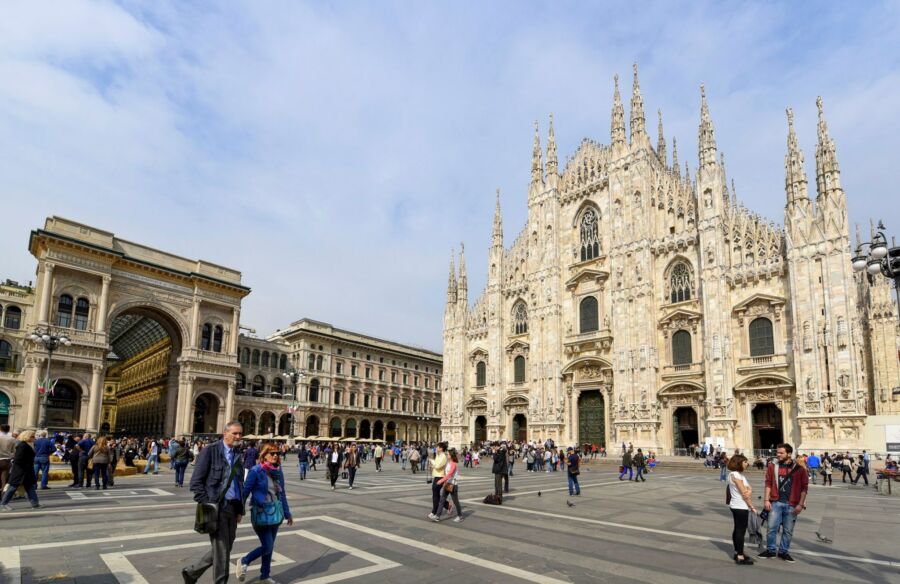
Milan’s cathedral, the city’s centerpiece, is the third-largest church in Europe. It’s massive: 480 feet long and 280 feet wide, forested with 52 sequoia-sized pillars and populated by 2,000 statues. The place can seat 10,000 worshippers.

Climbing the tight spiral stairs designed for the laborers who built the church, I emerge onto the rooftop in a forest of stony spires. Crowds pack the rooftop for great views of the city, the square, and, on clear days, the Italian Alps. But it’s the architectural details of the church that grab my attention. Marveling at countless ornaments carved more than five centuries ago in marble — each flower, each gargoyle, each saint’s face is different — I realize the public was never intended to see this art. An expensive labor of love, it was meant for God’s eyes only.

The cathedral sits on Piazza del Duomo, Milan’s main square. It’s a classic European scene. Professionals scurry, fashionista kids loiter, and young thieves peruse.

The grand glass-domed arcade on the square marks the late-19th-century mall, Galleria Vittorio Emanuele. Built around 1870, during the heady days of Italian unification, it was the first building in town with electric lighting. Its art is joyful propaganda, celebrating the establishment of Italy as an independent country. Its stylish boutiques, restaurants, and cafés reflect Milan’s status as Italy’s fashion capital.

I make the scene under those glassy domes, slowly sipping a glass of the traditional Italian liqueur, Campari, first served in the late 1800s at a bar in this very gallery. Some of Europe’s hottest people-watching turns my pricey drink into a good value. While enjoying the parade, I notice some fun-loving commotion around the bull in the floor’s zodiac mosaic. For good luck, locals step on the testicles of Taurus. Two girls tell me that it’s even better if you twirl.

It’s evening, and I see people in formal wear twirling on that poor bull. They’re on their way to the nearby home of what is quite possibly the world’s most prestigious opera house: La Scala. Like other great opera houses in Europe, La Scala makes sure that impoverished music lovers can get standing-room tickets or nose-bleed seats that go on sale the day of the performance. And the La Scala Museum has an extensive collection of items that are practically objects of worship for opera devotees: original scores, busts, portraits, and death masks of great composers and musicians.

Imagine: Verdi’s top hat, Rossini’s eyeglasses, Toscanini’s baton…even Fettucini’s pesto.

The next morning is the highlight of my visit: Leonardo’s ill-fated The Last Supper, painted right onto the refectory wall of the Church of Santa Maria delle Grazie. Leonardo was hired to decorate the monks’ dining room and this was an appropriate scene. Suffering from Leo­nardo’s experimental use of oil, the masterpiece began deteriorating within six years of its completion. The church was bombed in World War II, but — miraculously, it seems — the wall holding The Last Supper remained standing.

Today, to preserve it as much as possible, the humidity in the room is carefully regulated — only 30 people are allowed in every 15 minutes, and visitors must dehumidify in a waiting chamber before entering. I jockey with the other visitors, like horses at the starting gate. We all booked our timed entry weeks ago. Knowing that when the door opens we get exactly 15 minutes to enjoy the Ultima Cena, we’re determined to maximize the experience. I’ve studied up, but waiting to enter I review my notes, like cramming for a test. I want to get the most out of every second in the presence of Leonardo’s masterpiece.

The door opens and we enter. There it is…filling the far wall in a big, vacant, whitewashed room: faded pastels, not a crisp edge, much of it looking look like an old film negative.

To give my 15 minutes an extra punch, I decide to enter the room as if I was one of the monks for whom The Last Supper was painted some 500 years ago… I imagine eating here, in my robe and sandals, pleased that the wall in my dining room, which for so long has been under some type of construction, is finally done.

It’s a big day — the unveiling. The painting is big and realistic. Jesus and the 12 apostles are sitting at a table just like the three big tables we monks share here in our dining room. It’s as if we were just blessed with more brothers. The table in the painting is even set like ours — right down to the stiffly starched and ironed white tablecloth.

The scene now gracing our refectory is a fitting one. The Last Supper was the first Eucharist — a ritual we celebrate daily as monks. The disciples sit with Jesus in the center. Jesus seems to know he’ll die — his face is sad, all-knowing, accepting. His feet are crossed one atop the other, as if ready for the nail.

While we eat in silence, I meditate on the painting. It shows the moment when the Lord says, “One of you will betray me.” The apostles huddle in small groups, wondering, “Lord, is it I?” Some are concerned. Others are confused. Only Judas — that’s him clutching his bag of silver — is not shocked.

Again and again, my eyes return to Christ. He’s calm despite the turmoil he must feel over the ultimate sacrifice he must make.

But then, my modern-day sensibility intrudes. I can’t help it. I want to tell the monk that Leonardo cleverly used lines of perspective that converge on Christ, reinforcing the idea that everything does indeed center on him. But I suspect the monk wouldn’t care, since he already understands the artist’s intent.

Suddenly, two doors burst open — abruptly ending my musings. My group and I are sternly ushered out one door and a new group of 30 enters the room through the other. On a bench in front of the church, I sit down for a moment to settle back into the 21st century.

This story appears in my newest book, For the Love of Europe — collecting 100 of my favorite memories from a lifetime of European travel. Please support local businesses in your community by picking up a copy from your favorite bookstore, or you can purchase it at my online Travel Store. You can also find a clip related to this story at Rick Steves Classroom Europe; just search for Milan.