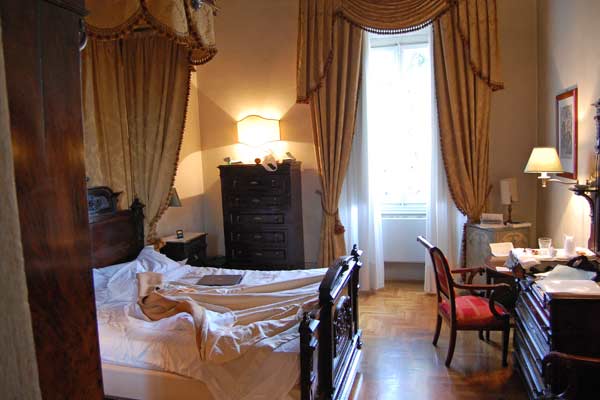
In each hotel room, I crack open a rickety old desk drawer, where I stow business cards I pick up throughout the day in my research work. This gives me a “trash can” that the maid won’t take out. I strive to keep loose papers out of my writing world, but very often I need to retrieve something I tossed.
Rummaging through my trash, reviewing the discarded cards of two days’ worth of people met, reminds me of how travel here is like a gelato social.
I met John Mica, a congressman from Florida, while dodging a horse carriage under a Donatello statue. He called himself a “knuckle-dragging conservative on economic issues who believes in funding the arts.” He and his wife sneak over here with no fanfare (so he doesn’t have to mess with security or any protocol). He was enthusiastic about a new “open skies” initiative leading to more transatlantic flights…and some funky little trattorias he wanted me to check out for my guidebook. For some reason he reminded me of salt on fresh pineapple (one of my favorite things). Meeting a likable Republican (like meeting a Catholic priest who challenges my intellect) reminds me that there’s more than one way to skin an idea.
When Congressman Mica opened his wallet to give me his card, I saw he had the card of a man I had just met and whose card I also had: David Stempler, Esq., president of the Air Travelers Association. A crusty man (and an Esq.), the government listens to him on consumer affairs dealing with the air industry. I told Stempler and Mica I thought the clamor for an “air travelers’ bill of rights” was media-stoked over-reacting to a perfect storm of airline bad luck, and that I am mightily impressed with our airline industry even if they do lose a few bags and once in a snowy blue moon a few planes are stuck on the tarmac. We agreed that the worst thing for our airline industry (and for consumers who know what’s good for them) is to saddle airlines with needless regulations and to create a business environment where they’ll cancel flights out of needless timidity.
Other cards were reminders of other encounters. For example, there was “Dr. Patricia Cantilli, Medic veterinary homeopath,” a Romanian woman on an extended computer date with a friend who once ran my favorite hotel in Florence (La Scaletta, which I deleted this year after about 20 years in my guidebooks — bad new management). Free trade, globalization…the expanded EU spills into romance, too.
“Lora Gori, president Scuola del Cuoio” runs the leather school at the Church of Santa Croce. It was actually referred to as “Citta dei Raggusi” (“Boys’ Town” in Italian) when her leatherworking family established it in collaboration with Franciscan monks during the tough years after WWII to give orphaned boys a trade. Sra. Gori still welcomes tourists as her leather workers fill former monks’ dorms with fancy belts and purses (www.leatherschool.com).
Christoph Rehli, a conductor from Switzerland with Young Frankenstein hair, was in Florence preparing for a concert. He was eating alone in one of my favorite restaurants. We had pianos in common. I told him my piano was made in the same Black Forest village as the accordion of the Gypsy man who just left the restaurant (Hohner harmonicas and accordions, and Sauter pianos — all made in Spaichingen). I told him my dad imported fine German pianos. There were three Steinway brothers, so factories ended up in New York, Hamburg, and Braunschweig. (Dad imported the Grotrian-Steinweg from Braunschweig. Back then, CBS owned the New York Steinway, was threatened by the better German Steinway, and successfully sued requiring that the name be simply Grotrian in the USA.) Christoph said he had a Hamburg Steinway that was old but good. I guessed it was a “vintage” from around 1930. He said yes. (Knowing pianos like others know wine assures me that we can all be snobs in some realm. I am forever impressed by wine-lovers who know the good years — a topic which completely baffles me.) Maestro Rehli and I had a wonderful chemistry…the kind of person I know I could be great friends with, but I’ll never see again. (A sad reality a traveler gets callous to: the best travelers say the most goodbyes.)
And another card from someone who called herself “The Tuscan Concierge” was a reminder that countless Americans and Italian entrepreneurs are still capitalizing on the “Under the Tuscan Sun” fascination we have with this part of Italy (and would love to get into my guidebook). Ristorante Medioevo (that Buca I loved in Assisi) has one of those cards so artsy you have a tough time actually deriving the name of the establishment — a growing problem, it seems, in Italy. Thankfully, Web addresses generally list the name without the over-the-top font play. Jim Fox and Barbara Miller, an American expat couple living in Florence, pass out their tandem card to people they meet. Jim said when you travel with a personal card and hand it out liberally, Europeans take you more seriously. Good tip.
Among piles of other cards penciled up with notes for the next edition of my Florence guidebook was a very clever card by Dr. Stephen Kerr, “the tourist doctor” with a clinic 100 yards from the Uffizi, open two hours a day for drop-ins. He also makes €80 “house calls” to hotels and gives student discounts.
A card from the Istituto Oblate dell’Assunzione, a welcoming convent renting rooms and tranquility, actually has an email address on it. Finally convents are getting a little business sense. The spunky sister there — Theresa — remembered me from the early 1980s when I kept my tour groups (minibus loads only back then) at a convent near the Vatican on via Andrea Doria. I didn’t remember her…but I did remember kindly sisters letting me hang my wet laundry on the rooftop with all their linen.
This little nostalgic swing through my trash drawer reminds me that good travel connects people with people. Whether I’m leading a tour group, researching a guidebook, or producing a TV show, I know that connecting my traveling Americans with Europeans is what will carbonate the experience.