Daily Dose of Europe: Cold War Memories in Budapest

Staying close to home this summer has got me nostalgic for recent trips…and for long-ago ones, too. Back during the Cold War, I had some eye-opening travels to communist Hungary.

Even though we’re not visiting Europe right now, I believe a daily dose of travel dreaming can be good medicine. I just published a collection of my favorite stories from a lifetime of European travels. My new book is called “For the Love of Europe” — and this story is just one of its 100 travel tales.

Back in the 1980s, on a train heading for Budapest, I stood in the aisle with my elbows on the edge of an open window, enjoying the moonlit countryside rushing by. I was soon joined by a Czech woman who was doing the same thing. She told me she was on her first trip out of her country. I asked her if she was excited about visiting Budapest. She said she was most excited about eating a McDonald’s hamburger. The buzz throughout Eastern Europe was that Hungary had just opened a branch of the American chain.

If communism was a religion during the Cold War, Budapest was Eastern Europe’s sin city, offering tourists from communist countries a taste of the decadent West: rock concerts, Adidas sports gear, and the first McDonald’s east of the Iron Curtain. Back then, eating a Big Mac was an act of defiance. There was nothing fast or cheap about Western “fast food.” A Happy Meal was a splurge. People traveling from other communist countries to Hungary waited in lines that stretched around the block for a burger, fries, and a Coke. Ronald McDonald stood on the street corner like a heretic prophet, cheering on the downtrodden proletariat, while across the street, wannabe capitalists drooled over window displays featuring running shoes that cost two months’ wages.

As I visit Budapest today, it’s clear that the younger generation of Eastern Europeans has no memory of the communist era. Enough time has passed that former Warsaw Pact nations can take an honest look at the period.

My first stop on this trip is the House of Terror, long the headquarters of communist Hungary’s secret police. When the Communists moved into Budapest after World War II, their secret police took over the Nazis’ secret police headquarters. It was here that Hungarians suspected of being “enemies of the state” were given sham trials, tortured, and routinely executed. The museum’s atrium features a Soviet tank and a vast wall plastered with portraits of victims. Exhibits cover gulag life, Social Realist art, and propaganda. A labyrinth built of pork-fat bricks reminds old-timers of the harsh conditions in the 1950s, when lard on bread was the standard dinner.

I enter the elevator to continue into the museum. As it slowly descends, a guard on video explains the execution process. When the door opens, I step into the basement chambers of torture and death. In 1956, the blood was hosed away and this cellar was made a clubhouse for the local communist youth club. In the museum today, it has been restored to its condition circa 1955, with chilling prison cells instead of ping-pong tables and chess sets.

In the museum’s poignant finale, the “walls of victimizers” are lined with the photos and biographical information of members and supporters of both the Nazi and communist secret police — many of whom are still living and were never brought to justice. The House of Terror must be a particularly powerful experience for elderly Hungarians who actually knew many of the victims of the secret police…and who remain neighbors of the victimizers.

When regimes fall, so do their monuments. Across Eastern Europe, statues of Stalin, Lenin, and their local counterparts came crashing to the ground. In Budapest, these stony reminders of communist tyranny are collected in Memento Park, where tourists flock to get a taste of the communist era. I head over for a lesson in Social Realism, the art of communist Europe. Under the communists, art wasn’t just censored. It was acceptable only if it furthered the goals of the state. Aside from a few important figureheads, individuals didn’t matter. Statues featured the generic working man or working woman. Everyone was a cog in the machine — unquestioning servants of the nation.

Wandering through Memento Park, I’m entertained by the jumbled collection of once fearsome and now almost comical statues. While they seem to preach their ideology to each other, locals and tourists take funny photos mocking them. The gift shop hawks a fun parade of communist kitsch. I pick up a Stalin vodka flask and a CD featuring 20 patriotic songs — The Greatest Hits of Communism. It occurs to me that Stalin — whose estate gets no royalties for all the merchandise featuring his dour mug — must be spinning in his communist grave.

This story appears in my newest book, For the Love of Europe — collecting 100 of my favorite memories from a lifetime of European travel. Please support local businesses in your community by picking up a copy from your favorite bookstore, or you can purchase it at my online Travel Store. You can also find a clip related to this story at Rick Steves Classroom Europe; just search for Budapest.

Great Guides, Pickpockets, and Haircuts in Central Europe

I’m wrapping up my time in Central Europe: Budapest, Bratislava, Vienna, Prague, and Berlin — a great itinerary. We have individual guidebooks for each of these cities (except Bratislava, which is included in both our Vienna and Budapest books). And with so much to experience in each city, keeping all of those books up to date is no easy task. But with the help of co-authors and guidebook researchers, we update each book, in person, every two years. And this year, it was my turn to take a spin through the great cities of Central Europe. Here are a few travel memories that are sticking with me.

Along the way, I got to meet lots of our happy tour groups and their wonderful guides. At my Budapest hotel, Gerlóczy, on three successive nights I got to pop in on Rick Steves Tour groups who were having dinner in the dining room. Each group was convinced that their guide — Peter, Etelka, and Katka — was the greatest guide on the Continent. For me, that’s a wonderful disagreement.

three photos of Rick Steves with three different tour guides and tour groups in the same restaurant
(clockwise from top) Tour guides Peter, Etelka, and Katka with their groups in Budapest.

A highlight for me in Vienna is dropping in on Karin and Gerhard, who have lovingly built — from nothing more than their love of the movie The Third Mana museum that tells its story, and the story of Vienna in the dark and spy-filled days after WWII. It’s only open on Saturdays and by private tour appointment…and it’s in the top ten list of things to do on TripAdvisor for Vienna. Bravo! Our tour groups enjoy a private tour of this fascinating museum.

Rick Steves with Karin and Gerhard holding a Third Man book
Karin Höfler and Gerhard Strassgschwandtner, Vienna’s Third Man Museum

In Vienna, I learned to spot pickpockets working the crowded tram system. They work in pairs and dress up as tourists, studying maps, wearing little touristy backpacks, and relieving careless tourists of their wallets all day long.


two people looking at a map


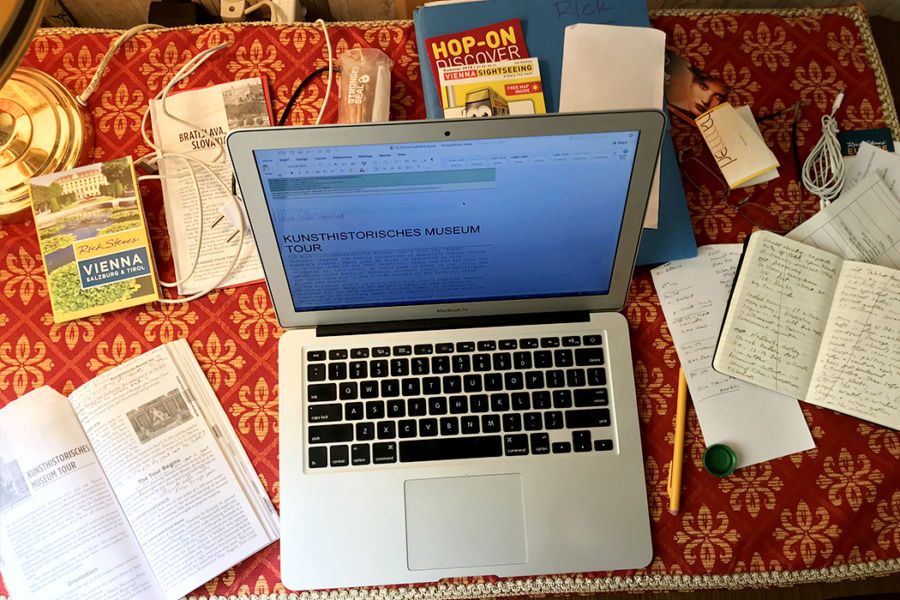
Traveling alone with four different books to update this month, I’m in a very focused state of mind. With impressive discipline (as I have a very hard time not being out and about in these amazing cities), I make sure to take time in my room to get all the new information massaged into the files for that book’s new edition. My hotel desk (strewn with “lady laptop,” maps, and notes) makes a wonderful on-the-road office.


laptop strewn with guidebooks and notes


In a few days, I’ll be meeting my TV crew in Scotland. It’s always a bit stressful to get a pre-TV shoot haircut in a land where I don’t speak the language. And hairdressers are one of those occupations where you’re likely to encounter some communication challenges. As I always say, if it’s important, have a local friend write your message on paper: “Please not short. Only a trim.”


rick steves and a stylist holding scissors. Rick is holding up a sign that says "Please not short. Only a trim."


Join our traveling community — connect with me on Facebook and Twitter.


Watching Democracy Slide Towards Autocracy in Hungary

As an American, you can simply travel — or you can travel as a political act. When we make a point to learn about the challenges facing other nations, we gain a deeper understanding of the challenges we face at home. And here in Budapest, where I’m kicking off the second half of my 2018 travels, I’ve already picked up the greatest of all souvenirs: a broader perspective.

Like Turkey and Poland, Hungary has a leader who’s derailing their democracy, buoyed by the support of people who live outside of the cities and care about one issue above all others: keeping refugees out. Meanwhile, the concerned citizens of more democratic nations (that are able to keep the issue of migrants in perspective) are watching, recognizing how fragile their freedoms are, and marveling at the fascinating parallels between one society and the next.

In much of Europe these days, one party offers education, progressive taxation, and care for the environment. The other offers tax breaks, fewer regulations, uniformly nationalistic textbooks that rewrite history, and “protection” from migrants. And the people choose.

Join me on the banks of the Danube for a peek at Hungary’s political swing from left to right.

The Latest From Mr. Eastern Europe

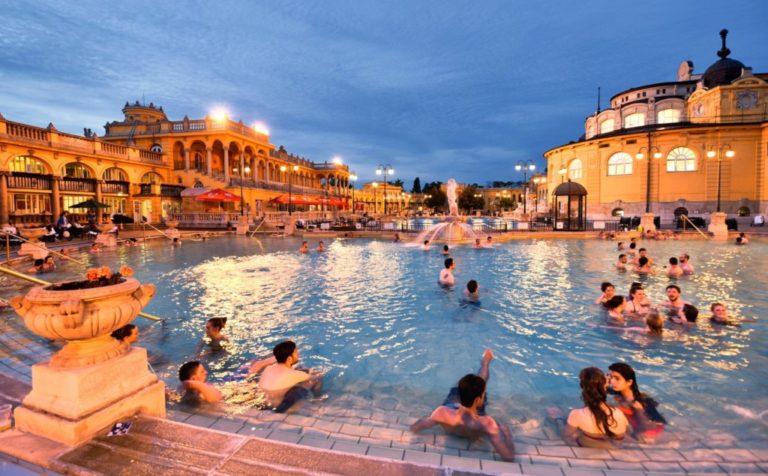
cameron-hungary-baths-budapest-szechenyi-35-768x476

There are few travelers whose opinions I respect more than the co-author of many of my books, Cameron Hewitt. And in my office, Cameron is Mr. Eastern Europe. When I hear Cameron explaining why Budapest is one of his favorite cities on earth, I listen. And when Cameron reports from Hungary, I know I’m in for some fascinating vicarious travel fun. Sure, Cameron’s soaking away all his troubles in a series of luxurious Hungarian spas on company time. But I’m so glad he is. Because he’s sharing that joy vividly in his reporting. Check out Cameron’s blog today.

Heat Wave in a Budapest Ruin Pub

Enlarge photo

Enlarge photo

Budapest’s trendiest clubs are called “ruin pubs.” Inhabiting ramshackle old buildings in the city center, they feel like a gang of squatters made a trip to the dump yesterday and grabbed whatever was usable, moved in today, and are open for business tonight. Enjoying a drink here, I’m reminded of creatures that inhabit discarded shells in a tide pool. The formula really works. With the come-as-you-are atmosphere, these clubs attract people who make a point not to be “fashion slaves.” And, for the traveler, it’s easy to meet people in a Budapest ruin pub.

I end up sitting with Peter (who designs ruin pubs), Laura (who works at a hotel), and Sandra (whose father’s company, “Heat Wave,” introduced pornography to Hungary after freedom in the 1990s). I say how much I like the shabby lounge atmosphere of a ruin pub, and Laura declares that this one, Szimpla (which means “Simple”; Kazinczy utca 14, www.szimpla.hu), is the mecca of ruin pubs in Budapest. Sandra agrees, but is distracted when Miss Hungary walks by. With a little disdain, she says, “There’s Miss Hungary — a beauty brat with a Gucci handbag, and nobody notices her.”

Ruin pubs come with a bit of communist kitsch. The twentysomethings that love these lounges were little kids during the last years of communism. Too young to understand its downside, they have fond memories of the good times, when the pace of life was slower and families were tighter-knit. Ruin pubs sell nostalgic commie soft drinks along with the cocktails. Peter buys everyone a round of spritzes (rosé with soda water). He’s excited about the new ruin pub he just designed across town, and wants us to go there. I comment on how well the design works. He explains how these clubs are the soul of underground culture here. It’s the anti-club: flea market furniture, no matching chairs, a mishmash of colors. It’s eclectic, designed to be undesigned. On hot nights, the pubs spill out into shoddy courtyards, creating the feeling of a cozy living room missing its roof…under the stars.

Everyone seems to smoke. Here, where no one’s a fashion slave, not being a fashion slave creates a similar burden. Peter demonstrates the different ways you can smoke a cigarette in a counterculture enclave. First he does the affected “Beauty Queen” smoke, then the calculated “Godfather” smoke. Finally, gulping the cigarette in the middle of his lips, he does the “Working Smoker,” saying, “You smoke with big lips.”

Laura is talking with Sandra in Hungarian about her dead relationship. There’s nothing there, but she’s afraid to leave. When I join the conversation, she shifts to English and says it’s like she has sexual anorexia. Her boyfriend and she are drifting apart. She wants him to watch Sex and the City, and says, “To understand the soul of a woman, you must watch Sex and the City.” This topic gets Laura and Sandra talking about how Hungarian men aren’t as good as men from other cultures — not considerate, not thoughtful in conversation, and so on. I explain to her the concept of “the grass is always greener on the other side of the fence.” She says we’re talking beds, not fences, and doesn’t buy my theory.

Politics are in the air all over Europe, with everyone looking at Greece’s economic disaster and wondering what to do. Hungarians are used to making not much money, but having the government pay for things. While Budapest is better off, in the east of the country, people still make horrible wages and expect the government to cover the essentials. The government provides, but things are supplemented with tips. Health care is a good example of this heritage of communism. Hungarians insist on complete coverage — with no co-pay. Technically, they get it. But everyone knows the system only works with the help of “pocket money” — people actually pay cash tips to their doctors in order to get an appointment and have their concerns taken seriously. That’s how it was in communist times. And that’s how it remains today.

In 1989, with the “spontaneous privatization of the society,” the Communists in power had the inside track and grabbed up the lion’s share of the country’s economic equity. Therefore, today, the former Communists are the privileged capitalist class and, ironically, these former “defenders of the proletariat” are now defenders of industry and corporate interests. Young people, who have a Tea Party edge to their politics, are wary of any promises that are populist and founded on deficit spending. They are tired of electing politicians who tell them what they want to hear. They see other former-communist countries doing better than Hungary in fiscal discipline.

Old people are inclined to vote Communist, and young people want the new austerity. In a recent election, young people joked about how to stop your Granny from voting. Pop stars were making videos: Lock her in her bedroom, send her on vacation, ask her to babysit for a couple of days. Or be straight with her and convince her to vote for her granddaughter’s future. Thanks to Greece, populism is has taken a big hit in Eastern Europe.