I’m deep into an 18-day shoot with my television crew: producer Simon Griffith and cameraman Peter Rummel. Rather than focusing on lovely sights, in this shoot we’re updating our three-part Travel Skills Special…while surrounded by lovely sights.
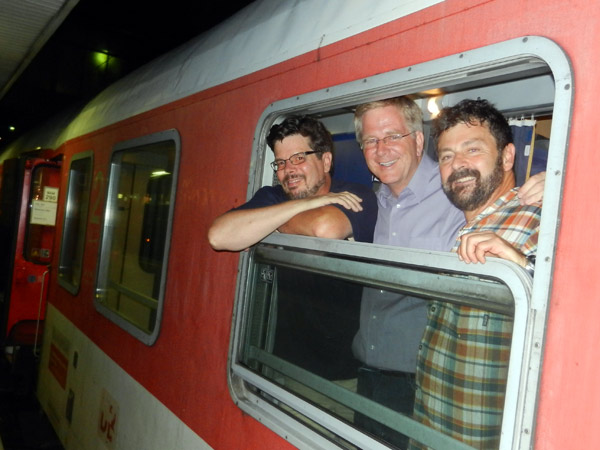
Our Crew, Just Before Bedtime
Most of an entire episode of our Travel Skills Special is devoted to train travel. In this shot, we’re settling in for the overnight train from Munich to Venice.
Alcohol-Testing Our Cameraman
Before shooting in Bavaria, we have our cameraman, Peter Rummel, submit to a breathalyzer. These machines are found at German beer gardens in the countryside (like Andechs), where most people arrive by car. They’re handy for locals who love their beer, but know that Germany’s drinking-and-driving laws are strong and strictly enforced.
ICE Woman and the Bullet Train
For three days, we filmed the how-tos of train travel using Germany as our classroom. It’s a challenge to spend lots of time, hard work, and money producing three half-hour episodes on travel skills that will still be up-to-date in six or eight years. While most of Europe is not yet quite as slick, Germany’s train system is what they aspire to: Futuristic ICE (Intercity-Express) trains cut like bullets through the green and tidy German countryside. And in this photo, “ICE woman” is a clear reminder that they run a very tight ship.
Enjoying my first-ever visit to Hamburg, I thought of great “second cities”: Marseille, Glasgow, Porto, Barcelona. Hamburg has a real feel and edgy charm, and an honest grip on where it came from and where it’s going. I can hardly wait to return with my TV crew.
Hamburg — with its important port — was hit hard in World War II. But today, about the only reminder I saw of the war was this bunker in a park. Too thick to bother tearing down, it has been painted and converted into a climbing wall.
The most impressive sightseeing experience of my entire trip so far has been this harbor cruise, with a jaw-dropping look at Hamburg’s mighty port.
The old warehouse district of Hamburg gives a strong sense of the vastness of what was Germany’s only major seaport in the early Industrial Age.
Hamburg’s former docklands — like London’s, Barcelona’s, Oslo’s, and so many others — is being gentrified. As the city reclaims what was once a wasteland in Europe’s biggest urban development project, HafenCity, it’ll become 40 percent bigger. And the centerpiece of the development: the Elbphilharmonie concert hall.
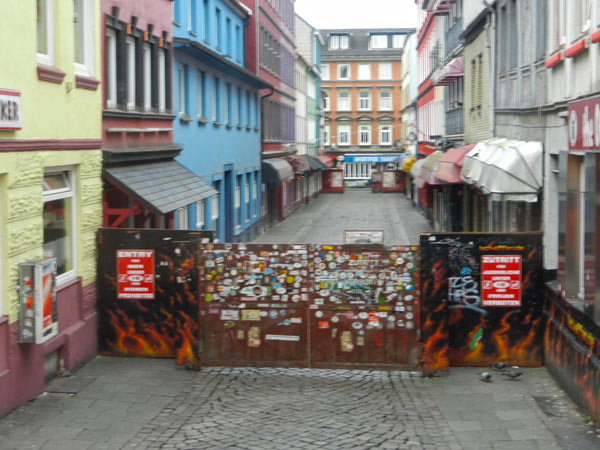
Hamburg’s Reeperbahn, its tawdry red light sailors’ quarter, is shrinking in a rising tide of affluence. So many people know the city for this zone (and for the fact that the Beatles got their start here). The Beatlemania Museum closed just last month. And the red light district feels barricaded within one small block, defined by the metal modesty walls erected during Hitler’s rule. Back then, German society didn’t admit to having such districts, but an exception was made for its hardworking and heroic (if horny) sailors on shore leave.
German trains are slick as can be. With a Eurail pass, I’m going first class. Packing light, I toss my bag onto the rack, pop open my laptop, burrow down into my writing, and before I know it, I’m in the next city. The trains are clean, sleek, comfortable, and on time. The old clackity-clackity rhythm of the rails is no longer there as it’s a nearly silent swoosh. On line schedule sites take all the guesswork out of departure options and times. And, across Europe, it seems train stations are remodeled and gleaming shopping malls—as slick and commercial as American airports.
The former headquarters of the Stasi (the East German equivalent of the KGB) is now a museum and an archive where former East Germans can come to explore their files. Nearly everyone had a file. Many today don’t want to look into their files to avoid the heartbreak of finding out which of their friends and relatives were informing on them to the secret police.
Each morning that I’m doing guidebook research, I scramble to get to the hotel lobby to meet my local guide by 10:00. I write until the wee hours, and I’m determined to stay healthy and get my beauty rest. Coming down a few minutes late one morning, I apologized to my Leipzig guide. He said, “Let’s not be too German. It’s just a couple of minutes.”
On this trip, I’ve been enjoying several cities that are new to me — and Leipzig is no exception. Noting all the construction throughout Germany, my guide explained that many of the post-WWII buildings, erected on the cheap in the 1950s and 1960s, are now due for replacement. Western Germans are still paying a “solidarity surcharge” of 6 percent of their taxes for building and rebuilding the East to bring it up to Western standards. Imagine the uproar it would cause if two-thirds of the USA were paying to spiff up the poorest third of our country. But rather than complain about the taxes, Western Germans are more likely to grumble that the former East now has even better streets than the former West.
My guide is a Westerner living in the East. Later that day, we sat down to dinner with his wife, who grew up in the communist DDR (the official name for East Germany). The conversation was fascinating.
There’s still a surprising gap between the psyches of the East and West in Germany. My guide said that only about 1 percent of Germans are in “mixed marriages” between Easterners and Westerners. And more than 20 years after reunification, half of all Western Germans still have never been to the East. His wife added, “Psychologically, people don’t want to confront their prejudices.” The German government celebrates the “reunion” of East and West. But let’s be honest: The East was effectively annexed by the West, on Western terms.
We talked about the people of Leipzig rising up against the communist government. The government knew that the security forces were likely to sympathize with the people. It was standard operating procedure that border guards and police would work in pairs. That way, if one lost their nerve and didn’t shoot, the other would — or report on the one who didn’t.
During communist times, the government employed a lot of people steaming open letters, reading them, and then resealing them with fancy machines like this. Amazing gear like this fills Leipzig’s Stasi Museum.
During those courageous days before the Berlin Wall fell, all eyes were on Berlin, but there was plenty happening in Leipzig — the second city of the DDR. I remarked how courageous protesters must have been to gather in solidarity inside St. Nicholas’ Church, not knowing how the soldiers and police would respond when they went outside. My guide’s wife was there, and spoke of leaving the church cupping candles with both hands to let the soldiers know they were unarmed. (Today, this is symbolized by white cobbles scattered among the black ones around the church.) She said people brought their babies and held them in their arms as human shields. Her husband did a double-take — he’d never heard her admit to that.
I never considered the importance of capturing, and then sharing, images of a popular uprising. While plenty of international news cameras were there to broadcast images of Germans partying on top of the Berlin Wall, Leipzig’s protests took place mostly at night, under cover of darkness, deep inside East Germany, where it was particularly dangerous to be seen with a camera. Organizers sent one photographer up the church spire, where he got some of the only grainy images of the streets of Leipzig filled with people bringing down their communist regime.
I remember being in West Berlin as a child in 1969. There were riots in the streets. Even as a kid, I was aware that the government effectively bottled it up and didn’t let any images be shown on TV. In some ways, if you stage a revolution and nobody sees it, it didn’t happen.
As the conversation rolled around to American politics, I complained about how obstructionist I thought the Republicans in our government are these days. She said, “Opposition is good… we’ve tried government without.”
Germany is working hard and producing more than it consumes with strong leadership. Being here is an inspiration.
Asking them what they thought of the political discourse in our country, they were both frustrated by how many Americans confuse social programs with “socialism.” They were offended that some Americans, who don’t really understand how the German health care system works, would use it to make the case that nationalized health care is ineffective and a bad idea. Quite the contrary: These two Germans couldn’t imagine an affluent, developed nation without a nationalized, single-payer system.
Their other peeve: They explained how in 1949, the USA and other WWII victors wrote a constitution for postwar Germany, requiring that the country remain non-aligned. Then, after 9/11, President Bush declared, “You are either with us or against us” — in essence suddenly requiring Germany to become aligned.
Noticing that I’d left the blood sausage on the side of my plate, my friends chided me for not being adventurous. I told them that just the thought of it made me queasy. They said, “What the farmer doesn’t know, he doesn’t eat.”
For me, coming to Lutherland in Germany is a bit like a Catholic going to Rome. I’m really tuned in to the churches and the other physical reminders of the courageous accomplishments of the Reformation. Without those hard-fought reforms, the Bible would still be read in Latin by priests, and then interpreted for us on their terms. The 500th anniversary of Martin Luther kicking off the Reformation in 1517 is quickly approaching, and towns like Erfurt will enjoy lots of attention. Here’s a quick visit to a great church in Erfurt, where Luther went to university, became a monk, and was ordained a priest.
If you can’t see the video below, watch it on YouTube.