Rothenburg as a Stage Set

We spent 12 days scrambling to film our Reformation special. And the last stop was the historic German town of Rothenburg. If the town’s good enough to use as a location for “Pinocchio,” “Harry Potter,” and “Chitty Chitty Bang Bang,” it’s good enough to film “Rick Steves’ Luther and the Reformation.”

Rothenburg entrance

Rothenburg scenes like this (the Burgtor) are perfect for on-camera bits.

Lord Mayor of Rothenburg with Rick Steves

For over 30 years I’ve been bringing groups to Rothenburg, promoting it in my guidebooks and featuring it in my TV shows. And Rothenburg, which recognizes the value of our partnership, was extremely supportive of our filming needs. Oberbürgermeister (Mayor) Walter Hartl, understanding how tight our schedule was, presented me with a lovely proclamation of appreciation without a big and fancy banquet. The medieval-style wax seal was still warm.

Bringing in a table

Upon arrival in Rothenburg, we scouted every museum, church, and possible film location. This was essential if we were to use our time smartly. The wonderful Imperial City Museum had the perfect place to recreate the moment Luther discovered the verse in Romans that said Christians are saved by grace and don’t need to earn it or buy it. But we needed a big old Bible and a proper table. Nearby, one of my favorite restaurants (Altfränkische Weinstube) had the perfect table. The boss was gone, so we had to do some fancy talking for the cleaning lady to let us walk out of the place with a table.

Large bible

With the perfect corner in the museum, artful lighting, our table in place, and a Bible that was actually 500 years old, we were ready to film. Here, Second Cameraman Tim Frakes sits in for me as we tweak the lighting. Can you imagine how beautiful that shot will be as I say:

He found his answer in Paul’s letter to the Romans. It read: “The just person shall live by faith.” With that key phrase, Luther discovered what he considered the “good news”: that salvation is not earned by doing good works or giving the Church money, it’s a free gift to anyone who believes. Luther decided the subject should be debated openly.

Rick Steves TV crew in the forest

After hiking into a forest to shoot the bit when Luther ran from the law before hiding out in Wartburg Castle, we paused for a crew shot: from the left, Cameraman Peter Rummel (who shoots nearly half our TV episodes), Cameraman Tim Frakes (who produced the Luther show I did for the Lutheran Church 15 years ago), Producer Simon Griffith, and me. Working hard is very rewarding with creative partners like this talented crew.

TV crew gear

It’s just great how, as we get older, our gear gets lighter. For a TV crew, we pack extremely light. I took a moment on the curb of the Frankfurt airport to show exactly how much our crew of three packs when we are making our TV shows (including a carry-on bag each for personal gear). The crew flew home, and I got off in London to start a three-week research stint in southern England.

Inside Look at Amazing Crime Museum

While filming in Rothenburg at the amazing Medieval Crime and Punishment Museum, we got a behind-the-scenes look at how great museums don’t just happen. (Tacky and commercial “torture museums” — which you’ll find all over Europe — do just happen… but I’m talking about real museums that have real historic artifacts.) Put on some white gloves, watch this video clip, and have a peek.

Modern Germans Reenact Medieval Battles

While filming our Protestant Reformation documentary in Germany, we decided to use Rothenburg’s 16th-century settings to do my “on cameras.” It was perfect: Its Medieval Crime and Punishment Museum is the best of its kind. Its churches are quiet and stately in a 1500s Protestant kind of way. The ramparts just scream Thirty Years’ War. And Jörg Christöphler, the very effective director of the Rothenburg tourism office, made sure we had access to whatever we needed to do our work well. Jörg actually called up his Thirty Years’ War (1618-1648) army for us. I had the joy of commanding about 50 stunningly clad reenactors. In this clip, we’ve divided them in two groups so each cameraman can be creative. We wanted to get some artistic clips that Simon, my producer, can use for his treatment of the Wars of Religion that devastated Germany in that period. (We kept thinking Protestant and Catholic Christians 500 years ago are an eerie parallel to Shiite and Sunni Muslims of our era. By 1648, about 20 percent of Germany lay dead.) When we were finished with our work, Commander Jörg declared “100 liters of beer for all!” And our army marched to the nearest beer garden. Life is much better these days.

Documentary Style à la Ken Burns

Rick Steves looking at a large bible

Ken Burns can enthrall me for hours on end with lavishly filmed, edited, and narrated history. It’s my hope that our hour-long special on Luther and the Reformation will be enthralling too. For me it was exciting to have access to actual documents, papal bulls, letters of indulgence, Bibles in both Latin and German, and pamphlets by Luther — all dating from the early 1500s. The Luther Haus in Wittenberg is the best single museum for Reformation artifacts and documents. We were given complete access to its treasures. We scouted one day to make a list and a plan. Then we filmed for four extremely efficient hours getting lots of great images to “cover” our script. As it was by far the most images we’ve ever shot in one location, I decided to be well-organized and catalog the clips. It’s like a puzzle, and at this single stop we got these 60 pieces. Here’s my list of camera shots:

Art shot in Luther Haus in this order: 1. Wittenberg townscape etching, 2. Frederic the Wise small color painting, 3. Luther with professor’s bonnet, 4. Indulgence etching scene with Tetzel, 5. Actual small indulgence (same thing filmed later in treasures room), 6. Tetzel on horse etching, 7. Pope Leo X, 8. Luther’s actual wooden pulpit, 9. First printed 95 Theses, 10. Luther with monk haircut etching, 11. Jan Hus etching, 12. Tiny color burning scene (big one later is much better), 13. Worms townscape color etching, 14. Booklet cover Luther at Worms in 1521, 15. Color painted Luther portrait, 16. Emperor Charles V, 17. Luther in disguise etching, 18. Cover showing three marriages, 19. Receipt for payment to city, 20. Money chest for community, 21. Latin Bible, 22. Etching of Luther and another reformer taking Communion, 23. Luther preaching etching, 24. Etching of fat usurer with good farmers, 25. Color portraits of two princes, 26. Life-size Frederic the Wise painting, 27. Portrait of Katie and Martin, 28. Wedding scene on book cover, 29. Katie portrait etching, 30. Locked metal box and coins, 31. Small painted portraits of Luther and Melanchthon, 32. Portraits of two princes, 33. Luther holding Bible (close up of hands on Bible), 34. Two-page spread with music, 35. First complete German Bible, 36. Tiny hymnal; Printing Press Room (37. Printing press, 38. Pope as Satan, 39. Color portrait of group of great Reformers, 40. Cranach illustrations on Luther booklets: 40. Grouping of several, 41. Cartoons of grinder, 42. Animal faces, 43. Big donkey, 44. Two anti-Jewish covers); Treasures Room — three 16th-century documents (45. Big one good for 100 days less in purgatory, 46. Small one with blanks to fill in, 47. Medium one with dingleberries), 48. Luther and Katie portraits young, 49. Martin and Katie in one painting, 50. Martin and Katie old, 51. Luther and swan etching, 52. Martin Luther fine color portrait, 53. Gathering of Reformers (with faces and the pope and company trying to blow out candle), 54. Big paintings of Diet of Worms (many shots), 55. Burning of papal bull, 56. Luther at Wartburg Castle fighting the devil, 57. Luther’s living room (with Rick walk through), 58. Luther’s first New Testament in German, 59. Pulpit room (with Rick walk through), 60. Rick walk into museum from outside — two versions, wide shot of the building exterior.

Reformation Shoot

We’re in Germany filming a one-hour special about Martin Luther and the Reformation which will be released in a year for the 500th anniversary of the Protestant Reformation.

Painting of Luther at Worms

Luther was the first guy to stand boldly against the Holy Roman Emperor and the medieval pope — and actually survive. In this dramatic showdown before many of the most powerful people in Europe (at the Diet of Worms) Luther is told to recant all he wrote in his trouble-causing pamphlets. He said, “Unless you can convince me by scripture or by clear reasoning, I am bound by my beliefs. I cannot and I will not recant. God help me.” From there the plot thickens…and Luther’s hoped for religious reforms go far beyond his intent.

Etching of the Great Reformers

Luther was a brilliant PR man with a coarse and edgy wit. He had Germany’s top political cartoonist for a buddy, and the printing press to amplify his ideas. This propaganda etching, typical of the inflammatory cartoons of the day, shows Luther, Calvin, and the other great reformers lighting the way for religious freedom while, at the bottom, the pope, a cardinal, a monk, and the devil do their best to blow out the candle.

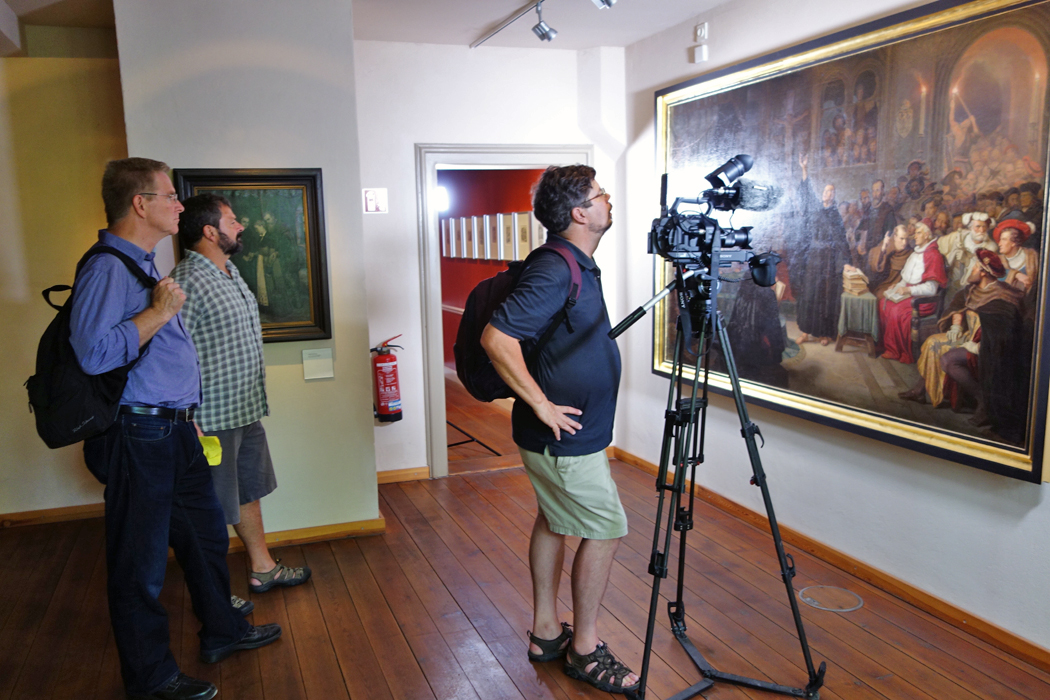
Filming crew in museum

This is the first documentary-style special we’ve produced, and it’s heavy on art. And art tells the story vividly.

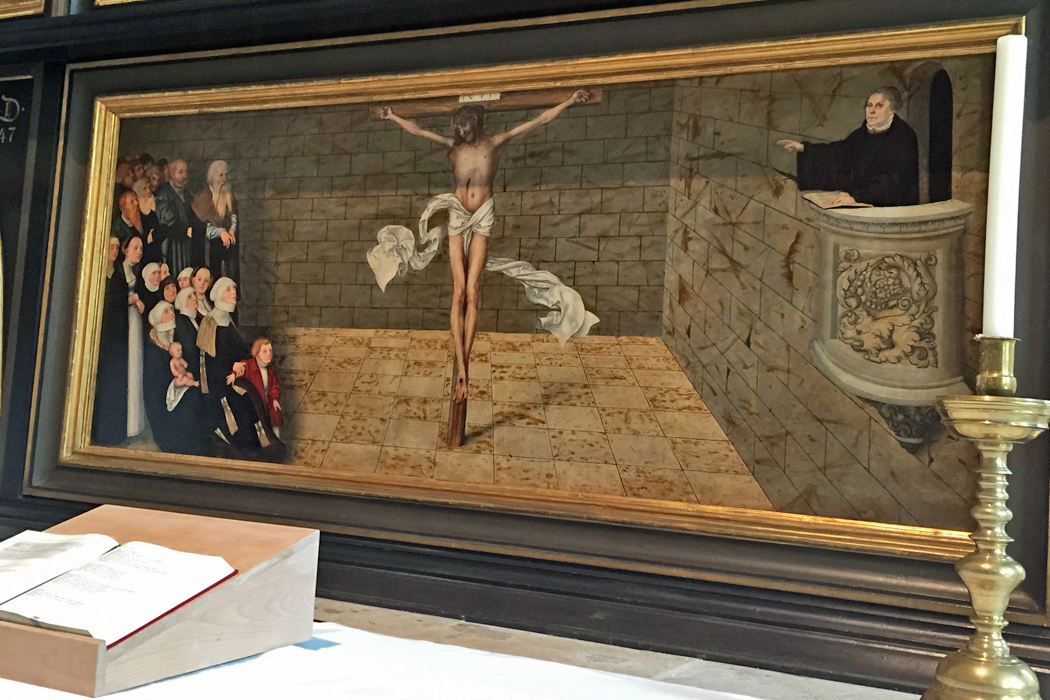
Painting of Luther Preaching

This painting pumps up Luther’s charisma as he challenges teachings of the medieval Church that he didn’t find in the Bible. He preached in the people’s language, quoting the Bible like a lawyer to make his cases — unprecedented at the time. Listening to him is his wife and many children. (A priest with a wife and kids…also unprecedented.)

Simon with the solar-flare halo over his head

Producer Simon Griffith did a good job of keeping our script balanced and reining in my enthusiasm for Luther’s groundbreaking work. But here, in the forest beneath the castle where Luther hid out as he translated the Bible into a language regular people could read, it seems Simon is having a special Lutheran moment.