Thinking in German

German sidewalks are designed to deconstruct and reconstruct economically.

Traveling into Germany, it’s so clear that the Germans know how to motor an economy. They seem disdainful of the tax cheating, the inefficient bureaucracy, and the corruption plaguing the Mediterranean countries they will be bailing out. Suddenly, all around Europe, German efficiency seems like a good idea. It’s amazing to think that Germany has built itself up (with US aid after WWII) from near-total destruction to become Europe’s economic powerhouse. For sixty years, they’ve simply worked hard and paid their taxes.

Germans I’ve talked to admit that they’ve benefitted most from the euro currency. And now they recognize that they need to prop up the euro and give a little back to the other European nations. One German’s thoughts on Greece: “Greeks have learned from their heads of state to be corrupt. Brussels believed in their false numbers when they applied for membership in the eurozone, and since they joined, there’s been no control — just wishful thinking. Today we have a big problem with Greece.”

You see lots of construction around Europe, but in the south, it’s often stalled. Traveling through Germany this last week, however, I’ve seen thriving construction projects everywhere. A beautiful thing about Europe (compared to the USA) is that there are no electrical wires overhead. They are nearly all buried. A local told me that much of the wiring is from the 1970s, and throughout Germany, it’s being dug up and modernized.

One night in Munich, I walked over a tidy sidewalk into my hotel. The next morning, I stepped out and had to walk the plank over a deep ditch with tractors, orange-vested workmen, and industrial-strength tubing and wires everywhere. That afternoon, I came home…and the sidewalk was tidy again. I wondered how long a job like that would take in Italy or Greece.

Germanic people even seem efficient about hedonism. Every country seems to have its own firewater. And, while I gingerly sip it, locals throw it down in a gulp. Finally a local friend gave me a tip: “My Granny taught me that you should first breathe deeply in, then take the shot, then breathe out.” It works. Ahhhh.

On the topic of languages, a German friend observed that the Spanish and Italians speak as if talking to God, the French speak as if talking to a lover, and the Germans speak as if talking to a dog. They seem to be barking, even when agreeing with you: Stimmt! Genau! Richtig! I said I like the sound of German, but it’s difficult for me. My friend said, “German’s an easy language. Even children speak it.”

Meeting a lot of Americans traveling — including families and people well into their adulthood who are out of the States for the first time — I’ve been thinking about how travel helps people blossom. If we are like seeds, the travel experience provides the dirt. The act of traveling plants us. And the people we meet in our travels are like watering the garden. Combine the dirt, seeds, and water properly, and you get the blossom. Happy travels.


Flying with a View…and We Have a Winner!

Our Mykonos flight was on Air Berlin, a discount airline filled with Germans who fly two hours on a cheap flight from Munich directly to Mykonos for a nice break. That’s a handy setup for German sun-worshippers. From Munich, we enjoyed Lufthansa luxury over the Atlantic. While we no longer had our own stateroom with the wonderful little view balcony, I did manage to enjoy a little privacy and wonderful views out my window at 30,000 feet.

By the way — I lost one pound in two weeks of cruise gluttony. Using the stairs on board, eating plenty but in small portions, not going back for seconds, and lots of running around on shore and dancing after dinner enabled me to consume a lot of calories — yet burn off even more. Jason Ree correctly guessed my post-cruise weight at 211 pounds. Congratulations! We’ll be in touch to send you your autographed copy of Rick Steves’ Mediterranean Cruise Ports and the Mediterranean Mosaic DVD.

If you can’t see the video below, watch it on YouTube.

Rail Wonks

A particular joy of my job is collaborating with people who really love their work. We employ 70 people at ETBD, and they amaze me with the passion they have for their niche in our travel-teaching machine. Russ goes to Asia to be sure work conditions are right for the people making our bags. Dave draws maps for our guidebooks, and in his free time, draws maps to people’s homes so everyone can get to the party. Laura is so excited about the new Central Europe Triangle railpass. And Julie won’t rest until the handouts for our next Turkey class are right up-to-date.

In Europe, I work with people who have that same passion. My guide friends can’t simply walk down the street — they have to explain to me why the plaster is being peeled away to show the old wattle-and-daub, or how the church spire is so low because the Soviets wouldn’t let it be higher than their war memorial. And Alan, who runs the EurAide desk at the Munich main train station (a great service to anyone traveling by rail), can’t wait to fill me in on the latest train news.

Alan is the ultimate rail wonk. For twenty years, I’ve dropped by when updating my Germany guidebook… and for twenty years, he’s been passionately helping travelers, one by one, catch the right train for the right price. It exasperates him that I just drop in unannounced, but that’s how I work in Europe. Last week I popped in, and there he was, patiently getting a Korean backpacker with a German railpass a ticket from the German-Czech border to Prague. He said, “Come back at noon, and I’ll take you to a great beer garden for lunch — one you can put in your book.” (We have an ongoing joke that he only takes me to his favorite places on the condition that I don’t tell anyone.)

At noon, we walk a few blocks to the Park Café beer garden. It’s so hot in Germany that literally no one is eating indoors. If your restaurant doesn’t have outdoor seating, you might as well not open up. The Park Café, with a sprawling beer garden and a little fake beach complete with sand and lounge chairs, is thriving. Alan calls it “Little Berlin,” as Berlin is really into fake beaches. (This is a big trend throughout Europe. Cities with no beaches — from Paris to Copenhagen to Vienna — now have sandy summer “beaches” dumptrucked in. These are a hit for Europeans city-bound in the heat of summer.)

I’m not a Radler (beer with 7-Up) type of guy, but this light refresher is the choice for both of us on this hot day. After we each guzzle about a third of our liter mugs and zip through a little small talk, Alan gets right down to his wonk-ish passion: rail news.

Pulling out a packet of questionable Eurailpasses, he tells me that the big news this year is how dishonest rail travelers may be the doom of traditional railpasses as we know them. Alan holds up one pass and says, “This is the pass of Mr. Chen. He came to me, I looked at his pass, and I knew it wasn’t his. I said, ‘You’re not Mr. Chen’…and he ran out of my office, leaving me with this doctored-up pass.”

Alan tells me that unscrupulous railpass-users — especially Australians and Asians — are erasing and re-writing the dates on their flexipasses in epidemic numbers. The European train officials are trying to counter this by requiring everyone to keep the pass in its original jacket and log each journey on the itinerary page attached. But no one obeys. Travelers in Germany know that cops here — shy about being considered “Gestapo-like” — are reluctant to enforce things too harshly. So in Germany, these new railpass regulations go completely unenforced.

Leaving Alan, I continue my research. My staff organizes and distills the mountain of feedback our readers send us, and I spend a lot of time running down places to eat and sleep that our travelers recommend. I eat dinner at a nondescript neighborhood bistro next to my hotel because someone reported that the food is great, and Youssef and Monika — who run the place — are charming. The place seems unexceptional. Skeptical, I give it a whirl…then the food comes. It’s delicious. Monika has such a pleasant way. When Youssef (the chef from Tunisia) finishes his last order, he sits down at my table and we get into a discussion. I’m loving the place — conviviality-plus. I surprise Monika and Youssef by calling them by name. They wonder how I knew. I tell them about my work, and how someone ate here and recommended them. I get out my pencil to write it up…until Monika says, “But we are closing in two months.” Heartbreak. (If you happen to be in Munich before the end of August, check out Das Kaffeehaus, near the train station at Pettenkoferstrasse 8.)

I’ve had people in the States ask me for reassurance that Europe won’t become Muslim in a generation (as some fear-mongers are saying). I say that’s nonsense, and don’t give it a second thought. But, while at Youssef and Monika’s restaurant, I see lots of extremely conservative Muslim women clad in black. I ask them about it. Youssef says Dubai and Yemen are on holiday, and people there love to vacation in Germany. Two moms — draped in black on this hot evening — drop into the restaurant. They’re making an ice-cream run with their kids. I start up a conversation with the 10-year-old boy and ask him, very clearly, “Do…you…speak…English?” He looks at me like I’m nuts and says, “Of course I do.”

Being on the road humbles me. It connects me with our world. It’s where I get my news. It makes me feel good about humankind.

Munich: German Flags and Georg

Enlarge photo

I love my times with Munich local guide Georg Reichlmayr — pronounced like a bad guy on Rat Patrol. Rrrrreichlmayr. We got together recently, just after Germany had beat Argentina in the quarterfinal in the World Cup, and everyone was out, going crazy. I enjoy seeing Germans wave their flag, which — with their difficult 20th-century history — they only do for football victories.

Marveling at the chaos in the streets, Georg says, “We won the game…lock up the cats!” I joke that people who were patriotic in the 1930s might be rummaging around in attics and basements, muttering, “There must be a flag around here somewhere.”
I’ve got a long list of restaurants to check for my guidebook. Post-Fussball victory, it’s not a great night for that, as everyone’s partying and it’s tough to get a fair gauge on the normal energy of the place. I complain that I have an imbalance of restaurants, with too many beer gardens and beer halls. Georg admits that’s a problem in Munich — it has an abundance of great beer halls and a shortage of fine restaurants without the noise and suds.

We pop into the Heilig-Geist-Stüberl — literally the “Holy Ghost Pub.” I always read my description before entering a place, then stow the book and see if it rings true. In my guidebook, it’s described like this: “Heilig-Geist-Stüberl is a funky, retro little hole-in-the-wall where you are sure to meet locals (the German cousins of those who go to Reno because it’s cheaper than Vegas, and who consider karaoke high culture). The interior, a 1980s time warp, makes you feel like you’re stepping into an alcoholic cuckoo clock.”

Georg cracks up about the last three words. Stepping inside, it’s perfectly described. It’s hard to get out, but I have to be very disciplined — one drink can kill your research momentum.

We pass an Apple Store — open late and thriving, just like those in American malls. Then we see a bookstore with big reading lounges. Georg says these are all the rage here. I say, “Bookstores providing a ‘third place’ have long been popular in the US.”

A few blocks later, a guy at a curbside table hollers at me. He’s a US soldier stationed at Grafenwöhr. He says they give everyone landing there from the States a copy of the Rick Steves issue of Smithsonian magazine as a welcome gift and encouragement to get out and see Europe while they’re here. I tell him sales have been great (Smithsonian thinks they will sell out of their double-sized print run), but I didn’t realize we were getting distribution at US military bases in Europe. It’s a great bit of news.

Talking with the soldier gets Georg going on Germany’s involvement in Afghanistan. He muses, “What are we doing in Afghanistan? Let’s give the baby a name” (a wonderful German phrase for our “Let’s call a spade a spade”). I say, “You’re there to make America your friend.” He says, “Of course. We’re not defending Oktoberfest. The Taliban is no concern of ours. This last Oktoberfest came with extreme security — the most I saw. Why? Because Germany is in Afghanistan.”

A bit later, seeing someone walk by with a T-shirt reading, “Costa Rica: no army since 1948,” Georg says, “I think America would be more a super power without an army. With no army at all. Think of what you could do with your money instead.” I explain to Georg that you cannot seriously discuss that issue in the USA. He says, “Yes, I know. We have a long history of important families like Krupp making vast fortunes on armaments.”

With our work about done, we stop by Georg’s favorite beer hall, Der Pschorr. At the Hofbräuhaus, they have a big wooden keg out on display, but draw beer from huge stainless-steel dispensers. At Der Pschorr, every few minutes you hear a whop! as they tap a classic old wooden keg. Hearing this, every German there knows they’re in for a good fresh mug.

Enlarge photo

In a beer garden, you’re surrounded by big women in uplifting dirndls. Georg confirms that German men don’t favor petite women. These famously low-cut outfits seem designed for German Rubenesque tastes. With the euphoria associated with the World Cup games, there are flags flapping everywhere. A beermaid with German flags painted above her cleavage joins us to take our order. I can’t resist saying, “Nice flags.” I don’t think…it just comes out. Nice flags. She looks at Georg and says, “Warum sagen alle Männer das Gleiche?” (Why do all men react the same?). Georg says, “Weil du sie genau dort trägst” (Because you put them right there).

I ask if they sell half-liters. Georg says, “This is a Biergarten, not a kindergarten”…and he orders us each the standard full Mass, or liter glass (about a quart, nearly what we’d call ein pitcher — but for one person).

Conversation flows like the beer in these beer halls. I mention that Austria just went smoke-free in restaurants this month. Georg thinks they’ll fight it. I marvel at how many people still smoke despite the comically blunt “smoking kills” warnings on cigarette packs. And he can’t resist commenting on America’s love affair with guns. “In European eyes, this America and private guns is something very funny. In the supermarket, kaboom, you defend yourself with a gun.” He doubles over in laughter. Recovering, he admits, “In a different aspect, we are mad, too. In Germany, every man has the right to go as fast as he wants on our roads. All Europe has a speed limit except in Germany. That’s our gun. Not even the Social Democrats dare to have speed limit discussion. Only the Greens do. It’s guns for you, speed for us, and smoke for Austrians. And Italians…they vote for Berlusconi. Berlusconi just bought a Botticelli. Like Mussolini owning a Rafael. They shouldn’t let it happen.”

To Georg, having guns everywhere and the death penalty seems incongruous. He marvels, “You have the death penalty and you give people the right to have a gun. To join the EU, you can’t even talk about the death penalty. It is so fundamental. The state does not kill people. That’s one reason why Turkey can’t get in to the EU. But we kill ourselves without guns. On a night like this, when Germany wins a World Cup match…tomorrow we read about more dead on our roads. The Autobahn is safe. It’s the countryside roads — they are suicide.”

Then, whop! Another keg is tapped as this night of German flags, high-volume conversation, and Georg’s favorite beer seems to be just starting.

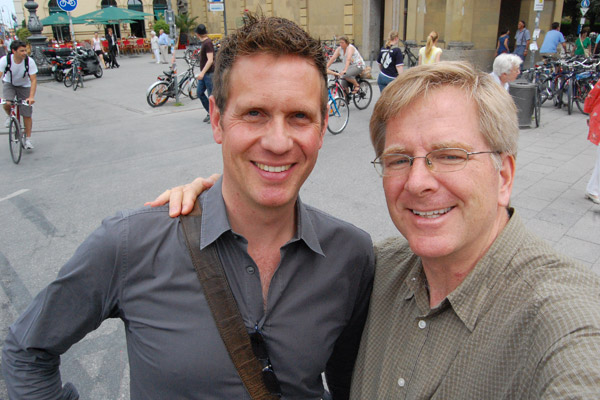
Munich, Where They Say Being Thirsty Is Worse Than Feeling Homesick

For several years, I’ve marveled at how Berlin has eclipsed Munich in urban energy. I was just in Munich, and now it seems to be comfortable just being itself rather than trying to keep up with Berlin.

After the last couple of years — with the elevation of Joseph Ratzinger (the local archbishop) to the papacy, Pope Benedict’s wildly successful visit, and hosting the World Cup — Munich seems revitalized and on a natural high.

And tourists love Munich. Legions of young expat tour guides are in a brutal battle for the tourist dollar. Here in the beer capital of Europe, tours start late — giving backpackers a chance to sober up. Feisty small walking and biking tour companies train guides who then split off and offer tours for free (and just ask for tips at the end of the gig).

I’ve tuned into bike tours in Europe this year, and I like them more than I thought I would. That’s partly because of competition driving prices down to literally zero. A guy named Lenny offers free tours every day from Munich’s main square — and he’s a fine guide. In general, the guides dumb down their lectures with lots of silly legends, and refer to the beloved Frauenkirche as the “church with the Pamela Anderson domes.” But they are introducing many visitors to a facet of Bavarian culture beyond its famed beer.

My favorite local guide joined me for an evening of restaurant visits. Heading for the Hofbräuhaus, I mentioned I’d love to give it some meaning. He thought that was funny and quoted Freud: “Sometimes a cigar is just a cigar.” We climbed to the beer-stained top floor hall where tour groups gather to pay €20 for an all-you-can-stomach buffet of traditional food and a yodel show. I did find some culture downstairs in the main and noisiest hall. The smoke-stained ceiling, repaired and repainted after WWII bomb damage, was an evocative mesh of 1950s German mod — Bavarian colors, chestnuts, food, drink, and music themes. And a slogan arcing across the ceiling above the oom-pah band read, Durst ist schlimmer als Heimweh(Thirst is worse than homesickness).

Wandering through the legions of happy beer-drinkers in the Hofbräuhaus, it occurred to me that, unlike with wine, more money doesn’t get you a better beer. Beer is truly a people’s drink, and you’ll get the very best here in Munich. Connoisseurs have their favorite brews — and to get it, they don’t pay more…they simply go to the beer hall that serves it.

Beer halls always impress me with their ranks of urinals. Munich had outdoor urinals until the 1972 Olympics and then decided to beautify the town by doing away with them. What about the people’s needs? The new law: Any place serving beer must admit the public (whether customers there or not) to use their toilets.

I struggled for a smooth transition from beer-hall toilets to a new synagogue and failed. Sorry.

Munich’s striking new synagogue is locked tight to the public, but it’s still worth a look for its powerful exterior — its lower stones are travertine, like the famous Wailing Wall in Jerusalem, and the upper part represents a tent that held the important religious ware during 40 years of wandering through the desert until Temple of Solomon was built, ending the Exodus. Today (because Germany has agreed to accept religious refugees from the former USSR), the Jewish population of Munich has finally reached pre-Nazi levels — 10,000. And Munich’s Jewish community is understandably enthusiastic about its impressive new center, with a synagogue, school, and museum.