Daily Dose of Europe: Wandering Dubrovnik’s City Walls

While I’m stuck at home, I’m missing some of my favorite walks in Europe. And high on that list is the glorious stroll around the top of Dubrovnik’s perfectly preserved City Walls.

Because of the coronavirus, Europe is effectively off-limits to American travelers. Through this crisis, join me for a quick, daily escape from the headlines as we count down the days until we can head back to Europe.

Anxiety is something I like to sweep away when guiding a tour. And anxiety is not welcome at home either — especially when dealing with a crisis characterized by uncertainty. As we work through these challenging days, I believe a daily dose of travel dreaming can actually be good medicine.

I’ve collected my very favorite travel dreams-come-true to share as a daily dose of embrace-the-world during a time when we’re unable to physically do that. Share this with your friends. Let each daily travel dream be a small dose of the wonder of our world that you can inhale, swirl around, and really enjoy.

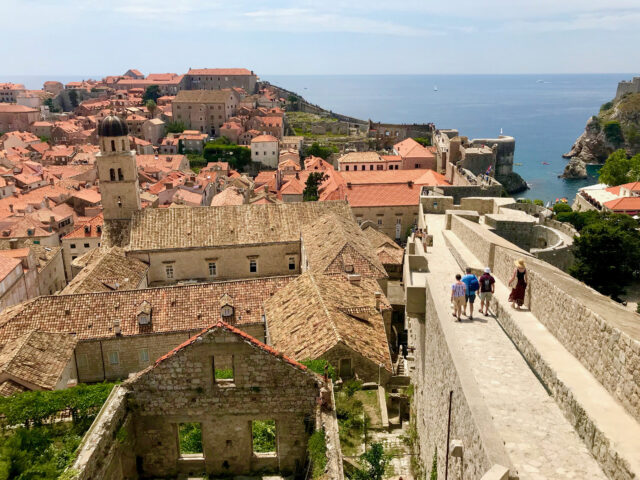
Jostled by the crowds, I walk toward the still-stout medieval wall encircling Dubrovnik, deservedly known as the “Pearl of the Adriatic.” It’s an unforgettable mile-long stroll above the city. While constructed over many centuries, today’s impressive fortifications date from the 1400s, when they were beefed up to defend against the Ottoman Turks.

I jockey my way between cruise-excursion groups that have descended upon the town (these days about 800,000 cruisers stop here each year) and climb the steep steps to the top of the mighty wall. As I begin a slow, circular walk around the fortified perimeter, I’m bombarded with ever-changing views. On one side is a sea of red rooftops; on the other side, the actual sea.

As I approach the wall’s formidable gate — the walled city’s front door — I pause to enjoy a sweeping view of the Stradun, the 300-yard-long promenade that runs through the heart of the Old Town. In the Middle Ages, merchants lined this drag; before that, it was a canal. Today, it’s the city’s pedestrian boulevard: an Old World shopping mall by day and sprawling cocktail party after dark.

Farther along on my rampart ramble, I look down and see a peaceful stone terrace perched above the sea, clinging like a barnacle to the outside of the city wall. Generously shaded by white umbrellas, this is my favorite Dubrovnik escape, a rustic outdoor tavern called Buža. The name means “hole in the wall” — and that’s exactly what customers have to climb through to get there. Filled with mellow bartenders and tourists, Buža comes with castaway views and Frank Sinatra ambience.

Looking inland from my rampart perch, my eyes fall on a random arrangement of bright- and dark-toned red roof tiles. In this complex and once-troubled corner of Europe, even a tranquil stroll comes with a poignant history lesson. After Croatia declared independence from Yugoslavia in 1991, the Yugoslav National Army laid siege to this town and lobbed mortars from the hilltop above. Today, the new, brighter- colored tiles mark houses that were hit and have been rebuilt. At a glance, it’s clear that more than two-thirds of the Old Town’s buildings suffered bomb damage.

Locals are often willing to talk openly about the bombing, offering a rare opportunity to grasp the realities of war from a survivor’s perspective. As I survey the rooftops, my thoughts turn to Pero, my B&B host, who spent years after the war turning the bombed-out remains of his Old Town home into a fine guesthouse.

When I arrived last night, Pero uncorked a bottle of orahovica, the local walnut liqueur. Hoping to write that evening with a clear head, I tried to refuse the drink. But this is a Slavic land. Remembering times when new friends force-fed me vodka in Russia, I knew turning Pero down was hopeless. My host had made this hooch himself, with green walnuts. As he slugged down a shot, he handed me a glass, wheezing, “Walnut grappa — it recovers your energy.”

Pero reached under the counter and held up the mangled tail of a mortar shell, describing how the gorgeous stone and knotty-wood building he grew up in suffered a direct hit in the siege. He put the mortar in my hands. Just as I don’t enjoy holding a gun, I didn’t enjoy touching the twisted remains of that mortar. Pero explained that he gets a monthly retirement check for being wounded in the war, but he got bored and didn’t want to live on the tiny government stipend, so he went to work rebuilding his guesthouse.

I asked Pero to hold up the mortar for a photograph. As he held up the mortar, he smiled. I didn’t want him to smile, but that’s what he did. He seemed determined to smile — as if it signified a personal victory over the destruction the mortar had wrought.

It’s impressive how people can weather tragedy, rebuild, and move on. In spite of the terrors of war just a couple of decades ago, life here is once again very good — and, as far as Pero is concerned, filled with promise.

(This story is excerpted from my upcoming book, For the Love of Europe — collecting 100 of my favorite memories from a lifetime of European travel, coming out in July.It’s available for pre-order. And you can also watch a video clip related to this story: Just visit Rick Steves Classroom Europe and search for Dubrovnik).

A Dozen Great Seaside Bars

With all the intensity in our domestic and political worlds lately, it’s a fine time for an escape — sunset glinting through the drink in your hand. Let’s fantasize about the best seaside bars in Europe. Whenever researching a guidebook chapter covering a port or seaside resort, I work hard to find the most romantic place to swizzle stick your vacation cocktail. Feel the breeze, smell the sea, enjoy the cry of the gulls, and let me share my favorites. These are each worth seeking out. (BTW, I’d love to read about your favorites. Please share.)

In Dubrovnik, Croatia
Cold Drinks “Buža” offers, without a doubt, the most scenic spot for a drink in Dubrovnik. Perched on a cliff above the sea, clinging like a barnacle to the outside of the city walls, this is a peaceful, shaded getaway from the bustle of the Old Town…the perfect place to watch cruise ships disappear into the horizon. Buža means “hole in the wall” — and that’s exactly what you’ll have to go through to get to this place. Filled with mellow tourists and friendly bartenders, Buža comes with castaway views and Frank Sinatra ambience ($4-7 drinks, summer daily 9:00-into the wee hours).

In Rovinj, Croatia
Valentino Champagne and Cocktail Bar is a memorable, romantic, justifiably pretentious place for an expensive late-night waterfront drink with jazz. Fish, attracted by its underwater lights, swim by from all over the bay…to the enjoyment of those nursing a cocktail on the rocks (literally — you’ll be given a small seat cushion and welcomed to find your own seaside niche). Or you can choose to sit on one of the terraces. Classy candelabras twinkle in the twilight, as couples cozy up to each other and the view. Patricia opens her bar nightly from 19:00 until as late as there’s any action. While the drinks are extremely pricey, this place is unforgettably cool ($8-11 cocktails, Via Santa Croce 28).

In Vernazza, Cinque Terre, Italy
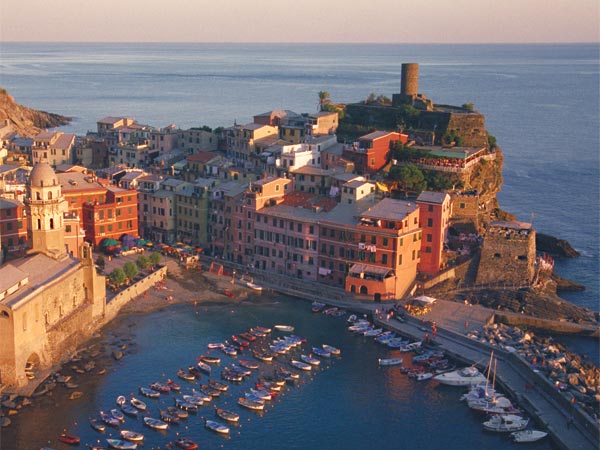
Ristorante Belforte’s tiny, four-table balcony lets you sip your vino della Cinque Terre overlooking the Mediterranean from the edge of a stony castle. You can feel the mist from the surf crashing below on the Vernazza breakwater. And the views of the ancient vineyard terracing all around you makes the experience a highlight. From the Vernazza breakwater, follow either the stairs or the rope that leads up and around to the restaurant.

In Hydra, Greece
Kodylenia’s Taverna is perched on a bluff just over Kaminia’s pocket-sized harbor, which shelters the community’s fishing boats. With a glass of ouzo and some munchies, as the sun slowly sinks into the Saronic Gulf and boats become silhouettes, you can drink to the beauties of a Greek isle escape. It has my favorite, irresistible dinner views on Hydra: This scenic spot lets you watch the sunset with Kaminia’s adorable port in the foreground. Owner Dimitris takes his own boat out early in the morning to buy the day’s best catch directly from the fishermen. For meals, you can sit out on the shady, covered side terrace above the harbor. For drinks, sit out front on the porch. Relax and take in a sea busy with water taxis, hydrofoils that connect this oasis with Athens, old freighters — like castles of rust — lumbering slowly along the horizon, and cruise ships anchored as if they haven’t moved in weeks.

In Istanbul, Turkey
The double-decker Galata Bridge spans the Golden Horn, a historic inlet that separates the old and new towns of Istanbul. And all along both the horn and the bridge, you’ll find dozens of inviting, no-name bars. Find a place to nurse some Turkish specialties: Drink an unfiltered, highly caffeinated “Turkish coffee” (which leaves a thick coating of “mud” in the bottom) or a cup of tea, and suck on a water pipe — called a nargile (NAHR-gee-leh) — filled with flavorful dried fruit. As you enjoy your drink and your hookah, be sure to play backgammon with (or at least among) the locals. If you’re on the lower level of the bridge, you can look up for a fun view of dozens of fishing rods twitching along the upper railing. Watch your head — sometimes an amateur fisherman carelessly lets his catch swing under the top deck. And keep an eye out for the flicker of a little silvery fish, thrashing through the air as it’s reeled in by a happy predator.

In Salema, Portugal
One bit of old Algarve magic still glitters quietly in the sun — Salema. It’s at the end of a small road just off the main drag between the big city of Lagos and the rugged southwest tip of Europe, Cape Sagres. Quietly discovered by British and German tourists, this simple fishing village has three beachside streets, many restaurants, a few hotels, time-share condos up the road, a couple of bars, English and German menus, a classic beach with a paved promenade, and endless sun. The Atlântico — noisy, big, busy, and right on the beach — has long dominated the Salema beach scene. It’s known for fun drinks, friendly service, and a wonderful beachside terrace.

At Burriana Beach, Near Nerja, Spain
Ayo’s is famous for its character of an owner and its beachside all-you-can-eat paella feast at lunchtime. For 30 years, Ayo — a lovable ponytailed bohemian who promises to be here until he dies — has been feeding locals. Ayo is a very big personality — one of the five kids who discovered the Caves of Nerja, formerly a well-known athlete, and now someone who makes it a point to hire hard-to-employ people as a community service. The paella fires get stoked up at about noon and continue through mid-afternoon. Grab one of a hundred tables under the canopy next to the rustic, open-fire cooking zone, and enjoy the beach setting in the shade with a jug of sangria. For $7.50, you can fill your plate as many times as you like. It’s a 20-minute walk from the Balcony of Europe, at the east end of Burriana Beach — look for Ayo’s rooftop pyramid (daily “sun to sun,” paella served only at lunch).

In Villefranche-sur-Mer, France
In the glitzy world of the Riviera, Villefranche-sur-Mer offers travelers an easygoing slice of small-town Mediterranean life. Luxury sailing yachts glisten in the bay — an inspiration to those lazing along the harborfront to start saving when their trips are over. The Chapel of St. Pierre, decorated by artist Jean Cocteau, is the town’s cultural highlight.  Le Cosmo Bistrot/Brasserie takes center stage on Place Amélie Pollonnais with a great setting — a few tables have views to the harbor and to the Cocteau chapel’s facade (after some wine, Cocteau pops). Manager Arnaud runs a tight-but-friendly ship and offers well-presented, tasty meals with good wines (I love their red Bandol).

In Conwy, Wales
This Welsh town, watched over by its protective castle, has a particularly charming harbor. Conwy was once a busy slate port (back when much of Europe was roofed with Welsh slate, Conwy was a boomtown). But today the harbor is a laid-back area that locals treat like a town square. On summer evenings, the action is on the quay (pronounced “key”). The scene is mellow, multigenerational, and perfectly Welsh. It’s a small town, and everyone is here enjoying the local cuisine — “chips,” ice cream, and beer — and savoring that great British pastime: torturing little crabs. Facing the harbor, The Liverpool Arms pub was built by a captain who ran a ferry service to Liverpool in the 19th century. Today it remains a salty and characteristic hangout.

In Staithes, England
A ragamuffin village where the boy who became Captain James Cook got his first taste of the sea, Staithes (pronounced “staythz”) is a salty jumble of cottages bunny-hopping down a ravine into a tiny harbor. This refreshingly unpretentious town on the North Sea is gloriously stubborn about not wooing tourists. The town has changed little since Captain Cook’s days. Seagulls seem to have picked the barren cliffs raw. There’s nothing to do but stroll the beach and nurse a harborside beer or ice cream. The Cod and Lobster, overlooking the harbor, has scenic outdoor benches and a cozy living room warmed by a coal fire. In nice weather, the best option is to enjoy a drink, snack, or light meal (i.e., fish-and-chips) sitting at an outdoor table fronting the harbor.

In Solvorn, Norway
Walaker Hotel, a former inn and coach station, has been run by the Walaker family since 1690 (that’s a lot of pressure on eighth-generation owner Ole Henrik). The hotel, set right on the Lustrafjord, has a garden perfect for relaxing and, if necessary, even convalescing. In the main house, the halls and living rooms are filled with tradition. (Patriotic hymns sit at the piano.) While great for its accommodations, the hotel also serves dinner and drinks. I love to savor my coffee and dessert on the balcony with a fjordside setting — mesmerized by Norwegian mountains. Rather than jagged, they’re bald and splotchy, with snowfields on top and characteristic cliffs plunging into inky fjords. One night I took my strawberries à la mode onto one such porch and sat there long after my coffee cooled and ice cream melted. After dinner, I strolled through the village enjoying the blond cherubs running barefoot through the stalled twilight. Cobbled lanes led past shiplap houses to rock cliffs — their gullies and cracks green with trees.

In Barcelona, Catalunya, Spain
Before the 1992 Olympics, Barcelona’s waterfront was an industrial wasteland nicknamed the “Catalan Manchester.” Not anymore. The industrial zone was demolished and dumped into the sea, while sand was dredged out of the seabed to make the pristine beaches locals enjoy today. The scene is great for sunbathing and for an evening paseo before dinner. It’s like a resort island — complete with lounge chairs, volleyball, showers, bars, WCs, and bike paths. Every 100 yards or so is a chiringuito — a shack selling drinks and light snacks. Originally these sold seafood, but now they keep locals and tourists well-lubricated. It’s a very fun, lively scene on a balmy summer evening. This is a nice way to escape the claustrophobic confines of Barcelona to enjoy some sea air and the day’s final sunrays. A double-decker boardwalk runs the length of the beach, with a fine walkway up above. There’s a series of great seafood restaurants and cocktail bars with romantic, candlelit, beachfront seating tucked down below.

Debating Dubrovnik and Making TV

Our TV show on “Dubrovnik and Balkan Side-Trips,” which debuts this month on public television, is one of my favorites of this new series. The editor’s cut came in at more than two minutes too long. Here’s an e-mail exchange I had with our team on the painful chore of cutting it to size. It’s between me, Steve Cammarano (our television editor), and Cameron Hewitt (co-author to my guidebook on this region and this episode’s co-writer). The reference to “kill your babies” is the slang editors use when writers can’t part with something adorable, even though it doesn’t fit the structure of an article, book, or script. It’s graphic, but to writers, it almost seems appropriate. This exchange, while a bit wonkish perhaps, gives a peek at the debates that go on behind the scene as we make these shows ‘ and also illustrates how fortunate I am to work with such talented people.

———-

To: Rick and Cameron

From: Steve

The “Dubrovnik and Balkans Side-Trips” show is ready for you to view. It is running 2:30 long, and nothing seems obviously cuttable. So, since it’s a “kill your babies” decision, Simon [the producer] and I thought we’d let you decide which of the little babies to slaughter. (We’ll nickname you Herod afterwards!) Let me know what you think. After you get a chance to look at it, I’ll give Cameron a file or DVD so we can get his comments too and consolidate all cuts/changes.

Thanks, Steve

———-

To: Steve

From: Rick

Here’s the Dead Baby Cemetery. Cut these sequences to save the necessary time:

[8 OC] Locals consider themselves a unique mix of Slavic and Roman culture. When Dubrovnik was just a small town in the seventh century, this main drag was a water way. Romans fleeing from the invading Slavs lived on this side, which was a fortified island. And eventually, the Slavs settled on the mainland. In the 11th century, the canal was filled in, the towns merged, and Dubrovnik’s culture blossomed.

[11] The Sponza Palace is the finest surviving example of Dubrovnik’s Golden Age in the 15th and 16th centuries, combining Renaissance and Venetian Gothic styles. Stepping into its stately courtyard takes you back to that illustrious age.

[13] In the Middle Ages, the city’s monasteries flourished. Today tourists escaping the heat explore these peaceful, sun-dappled cloisters and their modest museums.

[14] Religious art and fine reliquaries stand as evidence of the town’s importance in its heyday. Paintings from the “Dubrovnik School” show the Republic’s circa-1500 answer to the art boom in Florence and Venice. This canvas shows old-time Dubrovnik ‘ looking much like it does today.

[18] We’re staying at a small guesthouse at the top of town. Throughout Croatia, sobe ‘ that’s rooms for rent in private homes ‘ are a much better value than big hotels. Ours is run by Pero.

[19 Pero sound bites: walnut grappa, the war, six month siege, no food, no electricity, house bombed, 200 years in family, couldn’t just walk away, rebuilt, made guesthouse, now the tourists are back.]

This was really tough but I feel Dubrovnik is a well-worn topic and what we did in Montenegro and Bosnia was really ground-breaking. I really like Cameron’s presence in the show and wouldn’t cut a word of that. By cutting this, by my count, we save 2:25.

Other comments (not related to our time concerns): Could we include one more painting of a ship in a storm to make that bit more vivid? When the script says “gave the place its name ‘ Montenegro” I envision the mountain-ringed basin looking inland with the craggy rocks and the inhospitable expanse. Do we have something like that to consider? If you think the woman is inaudible for #69 I could read the VO for the park-turned-cemetery. It might save time too. I miss the map of the Serb Republic within Bosnia-Herz, and I miss the cruise ship reality bit. But there just isn’t time. Again, nice work.

Thanks, Rick

———-

To: Rick and Steve

From: Cameron

Thanks for sending this list, Rick. I discussed with Steve and took a careful look at the show/script. Here’s my take:

First, this is yet another fantastic show. Gorgeously shot by Karel and artfully edited by Steve. I wasn’t sure how we’d cram so much interesting content into one package and still let it breathe, but Steve pulled it off. The sequence near the end, juxtaposing the church and the mosque crowd over pensive music, is about the most powerful thing I’ve seen regarding this conflict. The show succeeds in grappling with the realities of war head-on, without glossing over painful truths, while still being entertaining, easy to comprehend, and a lively travelogue…all this and even-handed, too. Great work, everyone!

I agree with most of Rick’s suggested cuts. The Sponza Palace can definitely go; the monasteries are also optional, though I find them more interesting/important/pretty than the palace. If we cut both, however, the sightseeing content in Dubrovnik gets very thin; it’d be nice to save one or the other.

Rick’s on-camera about the filled-in canal is also somewhat deletable, though I like it. I’d try to keep it unless it’s essential to cut.

On the whole, when you add up all of your cuts, it seems like Dubrovnik is really being gutted. In your version, Dubrovnik ‘ which, after all, is the title and main destination of the show ‘ really gets short shrift. You mention that Dubrovnik is well-worn. Well, maybe for those of us who’ve traveled a lot. But in terms of the TV audience, this is your one and only shot at it, and it’d be a shame to do it halfway. Paris and London are well-worn, but they still deserve to be covered in a TV show as if for the first time.

So I’d lobby to keep Pero. I think that sequence is very effective. Pero comes off as likeable and articulate. And it’s very powerful to see the two of you standing in a formerly destroyed house holding a mortar.

More importantly, big picture: If we cut Pero, we throw off the delicate balance that this show has achieved. When you think about the local people you “interview,” we’ve currently got a Croat, a Montenegrin, a Serb, and a Muslim. I think it’s critical to afford each group a voice. Including Pero offers a powerful symmetry to this show: We see the gorgeous town of Dubrovnik, then hear about the war from someone who lived through it; later, we see the pretty town of Mostar, then hear about the war from someone who lived through it. If we leave out Pero, the only real talk of Croats is as the aggressors in Mostar. I think it’s essential to also show a Croat (Pero) as a resilient victim. Pero also personalizes the war in Dubrovnik in a pretty dramatic way.

So what’s to be done? It’s clear to me that ‘ both in terms of the quality of the sequences, and in terms of the overall balance of the show ‘ the most expendable bit is Cetinje. If you simply cut everything after the explanation of the name “Black Mountain,” it’s a tidy transition out of the country.

I really like Stefan, and I’d be very sorry to see him go. And, Rick, I know you have an affection for Cetinje. But let’s be honest: Cetinje is neither particularly attractive, nor historically interesting. At best, it’s a depressed, once-great town that gets a quirky footnote in history. And the church/monastery Stefan guides you through pales in comparison to the one in Trebinje. It feels like one Orthodox church too many (especially right in a row). I’d rather have an articulate, philosophizing priest explaining a gorgeous Orthodox church than a tour guide explaining a hokey artifact in a blah one. If you’re trying to flesh out a thin show, that’s one thing. But we have the opposite problem. If anything should get short shrift in this overstuffed show, it’s Montenegro ‘ not Dubrovnik.

Getting back to the issue of providing balance: If we take out Stefan, we’ve still got a Croat (Pero), a Serb (Father Drazen), and a Muslim (Alma). That feels right to me, as you promise in the opening OC, “We’ll get to know three major groups of the former Yugoslavia ‘ Croats, Serbs, and Muslims.”

If we cut Cetinje, it should get us closer to the time we need. We could also cut some of the Dubrovnik bits you suggested. I’d also nominate selectively trimming some of the interview sections. For example:

–Father Drazen is great, but one question/answer that could go is the one about “pluralism.” I found his answer too pat (“sure, sure, sure!”) and frankly unconvincing; his response to the next question, about “Balkanization” is similar but far more revealing (“we have to work hard at it”), and does the job better than the pluralism answer.

–The section with my lines conveys a lot of hard-to-digest content and is pretty dense. But we could cherry-pick a few lines in there to cut. For example, the explanation of why these wars happened (age-old hatreds vs. manipulative politicians) is an important point, but difficult to convey succinctly. It could go.

–I can see where it might work to trim down Alma’s talk in the cemetery, if you want, and cover some of that with your voice-over.

Rick, I feel strongly about the Cetinje issue. I really think cutting Cetinje would make this a more powerful show ‘ and a more balanced, nuanced, and thought-provoking one.

I hope this helps. I might give the show another look to see if there are any (minor) factual bits that need to be tweaked.

Thanks for listening, Cameron

———-

To: Steve and Cameron

From: Rick

Thanks, Cameron. You’d make a good lawyer. OK, I’ll buy keeping Pero. But I’d like to cut all the other proposed bits from Dubrovnik. That means we still have to cut something to make Steve’s time needs. I agree that the kid in the Cetinje church is cuttable, and the bit about pluralism. So, please, cut all but Pero in Dub, cut the church (only) in Cetinje, and cut just the line about pluralism. What does that leave us, Steve, for further cuts needed?

Rick

———

To: Rick and Cameron

From: Steve

Rick, I’ll take a look at what that would mean time-wise for your revised, proposed cuts. After taking into consideration both yours and Cameron’s comments, I’d like to make my own case. I agree with Cameron’s proposal to cut Cetinje entirely for the reasons he states, and cutting just the church/relic sequence makes Cetinje even more unnecessary in the show. If we cut all of Cetinje we drop 1:25. In terms of Dubrovnik, I would cut the monasteries and art because I feel they are less than impressive and doing so would connect your previous on-camera to the walls of Dubrovnik better (the OC was about the period when Dubrovnik was growing/becoming prominent, and the walls are the most visible and impressive sign of that). Losing the monasteries and art would cut around another 30 seconds. And I also feel very strongly that we should keep Pero in the show. Finally, I agree with Cameron’s suggested trim of Father Drazen when he speaks of pluralism. Depending on where I cut it, that gets us somewhere between 15 and 25 seconds. That puts us right in the pocket, time-wise. I can probably get it to time after that with my usual final pass of trims and fine cutting. I think this would make the best show and get me where I need to be time-wise. I’ll look into where your proposed cuts would leave us in terms of show length, Rick. Let me know what you guys think.

Thanks, Steve

———-

To: Steve and Cameron

From: Rick

Hello all,

Cutting Cetinje will come back to haunt you because I think we might actually have to return for an entire show. But, I’m clearly outvoted so I’ll go with that. How about this: Cut Cetinje altogether (1:25), cut monastery and art, cut pluralism. Does that get us to the goal line? I am ambivalent about the palace.

Why don’t Steve and Cameron huddle with this last input from me? The Dubrovnik thing is complex. Proceed from the starting point of what time we need to save without Cetinje and pluralism. Please tell me, without Cetinje and pluralism, how you propose to make it fit with just Dubrovnik cuts after that.

Thanks, Rick

———-

To: Rick and Cameron

From: Steve

Rick,

I’ve cut Cetinje and pluralism, and it leaves us 49 seconds long. Of your earlier proposed Dubrovnik cuts the OC about Slavs/Romans is 23 seconds, Sponza Palace is 14 seconds, and the monasteries and art are 30 seconds. Keep in mind that I should be able to get another 10-15 seconds of fat out when I take a final pass, so we could get most of the way by cutting one or two of these and find the remaining time in trims. We can easily figure it out after you get home. (I’ll begin working on “The Best of Cetinje” show after Oslo…)

Steve

———-

To: Rick and Steve

From: Cameron

Hey Rick,

Thanks for being open to our suggestions. It’s going to significantly strengthen an already stellar show! (Hmmm. I can see it now: “The Miserable Mediterranean: Cetinje, Gythio, and Genoa.” I’ll get working on a script…)

Cameron

———-

To see what ended up on the cutting room floor, watch this clip about Cetinje.
Nomads and Cuff Links

I was on the terrace of a fancy Dubrovnik hotel in jeans and a T-shirt. A big shot was at the next table with his hair just right, a coat and tie, and fancy cuff links. I thought, wouldn’t it make more sense if the poor and powerless were the ones who had to dress up like that?

In Dubrovnik, the cruise ship crowds were so intense that we literally could not do our filming in the middle of the day. The city was inundated…a human traffic jam. I got a bit down. Then, as is so often the case, things cleared out and the town regained its charm. Those who stay after the tenders have stopped ferrying people back and forth enjoy a town the thousands who blitzed it from their ship have no appreciation of. It’s sad to think that the vast majority of Dubrovnik’s visitors see a hellishly crowded city and probably leave with the wrong impression. Even if they think they liked Dubrovnik, they didn’t really get to meet it.

There’s a buzz about how humble little Montenegro is emerging as “the new Mediterranean hotspot.” The tourist board there put my film crew in an “emerging hotspot” designer hotel on the Bay of Kotor. It was so elite and reclusive that I expected to see Idi Amin poolside. (Actually, I think he’s dead…but I thought it would be cool if they had a blow-up version of him just parked next to the pool on a lounge chair with a cocktail.)

The hotel, open just a month, was a comedy of horrible design. We felt like we were the first guests. My bathroom was far bigger than many entire hotel rooms — but the toilet was jammed in the corner. I had to tuck up my knees to fit between it and the sink cabinet. The room was dominated by a big Jacuzzi tub for two. I am certain there wasn’t enough hot water available to fill it. I doubt it will ever be used, except for something to look at as you’re crunched up on the toilet. My bed was vast, but without a side table light or even access to a light switch. A huge rain storm hit with fury enough to keep the automatic glass doors opening and closing on their own. Nothing drained — a torrent ran down the stairs outside the front door, and everything was dripping. With the rain, a horrible smell drove us out of our rooms. Just as we sat down to our breakfast, the storm knocked out the electricity. Looking past the candelabra on our table, the overwhelmed receptionist explained with a shrug, “When it rains, there is no electricity.” The man who runs the place just looked at us and said, “Cows.” (I think he meant “chaos.”)

Looking in the mirror the other day, I noticed how white my teeth looked. It reminded me that when I asked my dentist the best way to get my teeth whitened, he said, “Get a tan.” It’s so great to be getting sunshine and exercise on the road.

We drove by a Gypsy camp switchbacking from the Mediterranean coast up into the interior of Montenegro. Our guide explained the local Gypsies don’t want to go to school and don’t want to work. I commented that they don’t want their children to be taught lifestyles that threaten their nomadic ways. The camp was absolutely filthy. Our guide said, “That’s their aesthetic.” I couldn’t really imagine a society with an aesthetic to be sloppy…as if moms bark at her kids, “You can’t go out to play until you mess up your room.”

All over our world, nomadic cultures like the Roma (or Gypsy) culture are struggling — I think because they’re at odds with societies that require fences, conventional ownership, and non-nomadic ways. I wonder how many nomadic cultures (American Indians, Eskimos, Kurds, Gypsies) will be here in the next generation.

Cresting the mountain into the Montenegrin heartland, we came to a village that looked like it had no economy. Then a man took us into a big, blocky, white building that looked like a giant monopoly house. He opened the door and we stepped inside, under tons of golden ham peacefully aging. It was a smokehouse — jammed with five layers of hanging hamhocks. Our Montenegrin friend stoked up his fire, filled the place with smoke, and we filmed. More industry than you realize hides out in sleepy villages.

Photos Help Tell the Story

Wrapping up a great trip, a few photos add to the story. Note also a number of photos added to entries over the last two months.

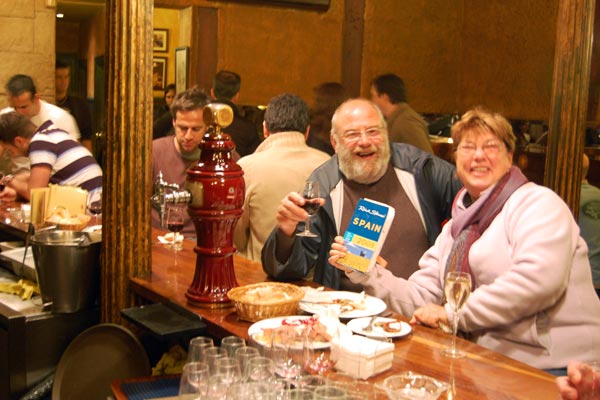
Travelers enjoying tapas and their guidebook. When blitzing tapas bars in Madrid’s best neighborhoods, it’s fun to find happy travelers putting their guidebook to good use.
Enlarge photo

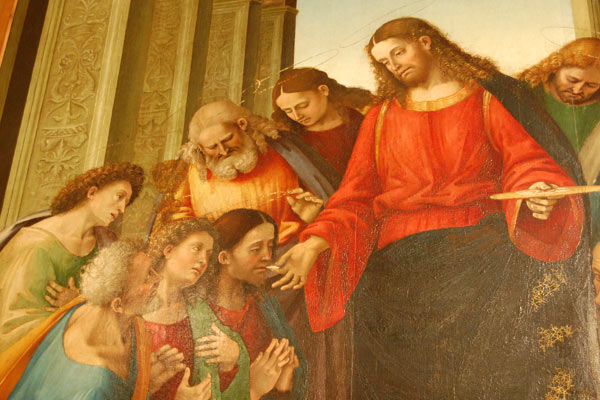
An amazing painting in Cortona.
Enlarge photo

Bright-eyed and bushy-tailed, I open the shutters and greet a new day in Volterra. In a week I meet the TV crew…
Enlarge photo

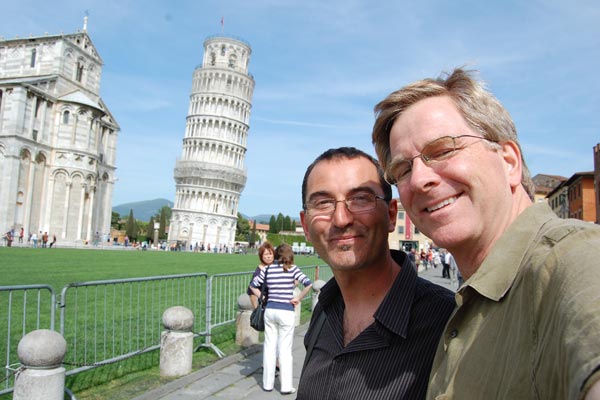
Dottore Vincenzo Riolo in Pisa taught me volumes about his town and is one of many excellent new local guides I met and will recommend in my guidebooks.
Enlarge photo

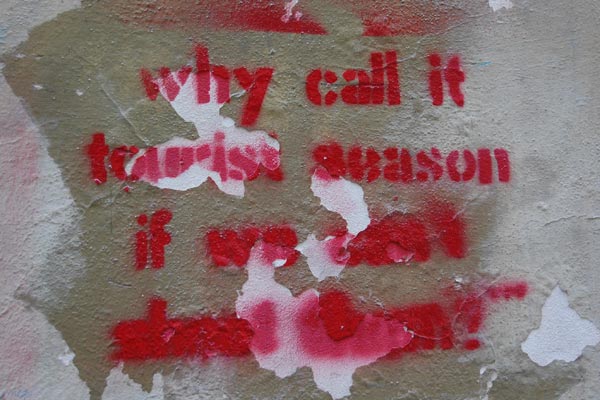
Why call it tourist season if we can’t shoot them? A scary welcome in Florence’s Oltrarno district.
Enlarge photo

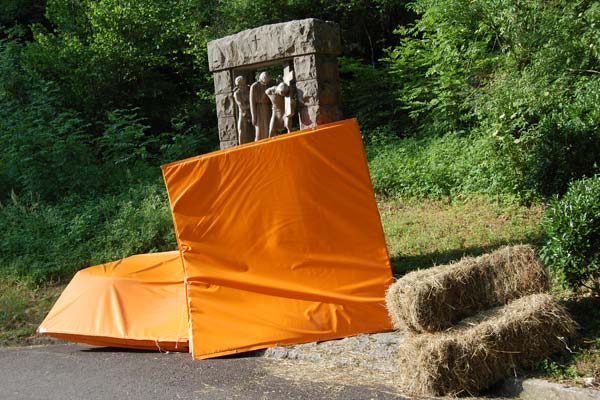
Station of the Cross, padded for protection, along the route of a bike race in Slovenia.
Enlarge photo

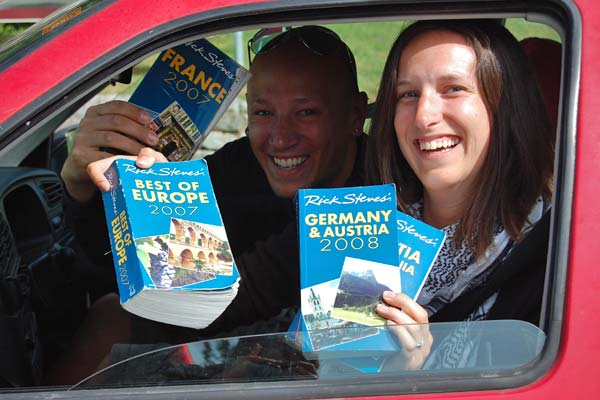
Happy road trippers with favorite guidebooks in Slovenia.
Enlarge photo

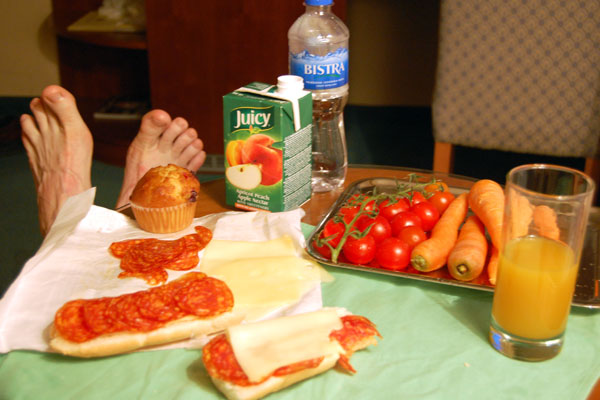
Cheap and delicious picnic, relaxing in my Zagreb hotel room.
Enlarge photo

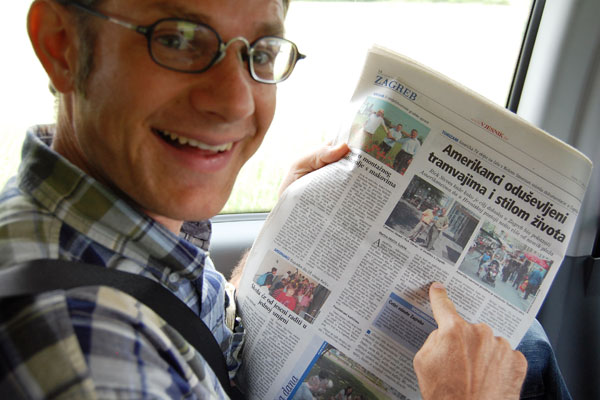
Cameron Hewitt (co-author of our Croatia & Slovenia guidebook) reads about himself, me, and our American film crew in a Zagreb newspaper. I guess an American film crew in Zagreb is newsworthy.
Enlarge photo

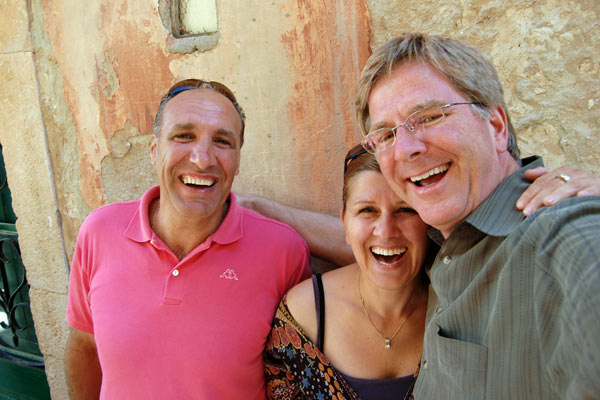
Croatian B&B hosts—clicking with new friends in Korcula.
Enlarge photo

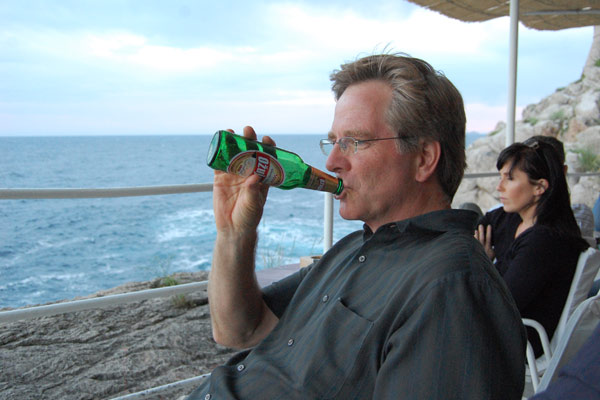
Day #70…Trip over, one last beer to enjoy a Dubrovnik vista and celebrate a smooth and productive trip before flying home.
Enlarge photo