I’m just wrapping up a trip through Germany, France, and Switzerland and I’ve got lots of travel lessons to share with you over the next several days. First up is the Black Forest. (Stay tuned for more tips from Alsace, Verdun, Strasbourg, the great Swiss cities, and Lausanne — and then I’ll be packing you along on a cruise across the Mediterranean!)
The Black Forest (“Schwarzwald” in German) is a range of hills stretching along the French border from Switzerland for about 100 miles to the north. Ancient Romans found the thick forests here inaccessible and mysterious, so they called it “black.” Germans and tourists alike are attracted to this most romantic of German regions — famous for its mineral spas, clean air, hiking trails, cheery villages…and cuckoo clocks. There seems to be a region-wide competition for the biggest cuckoo clock of all, and it can get pretty touristy. At this roadside attraction, tourists — often with wiener dogs in tow — stop, pop in a coin, and watch the cabin-sized clock spring (sluggishly) to life.
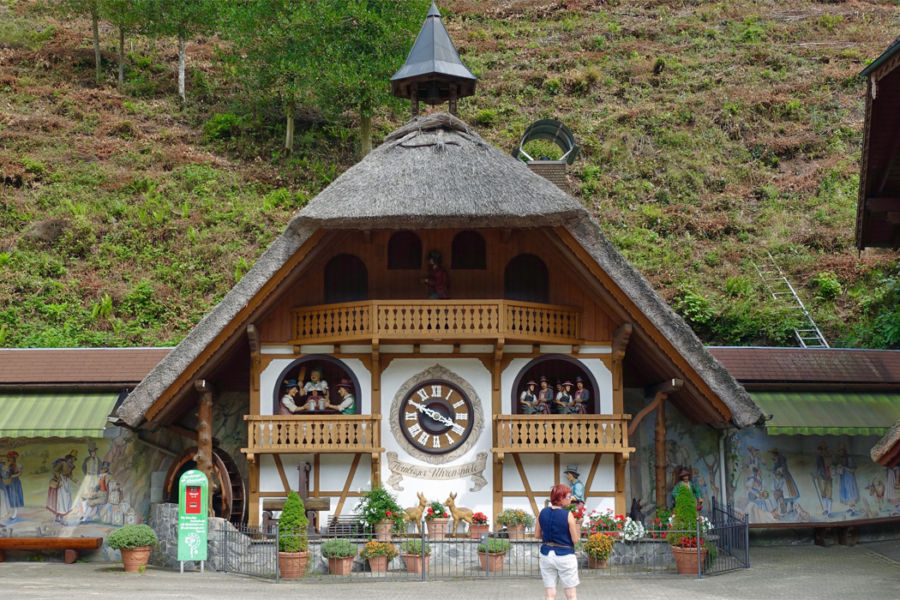
Until the last century, the Schwarzwald was cut off from the German mainstream. The poor farmland drove medieval locals to become foresters, glassblowers, and clockmakers. Today, the Black Forest is where Germans come to recuperate from their hectic workaday lives, as well as from medical ailments — often compliments of Germany’s generous public health system. (When I try to explain the debate over national health care in my country — so rich, yet so greedy —my German friends can only respond, “cuckoo cuckoo.”)
I visit the region regularly to research and update my Germany guidebook. While finding good places to sleep wasn’t on my research list this time, I stumbled onto a wonderful place in Baden-Baden that I just had to check out and add to the book.
Baden-Baden is the major spa town of the Black Forest and, while pretty touristy, it has a delightful abbey that also operates as a guesthouse. Lichtentaler Abbey, an active Cistercian convent founded in 1245, welcomes the public into its tranquil, gated world. And since 1245, here in what they call “a school for the service of the Lord,” the Cistercians have embraced the teaching of St. Benedict: to live with moderation, show compassion for all, be unselfish, and follow the Golden Rule. The abbey has survived nearly eight centuries of threats, including the suppression of monasteries in Napoleonic times and the destruction of both world wars. When you walk through its gate into the courtyard, cradled by trees and so peaceful, you sense that the place is blessed.
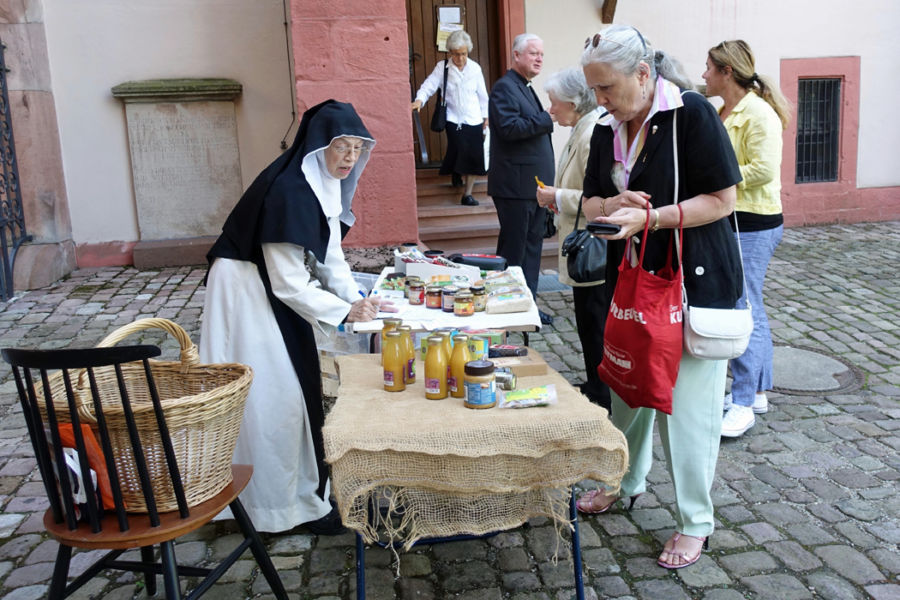
As they have for centuries, nuns at Lichtentaler Abbey sell the things they make and cook.
Here’s the new guidebook listing for the abbey’s guesthouse:
Kloster Lichtenthal Guesthouse lets you be a part of the peaceful cloistered world of a working Cistercian abbey, and your money supports the work of the sisters here. Its 45 monastic-chic rooms offer meditative simplicity under historic beams. Their rooms with only a sink (and access to modern bathrooms down the hall) cost about a third less than the en-suite rooms. As this is an abbey, there is no TV and no Wi-Fi. When the abbey gate closes at 20:00, you feel quite special (tel. 07221.5049119, gaestehaus@abtei-lichtenthal.de).
Freiburg and Baden-Baden vie to be the leading home-base city for those visiting the Black Forest. While Baden-Baden has an old spa-and-casino elegance, Freiburg is much younger and livelier. I explored Freiburg with Simone Brixel, a local guide who always makes my visits much more enjoyable and meaningful.

The Feierling microbrewery is a top local hangout in Freiburg. On warm summer evenings, their biergarten across the street offers cool, leafy shade, great beer, cheap dishes of cold cuts, and a bustling atmosphere. But when the rain hits, everybody scrambles.

In the last few years, Germany has experienced freakishly hot and muggy summers. Routinely, the day is hot and muggy and then, just when people are sitting down to dinner in the beer gardens, a monsoon-type thunderstorm unleashes buckets of rain and diners grab their mugs and scramble. When you feel that weather pattern coming on (a tiny version of what flooded Houston)…don’t get too comfortable. It never used to be this way.

My new favorite small town in the Black Forest (to rival Staufen) is little Wolfach. Nestled in the forest on the Kinzig River, the town is essentially one delightful main street lined with fountains, fine facades, and inviting shops and cafés. While things are livelier on market days (Saturdays and Wednesdays), the whole place generally feels like it’s on Valium.

At a museum in a castle at the south end of Wolfach, visitors can learn about the town’s history as an old logging town. In centuries past, log rafters were a big part of this town’s economy — the German equivalent of American cowboys who went wild on payday after herding their cattle to market. They’d lash together hundreds of logs into rafts as long as football fields and float them all the way to Amsterdam, where they were sold to Dutch shipbuilders and used as foundation pilings.
Staufen, another cute little Black Forest town, has long been a favorite of mine. Just a half-hour south of Freiburg, it is hemmed in by vineyards and watched over by the ruins of its protective castle. A quiet pedestrian zone of colorful old buildings and reasonably priced hotels once made it a delightful home base for exploring the southern trunk of the Black Forest. But on this visit, I found a town in crisis. Here’s how I wrote it up for the next edition of my Rick Steves Germany guidebook:
Geothermal Probe Sinks Staufen: A few years ago, Staufen proudly embarked upon a green and innovative plan to drill 460 feet down and tap into a geothermal power source. For a few weeks, things worked great. Then buildings started to show cracks. Catastrophically, the drills pierced a layer of anhydrite, breaking into an underground reservoir. When the anhydrite came into contact with water, it became gypsum and expanded, causing much of the town to sink and then rise. Buildings were breaking as the ground shifted up to four inches a year. The entire town’s underground infrastructure needed to be dug up and replaced and hundreds of buildings were suddenly structurally unsound. Insurance companies and the government are at an impasse for the cost and no one can sell anything. It’s a terrible mess. On the broken facade of the town hall, a big Band-Aid reads, “Staufen darf nicht zerbrechen” (“Staufen will not be broken”). Best wishes to the people of beautiful little Staufen as they work through this tragedy.
