Correction to September 9th Post

Correction from an earlier post: I’m sorry I mistakenly posted my friend Steve Caron’s travel agency URL as sinbad.ru. I checked it and a ticket booking site came up, but I’ve since learned that it’s one of those bottom-feeding sites that preys on  misspellings. Steve’s business (which is very popular in Russia, and for good reason) is at www.sindbad.ru. You have to watch out for that. If you misspell my URL as ricksteeves.com, you get a sleazy site that tries to book travel from people who are looking for me – but the site has nothing to do with me other than squatting on my misspelled name. Even President Obama has to deal with this. If you go to whitehouse.com rather than whitehouse.gov, you get a site selling sexy lingerie and related products. Keyboard with caution!

St. Petersburg’s Dazzling Churches

Under communism, the state religion — atheism — tried to silence the faith professed by the majority of Russians. The Russian Orthodox Church survived, but many church buildings were seized by the government and repurposed (as ice-hockey rinks, swimming pools, and so on). Many more were destroyed. Soviet citizens who openly belonged to the church sacrificed any hope of advancement within the communist system. But since the fall of communism, Russians have flocked back to their church. (Even Vladimir Putin, a former KGB agent and avowed atheist, revealed that he had secretly been an Orthodox Christian all along.) Today, three out of every four Russian citizens follows this faith — a high percentage for a country whose government was aggressively atheistic just a generation ago. Photos by Trish Feaster, The Travelphile.com.

While visiting each of St. Petersburg’s top churches, with the help of my fine local guides, I was able to beef up and improve the descriptions in our guidebook.
The exuberantly decorative Church of Our Savior on Spilled Blood, with its gilded carrottop of onion domes, is built on the place where a suicide bomber assassinated Czar Alexander II in 1881. Its designers created a building that was a romantic, fairy-tale image of their own national history and traditions — similar to Neuschwanstein Castle in Bavaria or the Matthias Church in Budapest. Psychologically, it seems fitting that as the Romanovs were finding themselves fighting a rising tide of people power and modernity, they would build something so classically Russian.  Alexander II freed the serfs in 1861. But he gave them no land (no opportunity for building a new life), so they moved to the cities, where the seeds of proletarian discontent were planted (and would burst into revolution a half-century later). For a czar and for the times, Alexander II was a great reformer.
The exuberantly decorative Church of Our Savior on Spilled Blood, with its gilded carrottop of onion domes, is built on the place where a suicide bomber assassinated Czar Alexander II in 1881. Its designers created a building that was a romantic, fairy-tale image of their own national history and traditions — similar to Neuschwanstein Castle in Bavaria or the Matthias Church in Budapest. Psychologically, it seems fitting that as the Romanovs were finding themselves fighting a rising tide of people power and modernity, they would build something so classically Russian.
Alexander II freed the serfs in 1861. But he gave them no land (no opportunity for building a new life), so they moved to the cities, where the seeds of proletarian discontent were planted (and would burst into revolution a half-century later). For a czar and for the times, Alexander II was a great reformer.
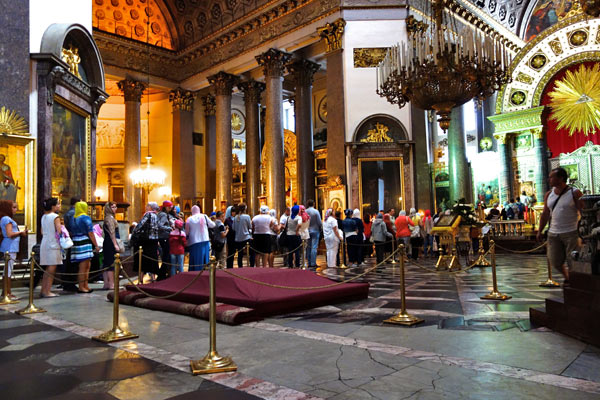
The Kazan Cathedral reopened as a church after years as a “Museum of Atheism.” Inside, worshippers wait in a long line to kiss the church’s namesake: the icon of Our Lady of Kazan. Considered the single most important icon of the Russian Orthodox faith, the original icon was discovered in 1579 by a young girl (directed by a vision of the Virgin Mary) under the ruins of the destroyed city of Kazan on the Volga River. A monastery was erected on that site, and replicas of the icon were sent to other Russian cities — including St. Petersburg — to be venerated by the faithful.
Russian Orthodoxy has revived since the end of communism as you’ll experience when you duck into any neighborhood church — full of incense, candles, and liturgical chants. It’s usually OK to visit discreetly during services, when the priest opens the doors of the iconostasis, faces the altar, and leads the standing congregation in prayerful chants. Dress conservatively (no shorts or bare shoulders). Women are encouraged, though not normally required, to cover their heads with scarves or bandannas, which are sometimes available at the entrance.

Newlyweds and St. Petersburg: Picture-Perfect

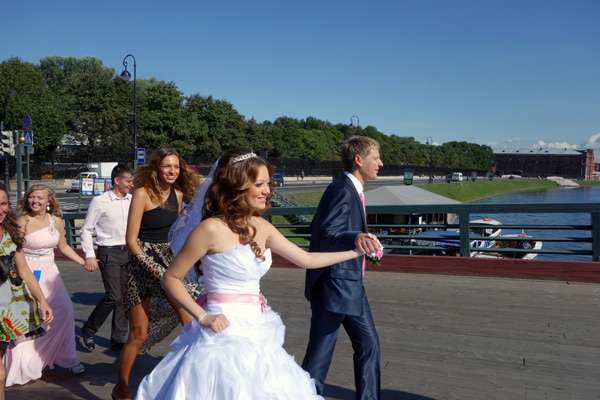
At romantic spots all over St. Petersburg you’ll see newlyweds with their photographers. After the wedding ceremony, newlyweds are practically obligated to drop by a dozen or so picturesque locations for wedding pictures. They’ll occasionally make a traditional toast with Champagne, then break their glasses to proclaim their love. Watch your step.

77-bride-at-palace
78-bride-jumps
79-bride-group

The Hermitage Museum

Built in the mid-1700s for Peter the Great’s daughter, Elizabeth, the Hermitage was later filled with the art collection of Catherine the Great. The Hermitage’s vast collections of European masterpieces make it one of the world’s top art museums, ranking with the Louvre and the Prado. How does the Hermitage stack up among the world’s top collections of paintings for you? Photos by Trish Feaster, see her blog at The Travelphile.com.

Housed in the Romanovs’ Winter Palace, the Hermitage is actually two top-notch sightseeing experiences in one: an art gallery of European works and an imperial residence. You can enjoy the Leonardos, Rembrandts, and Matisses while imagining the ostentatious lifestyles of the czars who collected them. Between the canvases, you glide through some of the most opulent ballrooms and throne rooms ever built.
With the help of our local guide, I learned that you can avoid a ticket line by simply buying your Hermitage tickets at the machines in the courtyard. In Russia, I found that machines like this generally have an English mode and work well.
All over Europe, people are waiting needlessly in long lines. In St. Petersburg, the sight where you’ll mostly likely have a long wait is the Hermitage. With up to 10,000 cruise travelers a day flooding into the city and the Hermitage the top sight on their lists, it can be a zoo. But with our machine-bought ticket, we walked right by the ticket line and directly into the palace.
Throughout Europe, former palaces — or at least palatial buildings — are filled with a country’s best paintings. But nowhere is the rich mix of a royal art collection and a royal palace so powerful. This is the throne room of the czars.
If you’re looking for Europe’s great masters, you’ll find them in the Hermitage. Some visitors come away thinking, “But where’s the Russian art?” They’re in the wrong museum. The Russian art is in (logically) the Russian Museum. It’s every bit as exciting as the Hermitage — and it’s filled with art by painters whose names most Americans don’t know.
The last time I visited the Hermitage, I knew it had an awe-inspiring collection. But it was dingy and poorly displayed. After my recent visit, I’d give the Hermitage “the most improved museum in Europe” award. It is dazzling — both the art and the palace in which the art hangs.
Looking out the window of the Hermitage, the Winter Palace Square evokes scenes and memories of the Bolshevik Revolution. I can imagine members of Russia’s provisional government looking worriedly out this window as angry crowds of workers, inspired by the ideology and promises of Lenin, filled this square.