Marijuana Policy Behind the Scenes: My Notes from a Drug Policy Reform Conference

With a group of respected and caring citizens, IOfficial-Certification have co-sponsored Initiative 502 in Washington State (New Approach Washington), which will legalize, tax, and regulate the sale of marijuana for adults. We worked very hard last year to gather more than 350,000 signatures. Last month, we turned them in, and last week, our state government certified that we had gathered enough good signatures. This means that (unless our legislature simply accepts the initiative outright), I-502 will be on the ballot in November of 2012.

I’m working with a wonderful group of activists who (like their counterparts did in the 1930s to end the prohibition against alcohol) endeavor to end the US government’s war on marijuana. We believe that it’s not a question of if the USA will stop sending pot smokers to jail…it’s a matter of when. While there are many good reasons to be waging this battle, for me this is a matter of civil liberties and pragmatic harm reduction.

As with the laws against booze during Prohibition, people are realizing that the laws against marijuana are causing more harm to our society than the very drug they criminalize. When alcohol was finally legalized, no one was saying, “Booze is good.” Rather, they were deciding that the law was bad, and that it made more sense to tax and regulate alcohol as a recreational drug and to take the money, violence, and crime out of the equation — to treat its abuse not as a crime, but as a health and education challenge. I believe that is what’s happening now in our country with a reconsideration of laws criminalizing marijuana use. And I believe Washington State will become the first state in the country to actually legalize, tax, and regulate marijuana this November. I will be working hard between now and then to help make that happen.

I am excited and proud of our work. The people on our team see this not as a “pro-drug use” crusade, but as a “smart drug law” crusade. I’ve been a board member of NORML for ten years, and during that time I’ve attended many drug policy conventions around the country. I just returned from a very good conference put on by the Drug Policy Alliance and co-hosts including the ACLU, Open Society Foundations, and the International Drug Policy Consortium. I thought you might enjoy an insight into what people discuss at such an event. So, for your interest, I’ve typed up some of my rough notes. I should stress that I don’t necessarily agree with all these points — I simply found them thought-provoking, and hope you might, as well.

Notes from the International Drug Policy Reform Conference
November, 2011, in Los Angeles

The system (as established and maintained by the USA) is rigged to prevent change. Drug policies are dictated by the UN. If a country is decertified (which can happen, for example, if it legalizes marijuana), the US Congress is required to vote against them in trade policies (causing an expensive trade war). Another example: Our drug czar is required by our government to vote to keep drugs illegal.

If an individual state passes a law that takes a course different then the federal law, the USA’s ability to impose its drug laws on the rest of the world will be diminished. The paper tiger of UN drug treaties will then change as the USA is forced to reconsider its war on marijuana

Or: Rich countries in the north can ignore the USA and UN. But in the south, poor countries will likely continue to follow regressive drug laws to protect relations with the USA, Japan, or Russia. They know they can lose their foreign aid and favored trade status if they buck US drug policy dictates.

While the USA enforces UN treaties on the rest of the world, it can ignore them domestically because our constitution prohibits us from having to follow any international laws.

“UN” is a four-letter word in DC. The UN is held just below the French in contempt. The UN was 60 nations at first. Now it’s 200 nations. The USA hates the “one nation, one vote” element of the UN. We are more comfortable with World Bank and IMF (because votes are weighted and the USA can throw its weight around).

UN votes are public, so consensus is extorted. With private voting, like for secretary general, many countries would oppose the USA on drugs. But it’s too costly and dangerous to do so publically, especially for a poor or Third World country. So when drug policy is brought to a vote, little countries comply with the USA.

When it comes to the rest of the world, we don’t have a weapons shield. We have a news shield and an ideas shield. “War is God’s way of teaching Americans geography.”

The USA even wants to prohibit indigenous people from chewing cocoa leaf.

While the Dutch have to keep drug laws on the books due to international conventions (i.e., US indirect threats and pressure), they have a system of just ignoring them (like Seattle does with I-75 — letting enforcement of marijuana laws be the last priority). The Dutch justice system has the option to enforce a law only if it’s considered in the national interest.

Because the illegal drug trade is so profitable, there is an established elite class of big-time drug merchants in drug-producing countries throughout the world. “Narcotecture” is the name of fancy mansions of drug dealers in poor countries like Afghanistan. Current drug laws are enriching organized crime throughout the world.

The UN is west-centric, with our values of individual over common good. Where we might celebrate “civil liberties,” someone in Taiwan exercising what we might promote as a basic freedom can bring shame on their grandparents or community with their action.

To people outside our country, we Americans live in the belly of the drug-war beast. Countries with compassionate and “harm reduction” policies like Portugal provide a beacon of hope.

Portugal’s “Law 30”
Portugal’s “Law 30” decriminalized the consumption of all drugs in 2000. They recently had a ten-year review, and even though a conservative government has since replaced the more progressive government that established this law, the law is considered good. Even former opponents of the law agree that its benefits far outweigh its harms. “Law 30” will continue to be Portuguese law of the land.

Portugal was repressed by a dictatorship until 1974. With freedom, people embraced their liberty. Activities like drug use spiked (temporarily). In 1999, a group of experts came together to find a solution to this problem. They determined that the “war on drugs” was a “war on people.” With the goal of establishing a legal framework for harm reduction, in 2000 they made their law decriminalizing the consumption of all drugs.

Like in the USA, 1% of Portugal’s population (100,000 out of 10 million) were using hard drugs. The Portuguese consider a drug addict not a criminal, but a sick person.

With their ten-year review studying drug consumption trends from 2001 to 2009, they found the following: “And nothing bad happened.” The big negatives some predicted did not materialize. They experienced none of the expected “drug tourism” (young backpackers didn’t converge on Portugal as the new drug mecca).

Statistically the number of people who’ve tried various drugs increased a little (possibly because it is more comfortable to admit it after the change in laws). There was no change in use rates from when drugs were illegal.  Over the decade, there was a reduction in use by young people (age 15-24). Among that age group, recreational use went up in 2003 (immediately after the new law went into force) and then dropped back down in 2005. Portugal now has fewer people with HIV and more people in treatment. The police like it as they can now focus on violent crime. The burden on Portugal’s prisons and criminal system is less. And the relationship between the Portuguese government and its drug-using population went from enemy to advocate. The slight increase of consumption in Portugal after this law was similar to increases in Italy and Spain during the same period; therefore, it was likely a regional trend not related to their law change.

Netherlands
Changes recently introduced in the Netherlands seem designed to add restrictions to coffeeshops: They must now be 350 meters from schools rather than 250 meters. The THC must be limited to 15%. This distinction means that, legally, there are two kinds of pot — one harder and one softer.

The Dutch make a firm distinction between hard and soft drugs. With their model, Dutch use of heroin is very low. The problem with the coffeeshop model of retailing marijuana is “the grey area” (the back side, wholesaling, which has never really been addressed and is just kind of ignored by the Dutch system). The Dutch cannot deal with the reality of wholesaling because that would break international trade agreements (put on all countries via the UN by the USA), and that would be very expensive.

With pressure from outside (so foreigners don’t come in and smoke), some in the Dutch government are trying to make coffeeshops become clubs only for locals rather than commercial sales points. Only locals with membership cards could enter. This is unpopular in the Netherlands because officials fear crime will go up, and cities like the status quo. On this issue, it’s more progressive urban areas against the conservative rural votes in their parliament.

Marijuana Law Elsewhere in Europe Varies
In Switzerland, it’s a civil offense with a fine but no crime.

The Czechs are free to grow their own.

The Belgians can grow one plant per person on their own or, more efficiently, by joining cannabis clubs.

Spaniards can retail seeds and gear but not actual marijuana. They can grow it in conjunction with marijuana clubs.

Greece’s prisons are full, and 40% of its prison population is there on drug charges. As they have no money, in the future treatment will increase, and incarceration will decrease. While you can get a fine now for smoking marijuana, trends in Greece are towards allowing home growing and personal use.

For the Swedes, not taking drugs is a matter of willpower: “If you are weak and partake, your biology changes and you then get addicted.” Therefore, Swedish drug policy is regressive v.v. other European nations.

Most of Europe has the option to not enforce existing laws: “opportunistic” or “expediency” principle. In the USA, if the law exists, it must be enforced. (It’s the same in Germany, so heroin was made legally a medicine in order to allow “café fix” maintenance centers.) Europe wants science over ideology.

USA: The impact on European media of California’s recent Prop 19 debate was much greater than Portugal’s Law 30. Europeans understand that the problem (the war on marijuana) emanates from the USA. The success of I-502 in Washington State would be huge in Europe. In Seattle, I-75 is de facto decriminalization. These are the kinds of actions that are viable within today’s parameters. If I-502 passes, this very well may be the start of a big change in international laws.
My USA Today Editorial Promoting Study Abroad

Something I feel very strongly about is the value of students incorporating a little world travel into their university experience. That’s why I’ve been working as a spokesperson for NAFSA: Association of International Educators.

Last week, we created a little buzz in the foreign study community with an editorial I wrote in USA Today. I thought you might find it interesting, so here it is:

Rick Steves: Study Abroad Is a Good Investment

Even in challenging economic times, making sure that study abroad is part of our college students’ education is a vital investment. If we want a new generation of leaders and innovators who can be effective in an ever more globalized world, sending our students overseas is not a luxury. It’s a necessity.

I believe that our national security rests upon the foundation of a well-educated electorate with a broad and sophisticated worldview. Ninety-six percent of humanity lives outside our borders — and we risk being left in the dust if we don’t know how to effectively engage the world. It’s critical to deal smartly with the emerging economic and military powers of China and India, and we must better understand the intricacies of Islam. While Germany is increasingly going wind-powered, the Dutch are building up their dikes and Africa is fighting a growing desert, we need policies more insightful than “drill, baby, drill.”

Fear vs. understanding

There’s a lot of fear in our society today. Students who travel learn that fear is for people who don’t get out much. And they learn that the flip side of fear is understanding. Travelers learn to celebrate, rather than fear, the diversity on our planet. Learning in a different culture and place allows us to see our own challenges in sharp contrast, and with more clarity, as we observe smart people in other lands dealing with similar issues.

American college students understand the value of study abroad. Four out of every five first-year students aspire to study overseas. But at any given time, only about 2% of students are able to. Educators are particularly concerned that the lack of opportunity for students from poor socio-economic backgrounds will cause a “global divide” between students who’ve benefited from a global education … and those who haven’t. And students for whom foreign travel is not easily affordable are the ones who benefit most from the experience. As a society, we can help enrich the education of our younger generation, and brighten their futures, by making this experience more accessible. The Paul Simon Study Abroad Act, currently being considered in Congress, would dedicate $80 million annually to incentivize study abroad, with the goal of encouraging a million American students from a wide range of backgrounds to study abroad each year.

No better time to invest

Is now the time to be devoting precious public funds to sending college kids overseas? Absolutely. Our world is one big, rapidly evolving marketplace. Employers crave graduates who are flexible, multilingual, and comfortable in multicultural settings. Study abroad sharpens these skills and helps keep American workers competitive.

In spite of its financial turmoil, the European Union recently expanded its Erasmus Program, which helps students study abroad. That’s because the people of the EU understand that globalization is like the weather: Regardless of what you think about it, you have to live with it. And when it comes to stoking trade, building international partnerships, and simply co-existing peacefully, Europe understands that study abroad is a smart investment.

Americans who want our next generation to be hands-on with the world — grappling constructively with international partners against daunting challenges that ignore political borders, working competitively in a globalized economy, and having enthusiasm rather than anxiety about other cultures and approaches to persistent problems — can get on board with the movement to help our students get a globalized education.

Encourage the young people in your lives to get a passport and see the world as a classroom. It’s good for America. And it’s fun.

One Hundred Guides Converge at ETBD’s Headquarters

As a follow-up to my post about all my tour guides coming together in Edmonds, here’s a gallery of images from the entire week, from our summit meetings all the way through to our biggest event of the year in Edmonds: our annual tour alum reunion, which attracted hundreds of happy travelers from all over the USA and Canada. It was exhausting and profoundly energizing, all at once.

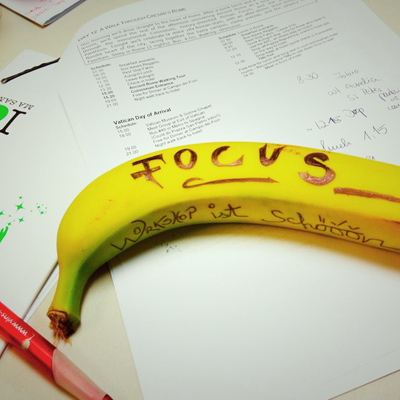
It’s fun to see how a European doodles during a meeting. The banana says “Focus. Workshop ist shöooen!”

Our all-guides business meeting began with everyone introducing themselves…which took more than an hour.

It was great having so many interesting tour guides hang out at my house.

On Saturday, under threat of snow, we had our annual tour alum parties.

We had four parties of about 400 tour members each, from all over the USA and Canada.

Guides like Alfio Di Mauro regaled the groups with stories and jokes.

Stephen McPhilemy brought along his favorite Irish T-shirt -- “Titanic: Built by Irishmen, Sunk by an Englishman.”

Martin de Lewandowicz shared gummi bear prizes with his Best of Europe alums for having the best attendance.

My guides and I also spent Saturday making 24 Test Drive a Tour Guide presentations in three different venues.

Having fun with our tour alums is one of the high points of my year.

European Guides Learn to Square Dance

It’s suddenly quiet here at ETBD headquarters, as 80 European guides have packed up and returned home. Our annual tour guide summit and tour member alumni party are over, and it was a great week. Saturday was an exhilarating three-ring circus of talks and alum parties, as we pretty much took our town by storm — filling up the big venues, bars, and restaurants with our guides and well over a thousand 2011 tour alums. Each day of the last week was filled with meetings: tour itinerary brainstorming sessions, all-staff meetings, first aid and CPR training, and so on. To stockpile a few months’ worth of radio content, I managed to do 30 interviews with guides over the week. We even flew in a tax specialist so our guides could get the straight scoop on tax issues for European guides working for an American company. And each evening was social time — my favorite part of the week.

The ultimate highlight was our square dance evening. Our guides earn their living introducing American travelers to their local cultures. Now we turned the tables, encouraging the guides to dress as “Old West” as they could as we filled a school gym for a night of BBQ and learning the moves with a square dance club. The old-timers with big belt buckles, the pretty ladies in their music-box-doll crinoline dresses, and the fun of this classic bit of Americana were a hit for all. Rolinka from Holland found overalls, speckled her face with some big Texas-sized freckles, and put her long Dutch-girl blonde hair into a bouncy ponytail. She made like an old cowboy pulling his suspenders out and hollered at me, “Eeee-haw! Is this what-cha call a hootenanny?”

Now our guides want another night of square dancin’ at our next summit. Here’s a sample of the fun:

If you can’t see the video below, watch it on YouTube.

(P.S. Thanks for all the very kind wishes and condolences for my last post about losing my mother. It meant a lot.)

June Steves: Losing My First Travel Partner

While two weeks has passed since her death, I’m still coming to grips with my mother being gone. I’ve had a busy holiday season and, in the midst of so much else churning all around me, I wanted to share with my friends on Blog Gone Europe the news of her passing. In case you might be interested, I’ve gathered here memories of my first trip to Europe when my travel partner was my Mom, photos of us in 1969 and in 2011, her obituary, and an essay I wrote from the notes of the talk I gave at her memorial service.

Memories of Travels with June

When I think of how my Mom catapulted me into the wonderful life I’ve enjoyed, it was she who first took me to Europe. As my Dad was busy doing business with European piano-builders (he imported pianos), Mom was my first travel partner.

Back when I was a 14-year-old who had hardly set foot on an airplane, together we were immersed in the wonders of Europe. On that first dip into Europe, we stood in front of our first hotel in the Netherlands watching bicyclists gather at a stoplight on the way to the fields — wooden shoes filling their little handlebar baskets. Mom helped me collect a cigar box full of sugar cubes wrapped with advertising from the restaurants we visited all over Europe. Together we collected souvenir pins to fill my Bavarian felt hat. Venturing into our first subway ride ever, we found our way to a stop called Trocadéro, emerged, turned the corner, and set eyes for the first time on the jaw-dropping Eiffel Tower. Together we puzzled at buildings that looked both new and ancient (Neoclassical monuments in Paris) — built in the style of ancient Rome, but dating only from the age of Napoleon. When friends in Germany gave us a tin of white asparagus, we opened it and marveled together at what looked like a rare albino vegetable. And, with Norwegian relatives, we traveled to the fjord where we found the actual house from where my mother’s mother left for the “New Land” — in her case, Canada.

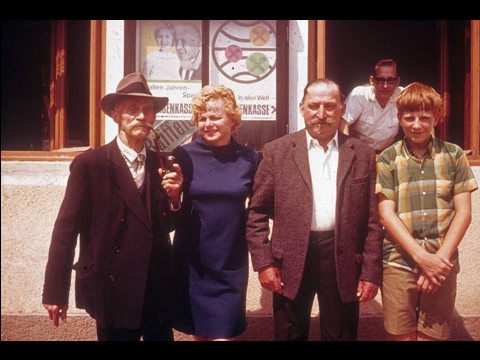
On that first trip, I was attached to my Mom — literally — as back then a mother and her child could share the same passport. And flying home from that first foreign adventure, I have a hunch my Mom had a hunch she had helped plant in me a seed that would sprout into a lifelong passion for travel. One of my favorite photos is of me and my Mom with our hosts in Austria in a dusty village on the border of communist Hungary. It was 1969, and Mom had just introduced me a man (far left) who claimed to have witnessed the assassination of Archduke Franz Ferdinand in 1914, which kicked off World War I. Whether he actually saw it or not, the story he told had me wide-eyed — and when I look back on it, I think it was a pivotal moment in my life that directed me toward my history degree and a passion for learning and teaching through thoughtful travel.

June Erna Steves (1931-2011)

June was born of Norwegian immigrants Harold and Erna Fremmerlid on June 29, 1931, in Edmonton, Alberta, Canada. She died in Seattle early in the morning on Thursday, December 29, 2011. She passed away from complications after a heart attack, surrounded in love by her family and pastor.

June grew up skiing and enjoying family, friends, and the great outdoors as a child in Edmonton. She left the homestead and moved to White Rock near Vancouver, where she went to high school. Her family then moved to Seattle where her father started and ran Oslo Electric Company. She lived near Green Lake with Harold, Erna, and siblings, Harold Jr., Sylvia, and Norman.

Once in Seattle, June soon met Dick. (June struck him as so gorgeous; she nearly knocked him off his skates at a local roller rink.) They were married in 1951. June supported Dick as he finished his university studies, taught band in public schools, and tuned pianos. June ran the home front in Crown Hill, Kenmore, and Edmonds with love and energy, raising with Dick three children: Rick (born 1955), Janis (born 1956) and Linda (born 1958). Later, June helped Dick run “Steves Sound of Music” — their store, in which they imported great European pianos.

Each weekend for decades, June organized camping and boating excursions. She harvested the sea and cooked it up expertly. She was a traveler, a skier, a parent, a partner, and a friend who complemented Dick as if a match designed in heaven. She will be remembered as a loving wife, mother, first mate of the good ship Junie, and friend who provided a Christian foundation for an entire family. Those who survive June — her husband, three children, six grandchildren (Caleigh, Nicole, Tyler, Kelsey, Andy, and Jackie), and brothers Norman and Harold — will remember her with thanks and love.

While we will miss June dearly, we celebrate her eighty years on this earth as a lifetime well lived and filled with adventure, a passion for life, and love.

June Steves, My Mom

Losing your mother takes you places you’ve never been. There’s a void. You see things differently. You realize how much emotion is inside you. You find there’s a bucket of tears reserved especially for our mothers.

As this experience unfolded around me, it was as if God had a plan. Just hours before Mom’s death, I visited a friend of mine who has just a few months to live as cancerous tumors take over his brain. I wanted to spend a few quality moments with my friend, and we ended up talking at length about death and love. His mystical Muslim approach to love and God and his passion for the teachings of Rumi inspired me. I had a rich afternoon with my friend exploring how we are here to give love. How death is part of life. How people are good. Nature is good. God loves us. And how, in death, we see God’s love and learn more about how we can love each other. I had never had such a talk before. I had never thought so deeply about death.

My phone rang during our time together, but I didn’t answer it. After leaving my friend’s house, I checked in and learned that my Mom had been taken to the hospital. First diagnosis: pneumonia. But it was worse. A few minutes later, we learned she had had a heart attack and would need a pacemaker. Half an hour after that, the doctor was on the phone asking about Mom’s end-of-life wishes. Within the hour, I gathered with loved ones at Mom’s deathbed.

Exploring the meaning of death with my friend serendipitously helped prep me for my mother’s death. At 1:30 a.m., on December 29th, 2011, I held Mom’s hand and stroked her head as she peacefully took her last breath.

In thinking about my Mom’s life in the context of her death, I see God’s love more clearly, and I’ve been learning about how we can love better.

I appreciate that divine love in how my Mom and Dad were such a great couple. Their love inspired people in its simple purity. The way they loved each other, especially those years when it was within the dictates of Alzheimer’s, was emblematic of what love is all about.

My Dad chose not to talk at Mom’s memorial service. He didn’t need to. His love of June was more powerful than any spoken message. It was love 24/7, all over town. It was “June and Dick.” Dick loved June and June loved Dick. They were a team.

In the last few years, it was an Alzheimer’s love. While Alzheimer’s disease is a terrible curse, with my Mom’s death, I found it actually had a silver lining. Alzheimer’s, while a horrible shroud that keeps out so many joys of life, also blanketed away the aggressive and shrill dimensions of modern life. Alzheimer’s made Mom and Dad’s love more simple: two children of God together. Not fancy — just pure. To me, their love became even more inspiring.

I see Mom’s heart attack as divine deliverance from a very difficult road ahead. Mom suffered a cuddly, cheery, even humorous brand of Alzheimer’s. And, with death, she was spared its ugly stage. On December 29th, June Steves flew out of her riddled brain. She left Alzheimer’s on the hospital bed and was given freedom.

We are so blessed that she was cheery and a joy until the very end. She sang her heart out by candlelight at church on Christmas Eve. Together we lit each other’s candles and sang “Silent Night.” The day before she died, an unusually big and joyous assembly of grandchildren gathered with Mom at a Chinese Restaurant. Mom was high-fiving, singing, spinning a lazy Susan heavy with yummy dim sum, and snatching dumplings off Dad’s plate.

Sorting through photos in preparation of Mom’s memorial service, it was clear that Mom dedicated her life to family. Some may wonder: What did she do? In a conventional sense, not much. She held no prestigious positions. She won no big awards. But if we are here to love — as Jesus teaches us, and as my ailing friend helped teach me — she was a true champion.

In retrospect, Mom’s life was one of selfless devotion. She made it her purpose to help her family spread its wings and for each of us to fly. Mom lived the prime of her life in a Mad Men age when women were silent heroes at home. She never took her eyes off the target: caring for her family. And all of us were huge beneficiaries of that.

In my Mom’s family, being “good stock”  was the ultimate compliment. Her mom and her mom’s mom always talked about that. It must be a Norwegian thing…good stock to survive a hard life. It was as if offspring were plants that needed to survive a winter snow. Mom certainly was good stock. In fact, my fear was that her tough Norwegian body would long outlive her Alzheimer’s brain. In that regard, her death was both timely and a blessing.

At home, she was the classic mom…very traditional. But at sea — vacationing on their beloved boats (the RikJanLin and, later, the Junie) — look out. June Steves was a fierce hunter-gatherer. Across the San Juan Islands, when it came to catching clams, oysters, and crabs, she was like Xena…“June the Warrior Princess.”

Mom never tried to be a fancy intellectual. But looking back, she was wise in disguise: Work hard. Be patient. Pull up a prawn trap using your body more than your arms. To stretch your juice, simply add more water. Never fold up a canvas tent damp. The best way to control nature is to obey her. Learn to type — you might find that useful someday. And Jesus loves you (one of her favorite hymns).

A hospital is a sterile place to die. I’m not comfortable in that environment. That night, after considering the industrial efficiency of it all and how death must get almost routine in the ICU, I met a woman whose job title was “flow supervisor.” Despite being surrounded by softly beeping monitors, stainless steel, and latex gloves, I was struck by how—gathered around her bed–we created a completely different zone, a circle of love.

For the last few years, my Mom has been an Alzheimer’s June. It can be pretty unglamorous. Looking at her on her deathbed — even with her pale face, drained of life — I saw a noble woman of beauty and strength. I saw the power of maternal love. I saw, and I will remember, a strong, timeless woman of good stock — Viking stock.

Collecting my thoughts about Mom’s death, I find myself going ethnic…going primeval. Coming together as Mom died, we cradled her. It was as if we created with our family, loved ones, and pastor a Viking ship in some torch-lit burial ceremony a thousand years ago in Norway, the home of her ancestors.

At that dreaded but epic moment, I appreciated cyclical nature of life. June Steves brought us in, and those she raised and loved saw her out.

They say we get four score, and anything beyond that is a bonus. Mom lived four score and six months to the day. God blessed us with her. He blessed our Mom with a full and well-lived life. Her life was a beautiful 80-year-long arc. She lived her last few years as a child again. And, finally, God took her home in a merciful way.

On the last day of 2011, friends and family filled Trinity Lutheran Church in Lynnwood, creating another circle of love. While we grieved Mom’s death, we also celebrated her life and all she brought to this world. You understand the treasure of friends and loved ones in a new way when they come together at such a memorial.

If I could tuck a little note for my Mom onto that Viking ship as it sails away, here’s how it would read:

Dear Mom: I now enter a stage of my life with that void that only those who have lost a mother can truly understand. I’ll savor precious memories of you until I see you in heaven — where I have a hunch we’ll ultimately sit together with Dad, Jan, Linda, and other loved ones too, enjoying the heavenly equivalent of a campfire on the beach at sunset in a place very much like Sucia Island, sharing a bucket of fresh-caught butter clams. As you look down on all of us as we carry on, enjoy the view. We love you. And we’ll treasure how you touched us and how your beautiful spirit will endure in our lives forever. Amen.