The New Tangier Is No Tijuana

I love Morocco. But I’ve always called Tangier the Tijuana of Africa. That has changed. Tangier was a neglected hell hole for a generation. It was an international city — favored by the West and therefore distained by Morocco’s last king. He made a point to divert all national investment away from his country’s fourth city.

The new king, who took the throne in 1999, believes Tangier should be a great city again. The first city he visited after his coronation was Tangier. The difference — as I just learned — is breathtaking. The place is still exotic…but likeably exotic.

Checking into Hotel Continental, flamboyant Jimmy, who runs the shop, met me. Six or seven years ago, I told him I was from Seattle. He said, “206.” Now I test him again saying I’m from Seattle. He says, “206, 360, 425…new area codes.” He knows every telephone area code in the USA.

Hotel Continental has you looking for the English Patient. Gramophones gather dust on dressers under mangy chandeliers. A serene woman paints a figure eight in the loose tiles with her mop, day after day, surrounded by dilapidation that never goes away. As I updated the information in my guidebook, I found a rare and nonchalant incompetence. My guidebook listed the hotel’s phone and email data more accurately than their own printed material. It’s a 70-room hotel with not a sheet of paper in its office.
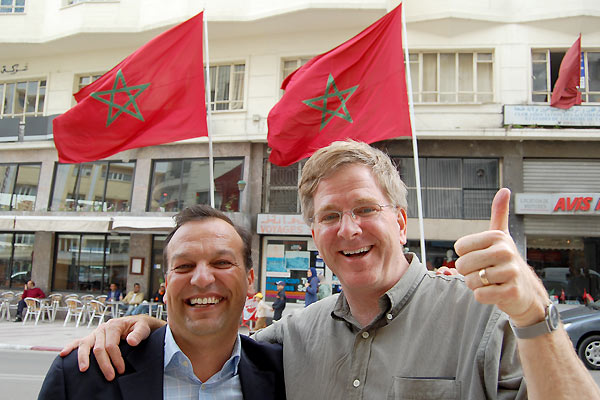
Roosters and the Muslim call to prayer work together to wake me and the rest of that world. When the sun is high enough to send a rainbow plunging into the harbor amid ferries busily coming and going, I stand on my balcony and survey Tangier kicking into gear. Women in colorful, flowing robes walk to sweat shops adjacent the port, happy to earn $8 a day sewing for big-name European clothing lines. Cabbies jostle at the pier for the chance to rip off arriving tourists.

It’s an exciting time in Morocco. The king is modernizing. His queen was a commoner. Moroccans say she’s the first to be seen in public. They have never seen the king’s mother. They actually don’t know what she even looks like. Walking the streets, you see a modest new affluence, lots of vision and energy, and no compromise with being Arabic.

They don’t emulate or even seem to care about the USA. Al Jazeera blares on teahouse TVs — with stirring images of American atrocities inflicted on fellow Muslims. But people seem numb to the propaganda. I felt not a hint of animosity to me as an American, something I was concerned about. There was no political edge to any graffiti or posters.

My guide, Aziz, explained to me the fundamental difference between Islamic and Islamist, and then said Morocco is Islamic.
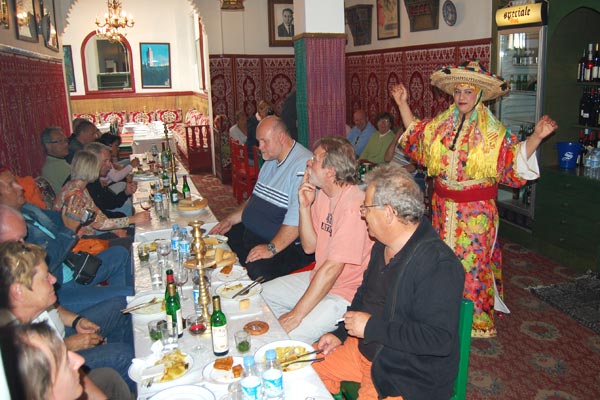
Wandering — especially after dark — is entertaining. It’s a rare place where signs are in three languages, and English doesn’t make the cut (it’s Arabic, French and Spanish). Aziz said when he wanted someone’s attention he says, “Hey, Mohammad” (or “Hey, Fatima” for a woman). It’s like our “hey, bub”…but very respectful.

The market scene is a wonderland — of everything but pork. Mountains of brilliant olives, a full palette of spices, children with knives happy to perform for my camera. Each animal is slaughtered in accordance with Halal: in the name of Allah, with a sharp knife, head to Mecca, drained of its blood.

Until now, I’ve recommended that day-trippers from Spain just hold their nose and take the organized tour (with all the groups from Spain’s Costa del Sol). A Tangier guide meets you at the ferry (after the hour-long ride from Spain). They take you on a bus tour of the city, a walk through the old town, lead you to a few staged Kodak moments (camel ride, snake charmer, Atlas mountain tribal musicians) and then you go to a clichéd restaurant where you eat clichéd food with a live band and a belly dancer (which has nothing to do with Moroccan culture, but tourists don’t seem to care). Then you visit a shop.

They must make a healthy commission, because the round-trip ferry ride with the tour cost essentially the same as the round-trip ferry ride without the tour.

During my stay, I met gracious Moroccans eager to talk and share. About the only time I saw other Western tourists was when I crossed paths with one of the many day-tripping tour groups. Those finishing up their tour walk in a tight, single-file formation, clutching their purses and day bags nervously to their bellies like paranoid kangaroos as they bundle past one last spanking line of street merchants, and make it safely back onto the ferry.

I was so comfortable and they were so nervous and embattled. The pathetic scene reminded me of some kind of self-inflicted hostage crisis.

Don’t Trust UNESCO

I spent all day yesterday climbing steps to Barcelona hotels and sorting through tourist propaganda fliers. As I research my guidebooks, it seems nearly everything I read is promotional — designed to get my traveling readers’ money.

Every town has 2,000 years of history. They all want to pump up their off-season charm. And anyone can claim a “vast gastronomy.” I pick up a pack of fliers at the tourist office, sit in the park and sift through it — putting all that advertising through my centrifuge and coming up with straight, descriptive material explaining a traveler’s options. At least that’s my hope.

When it comes to evaluating sights, I disdain the word “UNESCO.” I find that throughout Europe, places desperate to rise above the din of tourist attractions brag that they are on the UNESCO list of cultural treasures. It seems every time I reject a place, proponents of it come at me with the “We’re on the UNESCO list” line. I normally want to like the United Nations (something that really irks my conservative detractors). But in the case of mediocre destinations for travelers, I’m with them — butt out, UN!

Now that I have guidebooks covering all of Western Europe, I can no longer remember everything I’ve seen and reported on. I’m not sure if I should feel good or bad about a strange mental phenomenon that has been reoccurring at an alarming rate to me lately. I think I’ve discovered something new or found a new, clever way to better describe something. I write it up with great satisfaction. Then I turn the page and see that it’s already written up from a previous year’s visit precisely as I just did. At least my thought processes are consistent.

Reviewing 20 to 30 hotels in a day (average of four per hour if I get my ducks in a row smartly — and don’t let friendly proprietors kill my momentum with a drink), I run out of descriptors. With the dollar where it is, Americans need a frank description of their low-end options. There’s an interesting spectrum ranging from charming to characteristic to funky to quirky. Places can be: Old school. A slumber mill. Time warp. Professional-yet-friendly. Thoughtfully appointed. Minimal-yet-comfy. Gaudy in the city of Gaudi. They can have: “a bomb-shelter charm” or “the ambience of a locker room.” Popular with backpackers and dust bunnies. Warmly run by Juan and the man he thinks may be his father. If the starship Enterprise had a Motel 6, this would be it.

Occasionally, I need to defend a description. I called one place “uppity.” The next year, the manager there asked me what that meant. Thinking quick, I said, “elegant and proud.” One place didn’t like to be described as “one floor above the sex shop.” But that’s exactly what it is.

When I find receptionists I think I can trust for leads, I milk them. Many are so wired to sell things that if I ask for advice on the best flamenco show, they respond, “We sell tickets to this one.” “Best restaurants” are generally run by relatives.

Trends are fun to keep up with. In Barcelona, several hotels have replaced the mini-bars in their rooms with a maxi-bar (called tentempié bar) in the lobby. It’s stocked all day with cold drinks and light plates of food and fresh fruit, free for guests. Also, Wi-Fi is on its way to becoming standard as more and more people are traveling with their laptops. I don’t like a hotel that charges $200 a night for a double room and then nicks its guests with a Wi-Fi fee. (In my books, I only list Internet access and Wi-Fi if it’s offered for free.) Many hotels have their website run by a booking service (which takes a cut). They give you a discount only if you send an email direct, skirting their own website.

There are some wonderful, big, new, urban youth hostels — I just visited a great new 400-bed place in Barcelona’s ritziest zone. No membership or age requirements and dorm beds for $25 each…great news for traveling students. (My co-authors and I call these places “Andy beds” — for my son and his college-aged friends slumming through Europe as we used to.)

A decade ago, we had a page in our guidebooks for travelers to rip out and leave in the hotel bathroom if they didn’t want their towels changed. Then it became trendy for hotels to claim, “Help us be green…leave towels on the floor if you want them changed.” Today, I find hotels have dispensed with the token environmentalism and insist on changing your towels each day. We’ll reinstate our “don’t wash my towels today” page next year.

Speaking of washing — people are surprised I still wash my clothes in the sink. It’s faster than hotel service or going out, and hotel shampoo works just great as detergent. If I ring things really tight, they’re dry by morning. (I must be a quite a wimp though, because if I’m not careful, I can actually get blisters on my hands by wringing too hard.)

It’s fun to analyze chapters in my current editions to see what state I was in on my last research round. If I list a masseuse, it’s fair to guess I must have been really exhausted on my last visit.

(P.S.: I hope you can scroll down and enjoy some of the photos we’ve just added to previous entries.)

Married in Gibraltar Near Spain

I can’t resist popping into the British colony of Gibraltar when in Southern Spain. Gibraltar is hardly signposted in Spain, as if Spain wishes the British colony didn’t exist. (You follow signs to La Linea, the last Spanish town.)

Quirky Gibraltar is happily English. Just 30,000 people live along a three-mile lip of land under that famous Prudential Rock, but the people of Gib have an impressive national pride. In a 2002 referendum they voted 99 percent to stay with Britain. If you ask locals what they think of their current governor, now in his third term, they say, “He deals effectively with Spain.”

The colony is part British, part not-Spanish, part Gibraltarian. They have the big three-pronged English plugs, their own currency (the pound sterling — but a Gibraltar version, like Scotland) and their own web domain (gi). Their Anglican church is proudly “headquarters of the Anglican Church in Europe” (not very centrally located for the business of administering that vast parish).

The people have that annoying British correctness — I got chewed out by the woman at the tourist board for not giving them advance notice of my visit. They’ve decided to change the name of what for a thousand years has been known as “the Moorish Castle” to the “Medieval Castle.” (I told them, “Not in my guidebook.”)

An American submarine was in port during my visit, so the colony’s pubs were busy with Yankees on a quest for cold beer. Gibraltar’s economy, once dominated by the military, is now based mostly on tourism. (And that includes quickie weddings — only 48 hours notice is required and it’s legally British. Sean Connery got married here. And, of course Beatle fans remember from “The Ballad of John and Yoko” that they too got “married in Gibraltar near Spain.”)

While the British military presence is now dwarfed by the presence of British sun-seekers, the colony is encrusted with military souvenirs — thick, thick ramparts, war memorials, 30 miles of tunnels drilled into its rock and big rusted iron rings every 20 yards along the military roads that switchback to the top of the rock, designed to enable limeys to hoist up the giant cannons that once helped the Brits seal off the Mediterranean when they wanted.

As we drove high above the port, my taxi driver pointed down to a tiny breakwater and said, “That’s where they pickled Admiral Nelson after the Battle of Trafalgar.” (While he won, he died too. His body was preserved in a barrel of spirits for the trip back to London.)

Gibraltar’s dominant tour company is called Blands. I remember 10 years ago all the buses said “Bland Tours.” Mr. Bland — who speaks perfect English, so there’s no excuse — finally realized that his name just wasn’t ideal from a marketing point of view. But sometimes ego trumps greed. He added an “s.” Now his buses read: Blands Tours.

The Gibraltar business sense is quirky. The hotels are twice as expensive as those across the border in Spain (and not as comfortable). For a decade, I’ve said, “English food is no longer as bad as its reputation.” Now I’ll add: “…except in Gibraltar.”

And the businesses pad their bottom line by gouging anyone who comes in and spends euros. I imagine well over 200,000,000 people spend euros. Only 30,000 spend Gibraltar pounds. And Gib business people say, “Sure, we take euros.” They don’t tell you that it comes with about a 20 percent loss in the exchange rate.

Nevertheless, tourism is booming. Midday, the pedestrian-friendly main street (which locals call “Main Street”) is a virtual human traffic jam. And twice as many planes are landing in the colony every day. While it’s still only four planes, it is more important than ever now that when you walk across the military airstrip that marks the border between Spain and what’s left of the British Empire, you look left, right and up.

Time Shares and Rip Tides

One of my least favorite places in Europe is the Costa del Sol. When I’m not calling it “strip malled and parking metered,” I call it “bikini-strangled and Nivea-creamed.”

To me, it’s just endless condos filled with people who are there because they have free rooms in time shares. (It seems every time someone in the USA tells me they’re going to Malaga, I don’t say “yuk,” I ask “why?” They say, “Time share.”)

The Costa del Sol is just right for the tourists who fill it. There are enclaves that cater to various rainy cultures from the north. One town will be filled with Belgians, the next Swedes, and the next Scots — all able to still have their local brews, newspapers….and buy them from people who speak their language. The attraction: a change of weather without a change of culture. In some restaurants, the stray Spaniard complains that they can’t find a Spanish menu. Whenever I’m driving through I tune my car radio to “Sun Coast Radio” — the station for ex-pat Brits.

But west of Gibraltar it’s windy and the water is cooler. That was great…it kept out the sun-seekers and development. Tarifa has long been the South Spain of my dreams. Then the wind actually became a boon. For North European windsurfers, Tarifa — with its strong winds — has become a mecca.

The wind was up, so I drove out west of Tarifa for the spectacle. Munching my dish of paella in the lee side of a hedge, I watched the action. The world felt like an aquarium with way too many fish. Wetsuit-clad windsurfers jetted like skeeter bugs across the choppy water. And — something I haven’t seen before — countless brightly colored kites filled the sky as they powered surfers across the sea. To add to the color, flags flapped all around as if to celebrate the famously steady Tarifa winds.

Locals say this is the only place in the world where you can see two continents and two seas from the same vantage point. The mountains of Morocco stood crisp across the straits. Behind me, a forest of sleek windmills whirled with attitude. And the women in the thatched restaurant called out another hungry surfer’s name as the latest batch of paella was ready. From this vantage point, the world seemed healthy and at peace.

Back in Tarifa, I walked through the fortified gate and climbed the ramparts of the castle named for Guzmán El Bueno. Guzman earned his nickname 800 years ago when he stood where I stood, looking down at Moorish invaders who wanted into the town. They held Guzman’s little son hostage. As if in a movie, the Moors (Muslim invaders from North Africa) said, “open the door or we kill the boy.” Guzman said “hell no” and defiantly tossed them his knife to do the job. They slit his son’s throat, but Guzman held out and the town was saved. Bueno.

Stepping into the church (most churches in this part of Spain are built upon the ruins of a mosque which was built upon the ruins of a church), I see a painting of a favorite local saint. He’s called James the Moor Slayer. He was portrayed doing what he always does — lopping off Muslim heads.

Next to the church is the office of a “Save the Whales” group that takes tourists on whale-watching excursions, raising awareness of the plight caused by shipping through the Straits of Gibraltar. They hope to make the straits an international nature preserve (which would have shipping lanes steer clear of feeding grounds, among other things). These whale-lovers expressed frustration, saying progress was stalled because Muslim culture (Morocco) had no real affinity for creatures other than humans.

Here — where Africa, Europe, the Mediterranean, the Atlantic, Christendom and Islam all come together — a few cultural rip tides should surprise no one. Whales and dolphins know that where there are rip tides, there is food. Wind surfers know there’s excitement. I like to think there’s a positive aspect of intercultural rip tides for Christians and Muslims too. Perhaps it’s just hiding.

España: Happiness Curves and Hitting Jamon

My Spanish assistant Roberto was catnapping on a chair in front of the Avis desk at the Madrid airport. Born in Nashville but because of a love of Spain, Robert lives in Argentina. He prefers Third World chaos and inefficiency. (His blog, at wrighton.com.ar, explains.) While Robert celebrates things that are needlessly complicated and frustrating, I fight them. Traveling with him will probably be good for me.

It’s a big holiday, so the trains south to Cordoba were booked. We rented a car. Robert can’t drive a stick and automatics are still rare in Europe. Thankfully, Avis had a mighty little BMW — that was automatic — held for us. Robert drives…I type on my laptop. Efficiency. Ricky likes it.

Minutes later, we’re southbound on the freeway, immersed in the vastness of La Mancha. It’s a tough terrain. A windmill — weathered into a rough little useless nub — still caps its blustery hill. I swear, bugs here bounce off the windshield and keep on flying.

We pop into a rustic truck stop for lunch. As my teeth break into my ham sandwich, I finally arrive. España! My passport was stamped, but I didn’t realize that I hadn’t really arrived until I broke through the crisp crust, into the fluffy fresh baguette — and hit jamon.

In Spain, you gotta love the ham…from happy pigs…acorn fed. Cured ham hocks — toned legs with pointed toes, like dismembered farmyard ballerinas in vice grips — are found in every bar. That simple truck-stop sandwich spoke to me. “Welcome to España.”

Europe is changing fast. I once thought when I had TV shows covering the entire Continent I could say “mission accomplished.” But no. Spain still has its short men with tobacco voices and “curves of happiness” — round Buddha bellies. (Sure, some would say “reminders of lives cut short.” The men would say souvenirs of lives well lived.) But you no longer fear the thieves who smash your car window and grab your purse. People don’t throw trash on the bar floors as much as before. Restaurants are no longer hazy with smoke. And there’s orthodontia — young people with straight teeth. Affluence is here. It’s a cell phone and iPod culture.

Traveling shows you that history lives. It has a metabolism — driven by a society confronting (or ignoring) its problems. Solving old challenges…dealing with new ones. For instance, driving south to Cordoba, we pass road signs in Arabic, posted just two years ago. Some locals say “to make sure their Moroccan guests find their way home.”

Five hours after my Alitalia pilot said I could release my seat belt, we pull into Cordoba and settle in. Later, wandering the Art Deco streets, we’re drawn to commotion on a square.

It’s almost midnight. Short men with curva de la felicidad bellies jostle and bark as a dozen little school girls rattle a makeshift stage, working on their sultry. Even with iPods and straight teeth, Andalusia’s flamenco culture survives.

Burrowed deep into my bed, rather than count sheep I review the day: breakfast in Milan, the scare at the airport (long lines and too little time), being wowed by smooth and freshly painted asphalt ribbons lacing together Spain, and Cordoba’s every-night festival of life filling the streets. Then a noisy parade rumbles down the cobbled lane I thought promised a good night’s sleep.

Standing in my underwear and wrapped in the drapes, I peer secretively out my window. Below, a band of guitars and castanets with a choir of tobacco voices funnels down my narrow alley. Grandmothers — guardians of a persistent culture — make sure the children pick up their Andalusian traditions. Suddenly, one looks up and catches my eye. I feel like a Peeping Tom…good.