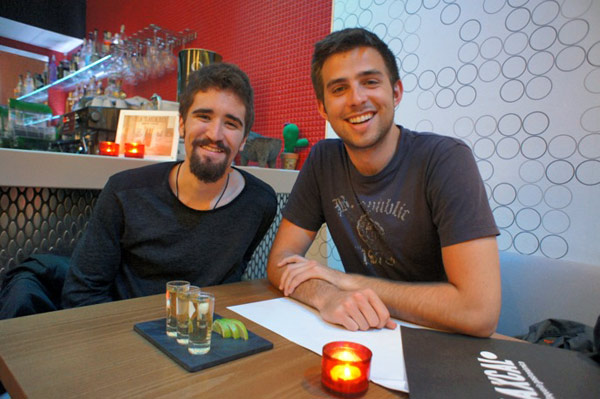
I just spent a weekend at the NAFSA: National Association of Foreign Study Advisors convention in Houston with my son, Andy. I was actually working for Andy at his booth, and enjoyed seeing how, in two years, he has really established himself in the minds of university foreign study program advisors across the USA.
As Andy (with his Weekend Student Adventures business) is more hands-on with student and budget travel than I am these days (he lives out of hostels running his business from his laptop in Europe for half the year), I ran the script for my upcoming three-part series on travel skills by him. (I’ll be updating my ten-year-old travel skills shows this summer, for debut on public television this fall.)
I gave Andy my rough script, and he shared some great comments on how I can be more up-to-date and tuned in to the way younger people travel. Here are Andy’s suggestions:
Bikes: While there are many public bike rental systems across Europe that work very well for locals, often times they require “chip and PIN” debit cards, and even national social security numbers to set up an account. For this reason, it’s unlikely your American viewers will be able to get in on the great deal if only in town for two or three days. For instance, in Barcelona, you need to have a national ID card to subscribe to the service (€45/year), and then your rides are free for the first 30 minutes. Locals take longer jaunts by checking in and out at multiple stations along the way before the time goes over the limit.
Credit Cards vs. Debit Cards: Using a credit card almost always comes with a higher percentage transaction fee compared to a debit card — 5 percent compared to 2.5 percent or so. Keep in mind that your daily withdrawal limit is in US dollars, but you have to convert that to euros — they’re different!
Recreational Reading: When discussing how to prepare for your trip, make a point to include listening to podcasts, too. There are great podcasts about all sorts of topics related to your upcoming trip.
Car Rental: For a backpacker, renting a car is hardly ever the cheapest option for getting around. The daily fee may be enticing, but the inevitable extras make it far more expensive then you were led to believe. You’re paying for your independence through tolls, gas, and parking. Remember, Europe is dotted with automatic speed guns and cameras that will issue a ticket and track you down even across the pond. I got photographed speeding and got a $100 ticket with a $100 service charge added on by my rental company.
Estimating Metric: For rough conversion from kilometers to miles, two-thirds does it: 30 kph is 20 mph, 100 kph is 60 mph. For Celsius, room temp (71 degrees F) is 20 degrees C.
Internet and Phoning: Cybercafés are getting more and more dated. Most travelers use Wi-Fi devices — in either cafés or hostels. Smartphone users beware the huge fees when you roam. Before my plane takes off from the States, on my iPhone I switch “on” Airplane Mode, switch “off” Cellular Data, and switch “on” Wi-Fi. This prevents me from racking up hundreds in phone bills for data usage. “International data plan” options offered by your provider are hardly ever a good deal.
Communicating with Loved Ones Back Home: Skype and FaceTime are key and cheap (or free). If you are both online and have iPhones, you can enjoy a FaceTime connection across the street or across the ocean for the same price — free. Otherwise, Skype is a good standby. In either case, the key is having a good Internet connection, as you have to be online.
Events: Take your trip to the next level by paying attention to and researching event schedules on the route you want to travel: sporting events, concerts, festivals, special exhibits, and other celebrations are invaluable experiences that will really make your trip unforgettable. Chasing down events that interest you help you connect with locals who share the same passion, whether it’s catching the Tour de France, or experiencing a special photography exhibit by your favorite photographer.
Beggars: Along with thieves, a common distraction technique is for young women to beg for you to sign a seemingly reasonable petition (like “against drugs”). These are just ways to distract you while their partners pick your pocket. Never stop for them.
Dress Code: European adults generally don’t wear shorts, no matter how hot it gets. If blending in is a priority, bring your swimsuit, but leave the shorts at home.
Hosteling: References to IYHF (the International Youth Hostel Federation) are dated. People book hostels through Hostelworld.com. Hostel rooms are generally either mixed or female-only — no exclusively male dorms. CouchSurfing.com and Airbnb.com are both popular these days. I don’t think I’d ever follow a local who picks me up at a train station home. Airbnb.com is safer — you can agree on the price, cash never trades hands (it’s done automatically), and you can read reviews to make sure it’s what you’re looking for.
Free Walking Tours: While you don’t get a licensed guide, and your “guide” is generally an expat student who has memorized a script, these “free” tours can be a great value. They are advertised all over the place, provide little personal attention, and are often entertaining, but emphasize stories over the strictly academic. They’re known to take some liberties with historical events and characters. And they are based on tips. You will be hit up really hard for a tip. Still, I use them all the time and enjoy them.
Cheap Flights vs. Sleeping on the Train: People don’t sleep on the train like they did in the old days. In your TV show, you should do a bit on discount flights: how to find a budget flight, search engines, booking flights online, encountering a difficult experience at the airport, how to play their games (baggage fees, fees for checking in at the airport, printing boarding passes before to save on more fees), etc. Also, be sure to factor in additional costs for the transfer between the airport and downtown. Some flights may cost €20, but the bus to and from the airports costs €35.
For more on Andy Steves’ travels, see http://www.wsaeurope.com/.
“Credit Cards vs. Debit Cards: Using a credit card almost always comes with a higher percentage transaction fee compared to a debit card — 5 percent compared to 2.5 percent or so.” This does not jibe with my experience. I have no foreign currency markup or fee with either my credit card or debit card. Basically, the switch between US$ and pounds or euros is free, unless you are speaking of foreign merchants that charge more for using plastic.
This excellent link shows plastic with 0% markup on foreign transactions [url]http://flyerguide.com/wiki/index.php/Credit/Debit/ATM_Cards_and_Foreign_Exchange[url]
Andy’s got some great tips, glad to see the inter-generational learning going on. To follow up on Chip’s point, while some credit cards do waive foreign transaction fees, most don’t–also, I wondered whether Andy’s point was to use a debit card (as a debit card) or just cash (withdrawn from a debit card). While credit cards are accepted more and more in Europe, in many places cash is still easier and most welcomed, I’ve found. Also, and I know Rick’s commented on this too, make sure they charge you in the local currency (especially if you have a no foreign transaction fees card) … I’ve had some vendors charge me in USD without even asking, which is frustrating (I got a no fees card particularly to avoid this issue!).
I also agreed about the point regarding night trains vs. budget flights. More and more, budget flights are the way to go (and in many cases, even the traditional carriers have competitive rates). Like Andy says, there are big caveats–what airport is the carrier using (it’s only a slight exaggeration to say that “Paris”-Beauvais is about halfway to Belgium) and what fees could be levied. Otherwise, especially for those traveling light, and especially for longer distances, planes are a very nice option.
One more thing on budget airlines, tips on how to scan for cheap flights would be helpful … personally, I’ve found Skyscanner to be very useful, as it searches not only the flagship carriers but also budget carriers and trains all at once, but maybe others have good recommendations.
Cheap flights on the LCC (low-cost carriers) of Europe are often much less expensive than trains. Always check Kayak.com, Easyjet, Ryanair, etc. for flight connections with flexible dates and airports while considering the comparable cost of train travel. However, if you’re comfortable booking train travel on the rail company’s websites, you can save money by booking a train segment in advance. Bahn.de is a easy to navigate site, and it is also in English, offers online e-tickets, etc.
Consider overnight train travel alongside the cost of a cheap flight combined with a night in a hotel/hostel. If money is tight and you’re on a student budget, combining sleeping costs with travel costs can be a better use of limited travel resources. But be careful and always keep your stuff physically connected to you because pickpockets will roam the train at night.
I have always used the debit card as a way to get cash and then use the cash for eating, and spending while traveling. But, usually, I will bet a cash withdrawal 2-3 times while on the trip, depending on how long I will be on the trip. Last year, I withdraw 3 times, since I was in Europe for a month and a half. In other words, if I am going to spend 1200 USD, I withdrew 400 USD each time for 3 times. It worked well for me, however, each person is different and and have different needs. The actual hotel, train and any rental cars were paid for on a regular credit card., however, about 9 months before I left, I made my reservations on the internet for the different hotels, and bought a Saver Eurail Pass for my brother and I to travel on. This worked for me since we traveled to, several countries, Germany, Netherlands, Belgium, France, Switzerland, Austria and Italy. We also stayed with friends in Germany for 2 weeks and relatives in Italy for 2 weeks to help cut costs, but did contribute to each family by taking them out to eat and sharing car gasoline costs. It is really fun to travel and I would recommend it to anyone. As Andy Steves makes his mark in Europe and with college students with his company, I wish him well and good traveling.
Sorry”, I will bet a cash withdrawal” is really” I will make a cash withdrawal….”
A note on bikes – in London, if you know where the bike racks are, you can essentially bike across Central London by hopping bike racks 30 minutes at a time.
Most credit/debit charge something to use in Europe. The best thing I have found is that you need to call you bank or banks if you have more than one and credit card. Last year I called Bank of America and found out that if we used one certain bank in Italy we were not charged a fee. And that is what we did. Then I have one BofA Visa world card that charges 2% on charges. It doesn’t add up to very much by the end of the trip and I feel that is more secure. It is worth it because I have bought things to ship home and they never came and Visa immediately took care of it. Also some of the Visa cards have Car Insurance included so that saves too. The train can be expensive. We have decided on the train because we love the experience and convenience. But there is no bargain to travel by train in Europe. I think you could get a flight cheaper for certain trips.
Rick,
This entry provided some interesting reading. Some of the topics you mentioned are often also discussed on your Travellers HelpLine, such as the issue of credit or debit card fees.
A few thoughts on some of the topics mentioned:
> Car Rental – this is also not a cost effective option for solo travellers (whether Backpackers or not). I tend to use rentals for specific purposes, but prefer rail travel or budget airlines.
> Internet & Phoning – I’ll be travelling with an iPhone this year, and plan on trying a data plan with one of the “travel phone” firms. I’ll be reporting on how well this worked on the HelpLine. I’ve used a “travel SIM” for voice and text the past few years, and it’s worked well and been fairly cost effective.
> Staying in touch with family back home – don’t forget text messages. That’s the method I use most often to keep in touch.
> Beggars – I’ve encountered this numerous times, including in “safer” cities such as Lucerne. I always use the method you described and tell them to “take a hike”!
> Hostelling – while references to IYHF may be “dated”, they’re still a good option and one that I use on occasion.
I’ll be looking forward to seeing the new season on KCTS in the fall.
I have Capital One credit cards, and a Capital One online checking account with an ATM card, that I got specifically for travel. I pay NO foreign conversion fees (and get 1% cash back on the credit cards, and interest on the checking account.). Also, CapOne refunds fees charged by foreign ATMs up to $25 per month. My backup account is with a Credit Union, 1% conversion fee, five free withdrawals/month.
There is no reason to pay 3% or even more just to get cash.
Note that budget airlines aren’t as cheap as they look at first sight. By the time you add in all the fees, a national carrier may be cheaper. I find EasyJet’s fee for using a credit card especially annoying, as I have no other way to pay them. I much prefer trains: more comfortable, better scenery, and city center to city center.
“Dress Code: European adults generally don’t wear shorts, no matter how hot it gets. If blending in is a priority, bring your swimsuit, but leave the shorts at home.” How does this out-of-date observation still persist? Although I’ll only comment on the countries where I spend the most time (I live in Germany and visit Belgium at least once a month), I can assure you that people of all ages regularly wear shorts when it gets too hot. True, most people walking through a large city during the week will wear long pants, but these people are likely going to and from work. But once the temperature starts approaching the upper 20’s C, look at what people wear in their leisure time as they shop or walk around their neighborhoods. You may find that short-wearing adults are in the majority.
Kid’s gunning for your job, Rick…
I think Andy needs to learn more. I found some of his comments re: debit/credit card use, and hostels not accurate, and some other comments are things I already knew so it’s not that informative.
Do be aware with those “Free Tours”, that not only are you expected to tip, those guides have to pay the company for each person that begins their tour. Average amount is 3 euro per guest. The company tries to hide this fact though, and the guides aren’t allowed to say anything. If they do, they get fired. Many cities and countries have banned these Free tours, due to their many illegal practices. Court cases are pending against them in Germany.
Better is to go with one of the regular, well established walking tour companies, available in every large city, where students pay an average of 10 euro, for a 3-4 hour quality tour. When vacation time is short, use it wisely, and don’t waste it or your money on a company that mistreats its’ employees and flaunts the law every chance it gets.
Also, many Scandinavians wear shorts and capris in Scandinavia, especially while on vacation. And, no, many Europeans actually do not wear those old fashioned silk scarves these days.
You don’t see shorts-wearing adults in Paris. I think it’s a big city or capital city thing.
I do not like the modern way of doing things. There is no way I will ever modernize. Rick should not include the modern ways of doing things that are implemented by his son in his future guidebooks and television shows. Let overnight train travel live on forever.
Depending upon the audience, these blogs plus feedback from readers could prove useful to Andy Steves. We all had to start somewhere and there is no better way to learn than by putting out there what you think you know and hearing others’ experiences. It also helps draw potential customers from a different generation.