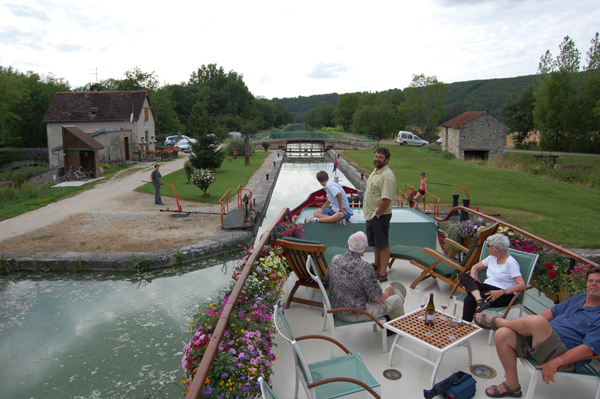
I’m happily sunburned today — after a day barging Burgundy. We filmed the luxury barge experience, and captain Arnaud and first mate/chef Marie made sure the day was smooth and stress-free. I’ll never forget producer Simon and cameraman Peter running along the tow path to get ahead of our barge, then filming Steve’s family and me stretched out on the deck as we floated elegantly by.
It was an idyllic scene: Gliding by fields of sunflowers, playing with my tapenade, being careful not to let the fine red wine mess up my ability to remember my lines, savoring the sight of Steve’s in-laws enjoying their grandchildren so…and doing the arithmetic to try to justify the high cost of a luxury barge (while expensive, the experience includes absolutely everything: sleeping, eating, drinking, excursions, transfers, transportation…and the scenery comes to you).
It’s spendy, but it’s easy to make the case that luxury barging is a reasonable value…especially if you share a barge with three or four couples you really wanted to be decadent with. The glide is punctuated each mile or so by a lock — each a model of 19th-century Industrial Age efficiency, with a tidy lock house providing government-subsidized housing for the bohemian couple who runs the lock. These characters are fixtures in France’s lazy canal culture.
Later we filmed Château de la Rochepot. For years I’ve had a negative feeling for the national chauvinism of this castle. Its owners, the noble Carnot family, refused to offer English descriptions of their fine rooms as a matter of principle (“As part of the patrimony of France, it should be explained only in French”).
Today, I came with my film crew, and after we filmed the wonderful centuries-old kitchen, the staff announced that Madame Carnot had a special treat for us. They opened a fine ancient chest and pulled out a huge 48-star American flag, explaining this was the flag that the Carnot family flew on the day of Liberation in 1945. And, to this day, they love their American guests.

For two decades, I led groups through France and was constantly impressed at how Americans expected the French to speak English. People would go to the post office in some little town and be frustrated and upset because there was no help in English and the people were not friendly. I had to remind them that small-town French postal clerks are every bit as speedy, cheery, and multilingual as those you’d find in the USA. It’s important when we are frustrated by the language barrier that we don’t expect linguistically more than we give.
Hmmm…does this smell fishy to anyone else? How can Language Snobs (as I call those who think their language should be the only one spoken) who refuse to even speak English to their guests suddenly be all rah-rah pro-American. Maybe it had a little something to do with the TV cameras? Do you think?
I think the French are very formal when it comes to their language. So, they dug out the American flag for a surprise…hmmm. Maybe a polite gesture.
We were pleased, to find that each year millions of French people visit the US Army Cemetery, near Colleville-sur Mer, France, along the Normandy beach. Henri said, as he held his hand over his heart, “The Americans came to liberate us, they did not come for money.†All over Europe, rivers large and small have been engineered into canals, with locks and dams to facilitate boat traffic. Right next to the Valentré Bridge, in Cahors, France, I pointed and told Emmy, “There’s the locks.†Her response, “Wonderful, where are the cream-cheese and bagels?†Her favorite breakfast was “lox, cream-cheese and bagels.†One day a barge was sailing down the Seine, and on the clothesline strung from bow to cabin, we could see a couple dozen items hung out to dry. Those unmentionables were the talk of the town. One river we visited, was filled with people, including a young lady who would have been considered exceptionally gorgeous even if she hadn’t lost most of her swim suit.
I had to remind them that small-town French postal clerks are every bit as speedy, cheery, and multilingual as those you’d find in the USA. It’s important when we are frustrated by the language barrier that we don’t expect linguistically more than we give. . . . ah, so eloquently stated. Everyone should really read these two sentences and apply to life not only in France but all countries including the U.S. Yesterday I dealt with my local post office in English & I would have much rather dealt with the nice postal official in St. Goar, Germany than the surly ones here in my area.
When I was in France I had a wonderful experience although my French is limited. I tried to speak the language whenever possible. My travelling companion did not. She continually spoke English- louder and louder until the store clerks would just ignore her. I was constantly reminded that I was in a different country thus they spoke a different language. It would be presumptious of me to demand that they cater to my deficit. I believe strongly that when in Rome do as the Romans. . . and speak as much as possible as the Romans do. . . you may not say it right- a few laughs will ensue- but you are indeed honoring a culture by at least trying. Ironically- while I had a wonderful time in France- my companion did not- she found the language barrier overwhelming. I found most of the people I met would rather speak to me in English than endure my bad French!
We had very nice experiences with French people during the 6 months we spent there over 25 years. Our beautiful French friend Brigitte said, “That’s impossible, French people don’t even like each other.â€
We tried to find the Paris campground where we stayed in 1970, but found nothing. We saw a French family, complete with dog and kids, starting out for a drive somewhere. We asked if they could direct us to the Paris campground. The son was happy to use his High School English, the father signaled, “Follow me,†and drove to the campground on the Marne River, just before it merges with the Seine. There are two rivers in this part of Paris, I knew we were on the right street and knew the campground was on a river bank, we were just at the wrong river. When we got to where we were going, the whole family, including the dog, got out of the car and shook our hands (yes, including the dog, that was cute) and wished us good luck. Forget the myth of the unfriendly Frenchman .
I am glad to read Gwen tried! Though my wife doesn’t try she also doesn’t speak to people until she finds out they speak English, she leaves it up to me to mangle the native language. That can be quite discomforting when a waiter asks you a question while your husband is in the washroom! First time travelers should try to learn a few basic words, you’d be suprised how far it gets you.
John, What a shame your wife does not try to communicate with the locals. You learn so much and are embrassed by them. You miss alot by not trying to communicate with any of them. I use to be “quiet” but if we want to experence how the locals live we must try to talk to them even though it is just a goodmorning/goodbye. Hopefully she at least greets people in the stores/restaurants/markets, etc.
I agree with Miss B. My husband and I have been traveling to France yearly for a number of years, and love the country and its people more each time. What makes our trips particularly meaningful for us is that we really do try to connect with the locals by trying to speak a little French. One phrase that has worked wonders for us is to start out a conversation by saying in French, “I’m sorry that I only speak a little French.” Smiles appear, and a real connection is made. Thanks Rick–and particularly Steve Smith–for your invaluable travel trips over the years.
Three years ago my husband and I took the ETBD “Best of France” tour. We had a WONDERFUL time but I think the secret to making the trip so perfect was in the months of reading about France before we left the States. “Culture Shock France” (Sally Adamson Taylor) was really helpful in learning about French customs and etiquette. I especially loved reading several books on the history of France. Not only did I learn a lot but it made the tour so much better. One of the most memorable sights was in the small townn of Oradour-sur-Glane – also known as La Ville Martyr – where the Nazis sought revenge of the French resistance fighters and killed the entire ppulation of 642 on June 10, 1944. The town is left untouched today, exactly as it was when the atrocity was discovered. What a powerful monument and reminder of the savageness of war. It made a huge impression on my husband and me.
I’ve had contradictory experiences with foreign languages and companions. My mother proudly speaks only English, and even mangles what little she speaks. The biggest laugh I shared with a foreigner this past March in Paris was when my mother bought some little souveneir entirely in English and left the shop by saying “Gratzi.” I got a gracious smile for my “Merci beaucoup”. But last year on a ETBD tour of Paris with a girlfriend, the French waiters were falling over themselves to get her to speak a little French. They loved her English and all but ignored my ordering off the menu in French. Maybe they respond to who they perceive as cuter at the time, but these experiences remind me what a contradictory nature all we humans have. I got annoyed with my girlfriend for not attempting her high-school French, but I don’t get as annoyed with my mother for not even bothering to learn courtesy phrases. The good news is that it didn’t diminish anyone’s enjoyment of France a whit.
I don’t understand the problem with natives in European countries, especially France. In our 1,000 days in Europe, in over 30 countries, including 6 months in France, during 9 trips over 25 years, we had less problems with people than we can find at the local 7-11.
My wife spoke a few words of German, but we had no problems communicating anywhere, and no one, NOT ONCE, was anyone unhappy we did not speak their language.
We traveled by RV rather than hotels and restaurants, and I say the clerk in a bakery or grocery is thrilled to meet an American, the bellhop and waiter is thrilled to get a tip. In shopping in far more than a thousand groceries and bakeries, I can remember only one disgruntled clerk, in a bakery in Zermatt, Switzerland.
But remember, it’s amazing how many stupid, ignorant, inefficient, obnoxious people you meet when you are in a bad mood. Smile and at least act happy, it’s contagious, we were thrilled to be there, wherever it was.
I have never been disappointed with the result of my sincere, earnest attempts at any native language abroad. People are people wherever you go and it does seem that personality, gesturing and overall mannerisms override any other presumptions or prejudices we Americans think other people have of us. I believe that if we focus less on being “Americans” abroad and just focus on being “human beings” politely travelling in another country, we would all find things much simpler, and we would find ourselves enjoying everything more from the “local” perspective than not! Happy travels to all!
I think I may have left my fellow travelers with the wrong impresion of my wife. Those of you with a loved one may understand her better. She is comfortable and outgoing around friends and family, not so in other situations. I on the other hand will talk to anyone anytime anywhere. This does not diminish her enjoyment of our travels. We rent a car, she navigates and I drive wherever she wants to go. Like a guest in our country who is hesitant to speak English, she is no different overseas. I am glad to go with her and do the communicating. As has been expressed many times on this site, we are all different. May you all have happy and safe travels for years to come with your loved ones.
Alot of Americans like to remind the French how we saved their country during WW2, and that they should be appreciatively pro-American. Lets not forget WW2, but without French help during the colonial war, really our country wouldn’t exist.
Is the name of the firstmate/chef on the Burgundy canal boat trip you took Marie Altman? I’m curious because we took the RS Paris tour June 17 to 23, and our guide, Marie Altman, said she lives in Burgundy and she used to be a chef on a barge. Thanks, if you can answer.
David C.- one small difference, very few of the 18th century French are still around to thank whereas there are still quite a few WWII heroes amongst us!
I am an American tourist who has been visiting the Chateau de la Rochepot since the early 1990’s, most recently in April 2007. The staff at the chateau has always made every effort to offer me and my travelling companions either a tour guide who speaks English, or a written copy of the tour in English to refer to as we followed a French speaking guide. I am not convinced that your quote concerning this Chateau’s “nationalistic chauvanism” is accurate or true. Molly Higbie
I just visited the chateau this summer, and it was absolutely charming: intimate, beautiful, and friendly. The lavender was in bloom, the sun was shining, and the simplicity and grace of the spot was hard to beat. I’m not sure how long it’s been since the “noble Carnot family” refused to translate stuff—-our guide conducted the tour in English, and we had handouts in English. A couple of other American tourists were there at the same time, and they said that it was their third trip (and they spoke no French, so I guess it’s been a while since the bilingual tours started). I think that getting out the American flag was just a lovely gesture!!!
Boy, aren’t my fellow Americans mean-spirited. It seems the French can’t win either way. First the Carnot’s get bashed for not accomodating American speakers at their chateau in the distant past, then they get bashed in the present for showing their appreciation for American’s during WWII. These comments are certainly worthy of the “ugly American.” I for one have loved visiting the chateau. It’s charming, and has a lot of interesting history. Information was available in English.
Whenever visiting France I am always impressed by the French. So many, especially in larger cities and especially in Paris, seem to feel the French empire still exists. Their superiority complex to others, (Americans and Europeans)and rural French men and women is striking. Once the French lost their empire their source of national superiority seemed to flow from their outstanding winemaking and culinary skills. But now the rest of the world, from Chile to Australia can make the wine and the entire world has learned French culinary skills. So what separates France from the rest of Europe and the world? Their language. I think that is why they have so much pride in it and often refuse to speak anything else. Even the youngsters near the border also speak German. As a tourist this false national ego can be frustrating. But it is their culture. In contrast, the British lost an empire but have preserved many traditions. I see no superiority complex in the British Isles–so very different.