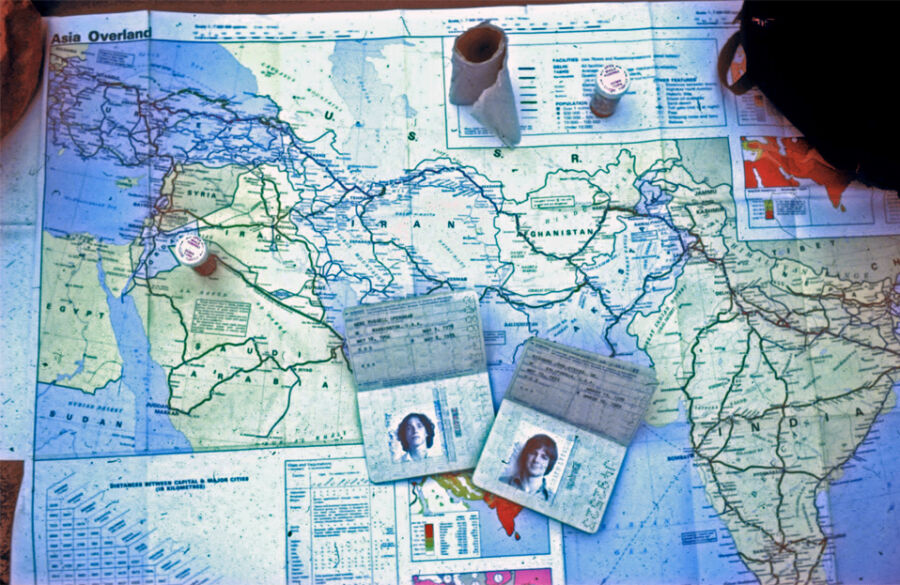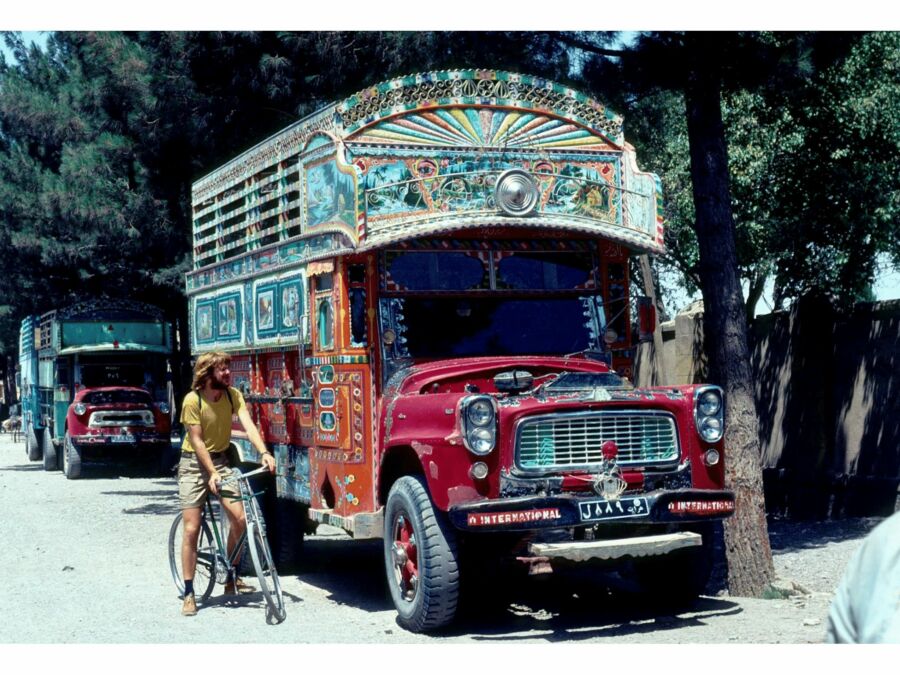
With the fall of Afghanistan, I’ve been reflecting on my travel experiences there as a 23-year-old backpacker on the “Hippie Trail” from Istanbul to Kathmandu. Yesterday and today, it’s a poor yet formidable land that foreign powers misunderstand and insist on underestimating.
In this journal entry from 1978, stow away with me for another dreamy day in Herat, Afghanistan.
Monday, July 31, 1978: Herat
I didn’t stir for nine hours. After breakfast we picked up our rental bikes and began a little adventure. It felt good to have wheels. We could stop when we wanted and, if the people got too intense, we could make a clean escape. The breeze cooled us off and things happened at a much faster rate than when we traveled on foot.
Speeding through the part of town we already knew well, we headed for the old ruined minarets that we saw when we approached Herat two days ago. Checking out this historic site, an old man let us in the mosque for 10 afghanis and we saw the tomb of an old Afghan king.
Now we had seen the big historic site and we stopped to visit with some studious types in the shade. We had a nice chat and learned something about the culture and language. We also learned from our friend that we were spending too much money for just about everything.
Coasting happily down the road, I took a string of fantastic photos. This is the photographer’s moment I’ve waited for so long. I got guys tossing melons, colorful girls sitting on curbs, lazy teenagers slouching on warm wagons, and lots of little tidbits of Afghan life. The people are genuinely friendly and proud, shaking my hand firmly and as equals. I did get one small fruit thrown at me but, all in all, this is one of the friendliest countries I’ve experienced. Any women who ventured onto the streets and who are post-pubescent are totally covered up seeing only through a tiny gridwork in the cloth that covers their faces.
We were determined to pedal in one direction until we reached the edge of town. After wetting our whistles with a Sprite, we made our way down the busy, dusty street until the city became more of a mud village like ones I’d seen in Egypt and Morocco. Taking side roads, we found ourselves enveloped in a new and different world. Quiet brown mud streets became high walls, long and narrow. The walls were broken occasionally by small shops and rustic wooden doors. Young and old sat around as if they were waiting for a stranger on a bike to happen by. I’m sure we were a very rare sight for them. I wonder if they enjoyed our presence or if we were violating their peace.
I experimented with different greetings from a salute to a child’s wave, to the solemn “kiss the hand and put it to the heart” that religious-looking types offer us. That one gets great results. I had a pocket full of candies for gifts and I feel better giving that than giving money.
You know, everyone in this happy society seems content and I’ve seen no hunger and very few hard case beggars. They have modest needs for their meager productivity and things seem to work out just fine and there’s more than enough tea, hashish, and melons for everyone.
We poked around until we had had our fill and realized that this was hot and hard work. Then, on the way back, we stopped off at a pile of hay being romantically thrashed by a couple of oxen pulling a wooden hay-chewing device. What a dreamy tourist and photographic opportunity! I pounced on the chance to drive the cart and had an unforgettable blast. I got to sit on the chewer, driving the oxen around and around and I think the peasants got as big of a kick out of me as I got out of them and their hay. That’s optimality.
We got our bikes back after two hours and paid a buck each. We picked up a melon and retreated to our hotel. Feeling hot but happy, we stopped off at the pool, stripped to our underwear and took the chilly plunge. Instant refreshment! Wow! What a fantastic day we’re having! We frolicked around, took a few dives and some good photos and I thought “My goodness — this is what a vacation is supposed to be”. Dripping up to the room, we sacked out for a while and went down for lunch. Good sleep, good food, and my vitamin pills were my formula for the rest of this trip to be enjoyable and successful. I don’t think I can go wrong with that recipe, but we’ll have to wait and see, won’t we?
After a rest and a few cold showers, the sun was a bit lower in the sky and we stepped back out. While I was deep into a bargaining match with a nice guy for the mink I had fallen in love with, Martin from the Istanbul-Tehran bus dropped by, and we chatted, and he highly recommended the endless bazaar. We said we were heading there.
I had my zoom lens on and I got such a thrill out of zooming in on these lovely people. I can hardly wait to see my pictures. We morphed or melted from scene to scene soaking in all the bazaar images. What a sensual experience. We’d pass from water pipe making souks or neighborhoods, to tin pounders, weavers, beadmakers, bead stringers, people working billows, people sharpening knives on rickey foot-powered wheels, chain pounders, and nail benders. Everything was hand done. Old and young worked furiously at the same menial task all day long — all life long. I’ll never again complain about a long day of my work — teaching piano lessons.
Each shop was about five yards across and every five yards was a new scene — a new glimpse of Afghan life. Some things we couldn’t even understand. At one point, little children wouldn’t give up asking for “baksheesh” (gifts of money) and we had to duck into a huge mosque where a policeman chased them away and we had to take off our shoes and pay him something to check this place out. It was impressive.
Now we were exhausted. Back at the hotel we went for a swim and a strange dog knocked my glasses off my bag and the lens fell out. I was worried but it popped back in — apparently good as new. I dread the thought of breaking my glasses and having to wear my high school hornrims that I brought for a spare.
Up in the room we tried out a little more hash and went out to mingle. Mingling was a bit intensified. Little things, like a man weighing tomatoes, tickled me special and I was more receptive to would-be pests and ready to poke around a little more freely. I didn’t know it was because of the hashish or because I was in a very good mood.
We hopped in a funny little three wheeled taxi that looked like a souped-up ice cream truck for a ride to another part of town and I really got into some exciting photography. Existing light and lantern light subjects. I got men to pose precisely how I like them. I would even shove their chin up a tad or move the lantern closer. They could be exceptional, or they might not, but both my subject and I had a memorable time trying.
We goofed around some more and then hopped on a fancy two-wheeled horse-drawn buggy taxi. Charging all over town as if in a chariot, we sang songs really entertaining, or at least amusing, our driver. We surprised him with a confident 10 afghanis and he barely had time to gripe as we hopped off. These tourists weren’t taken for a ride except on a horse. I decided that if you try to agree to a price before boarding, they know you’re new at the game and they’ll rip you off. If you just get on and say “Home James” and pay them what you think is reasonable, you’ll do fine.
On our way home, I bought a lovely little five afghanis (1 cents) goody. Then we stopped by to check out my friend with the mink. I knew I’d find myself bargaining furiously again and that’s what happened. This was my third time in his shop and I knew if I went home without that mink, I’d kick myself. I love it just like I loved old “Ringworm” (a cat I befriended and took home back in 2nd grade — that gave me Ringworm). I finally went to 460 afghanis ($12) and came away with a great skin.
Now we were hungry and our hotel awaited. We are living so fantastically. Sitting down where the waiters know us, we ordered a hearty meaty meal with tea and a melon. We’ve been drinking the water and my stools are solid, so we had more of that. I feel so good. I’m in control and anything I desire, I can just get it. Wow.
Up in the room, I took a long shower, cleaned up my pack, enjoyed my little souvenirs, and hit the sack. I laid there with nothing on wondering how cockroaches got their name. (Maybe I am high, after all.)
People enjoy the same things all over the world. The old cleaning man ignored my plea for more toilet paper and said dreamily, “Look, isn’t it beautiful?” We both stood motionless on the roof of the hotel watching torch toting chariots gallop by as the sun sank behind the distant mountain.
We were sitting and talking with some studious Afghans in a park when one asked, “Aren’t you travelling with your women?” I said my girlfriend is at home and he replied, “Oh that’s very difficult — I could never do that.” I do feel like I’ve been “on the road” for a long time now.
(This is journal entry #3 of a five-part series. Stay tuned for another excerpt tomorrow, as 23-year-old me rides 500 miles across Afghanistan and explores the capital city of Kabul.)